The tension – and cross-fertilization – of old and new is not the only paradox of the Jewish state.
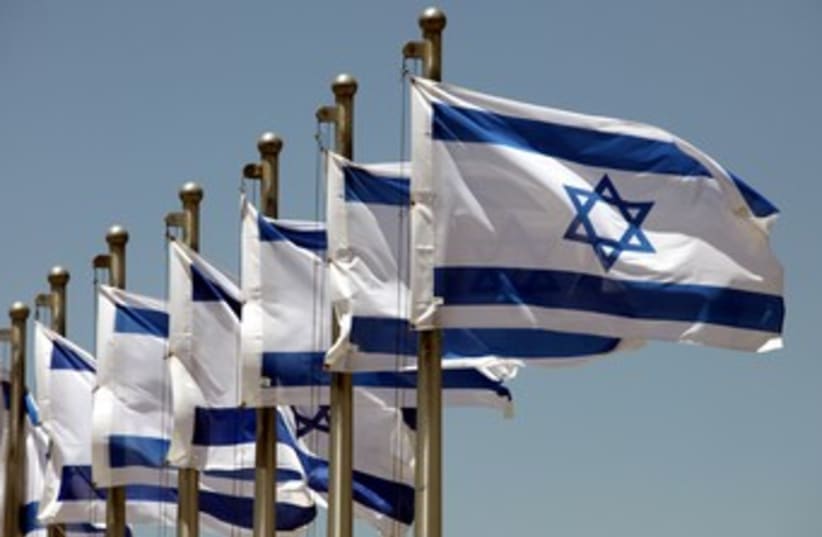
By JPOST EDITORIALIsraeli flags 370(photo credit: Marc Israel Sellem/The Jerusalem Post)
Celebrating the 65th anniversary of Israel, one cannot help but be struck by the incongruity of conflating an ancient people with a birthday befitting a baby boomer.Indeed, the old and new coexist side by side in the Jewish state, perhaps like no other country in the world. Unlike in modern Greece, for example, citizens of Israel converse in their ancient tongue, a language that would still be intelligible to the Hebrew prophets who lived here in the biblical era.Archeological sites that are an integral part of our landscape are discovered regularly, giving constant, tangible evidence of the Jewish people’s ancient ties to this particular strip of land. At the same time, Israel is an eminently modern country, overrepresented in the number of patents it produces per capita, in the number of PhDs, published scientific papers, companies listed on NASDAQ, and start-ups per capita. It was nothing short of prophetic that Theodor Herzl called his 1902 utopian novel depicting the blueprint for the realization of Jewish national emancipation Altneuland (The Old New Land).The tension – and cross-fertilization – of old and new is not the only paradox of the Jewish state. The Jews who settled in their historic homeland have for the first time in nearly two millennia of exile taken control of their destiny and, thanks to their military and political strength, “returned to history.”(Jewish philosopher Franz Rosenzweig (1886-1929) famously warned that Jews’ “eternal purpose” would be thwarted by such a return to history, though he might have had second thoughts if he had lived to witness the Holocaust.) Though they were wildly successful at fulfilling their state-building goals, Zionists did not put an end to persistent anti-Semitism. It was not, it turns out, Jews’ “abnormal” status as weak and stateless that was the cause of the enmity toward them, any more than it is Jews’ newfound power or the “occupation” that is the root cause of “new” anti-Semitism.There are those who would argue that if anything, Zionism has made Jews’ predicament even more precarious.Israelis, more than Jews in the Diaspora, are directly in danger of facing a nuclear Armageddon if Iran get its hands on the bomb. And the sudden changes sweeping the region, now optimistically called “the Arab Spring,” could easily lead to an increasing dangerous geopolitical environment for Israel.Yet the Jewish state is also a bulwark against the biggest peacetime threat to Diaspora Jewry – assimilation.In November, the Jewish population in Israel for the first time passed the symbolic six million mark. In contrast, the Jewish population in the Diaspora has been steadily shrinking. The day is not far off – experts say within two decades – that a majority of the world’s Jews will live in Israel.Most Israelis are also aware of the demographic threat to democracy posed by remaining in all of the West Bank and, therefore, support the creation of a Palestinian state, provided this historically unprecedented entity does not threaten us military, or require our withdrawal to the vulnerable pre-1967 lines, or flood us with Palestinian “refugees.” And while Israel is regularly singled out for its purported bigotry because it dares to define itself as Jewish, few societies are so diverse. Not only has it absorbed Jews from the four corners of the earth, the Jewish state strives to protect the basic rights of the large non-Jewish minority. Druse, Beduin and other non-Jewish Israelis fight side-by-side with their Jewish brothers in the IDF to protect Israel and, as evidenced once again this Remembrance Day, they sometimes pay the ultimate price.Israel at 65 remains a country of paradoxes and contradictions that strives to fuse new and old, particularism and universality, vitality and vulnerability. Israel at 65 has not resolved the Jewish predicament and has even created a set of new challenges. But its accomplishments are mind-boggling considering they were achieved while fighting conventional and nonconventional wars, absorbing a huge immigrant population and providing basic democratic rights to every citizen, regardless of race, creed or religion – including those openly opposed to Israel existence as a Jewish state.Not bad for a country the age of the average baby boomer.
if(catID != 151){
var cont = `Take Israel home with the new Jerusalem Post Store