A federalism that empowers local authority would seem to be best suited to Libya, though there must be a proper balance between centralized and local power.
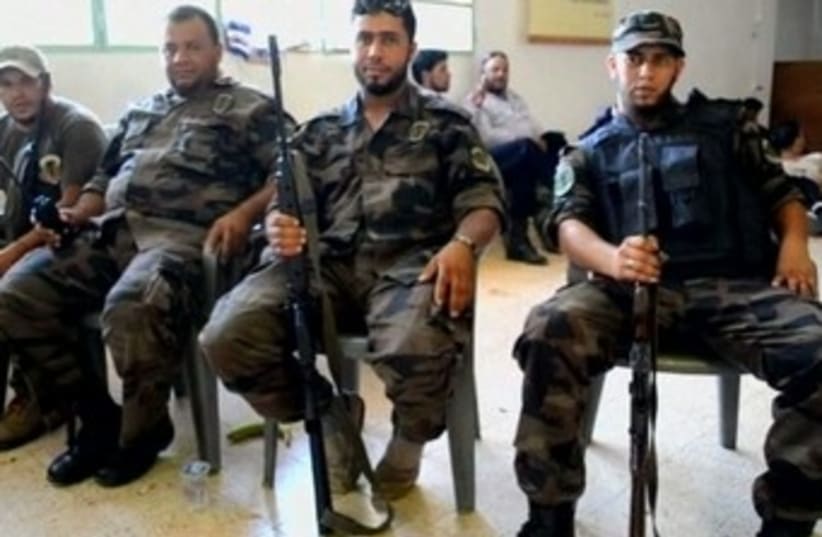
By JPOST EDITORIALLibyan security officials 370 (photo credit: REUTERS)
The first bit of good news in Libya’s first free election – assuming the preliminary results that have trickled out of ballot boxes so far are accurate – is that a secular-leaning alliance is the winner.Unlike Egyptians, Tunisians and Moroccans in the aftermath of the Arab Spring uprisings, Libyans have chosen to buck the Islamist trend sweeping across the region. The Muslim Brotherhood and other Islamists, who were declaring just days before the elections that they would garner as much as 60 percent of the vote, have been humbled. They appear to have taken no more than a quarter of the vote – though Islamists seem to have edged out other parties in the Misrata region, one of the fiercest strongholds of opposition to the wicked, violent and capricious dictatorship of Col. Muammar Gaddafi.The second bit of good news is that a society that was dominated by autocratic regimes even before Gaddafi wrested control from King Idris in 1969 has taken the first substantial step in its cautious transition to a more democratic regime. The elections, which presented over 3,000 candidates competing for 200 seats, were not without turmoil, but violence levels were lower than expected. Armed groups in the eastern region of Benghazi – where Libya’s easily accessible oil reserves, supplying 2% of world demand, are located – stormed a few polling stations, and tribal groups in the long-neglected and isolated south tried to sabotage the voting as well. But voters were not deterred – turnout was over 60%.It was abundantly clear that Libyans did not want a return to authoritarianism. A full 97% of Libyans surveyed by Oxford Research International in January thought the revolution was absolutely or somewhat right.BUT THE obstacles on the road to a true democracy are formidable.Libya carries the legacy of century-old fractures – social, economic, geographic and cultural – unhealed since Italy, in November 1911, first brought together by royal decree the disparate regions of Tripolitania, Cyrenaica and Fezzan under the artificial construction known since 1934 as “Libya” – the Greek term for Northwest Africa.And Gaddafi ruthlessly exploited this legacy of fractured national identity, intentionally maintaining a state of perpetual change with the constant reshuffling of provincial borders and systems of administration. Street names, place names, universities, even the names of months were constantly in flux, creating a feeling of disorientation. In this atmosphere, it was easier to handily repress, jail, exile or eliminate all potential opponents.In the post-Gaddafi era, Libya’s unification under a central government is being threatened by a myriad of ad hoc militias, police forces, neighborhood guards and miscellaneous riffraff – not to mention 120 to 130 tribes all armed to the teeth with questionable loyalties. The oil-rich Benghazi region to the east is at odds with the traditional seat of power in Tripoli to the west, and Sirte, Gaddafi’s hometown, is at odds with Misrata, one of the bastions of anti- Gaddafi forces. The southern region is isolated from the rest of the country.LIBYA MUST proceed cautiously, putting in place the sorts of institutions that are a prerequisite for even the most rudimentary forms of democracy (a representative parliament, a judiciary, strong law enforcement). It must address legitimate concerns about the equitable sharing of natural resources and political power among all the fragmented areas that make up the country. A federalism that empowers local authority would seem to be best suited to Libya, though there must be a proper balance between centralized and local power.Another order of business – which could be achieved with the aid of NATO forces – is to disarm the myriad gun-toting militias or incorporate them into a national military force.Libya has a long road to traverse before it sheds the debilitating baggage of its troubled history. But the July 7 elections were a step in the right direction.
if(catID != 151){
var cont = `Take Israel home with the new Jerusalem Post Store