On election, PM said that he hadn't authorized new settlements in the W.Bank during his previous term, didn’t intend to authorize any this term.
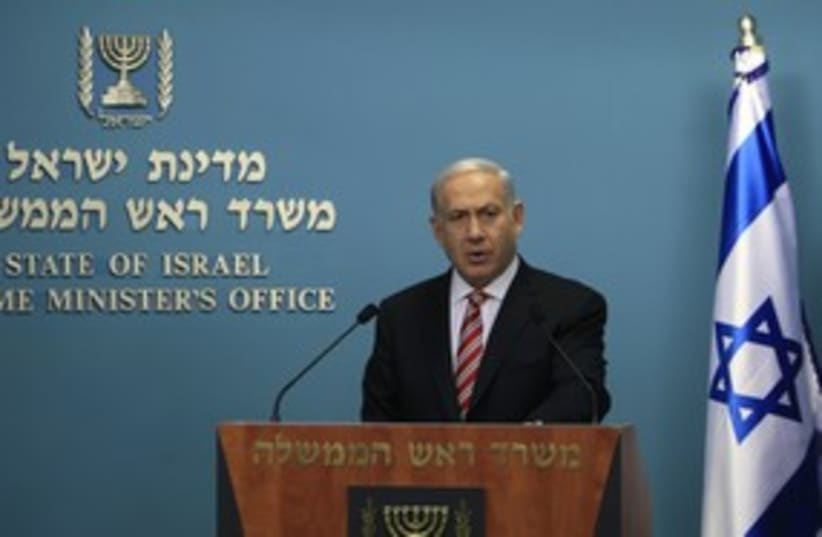
By PAUL HIRSCHSONPrime Minister Binyamin Netanyahu at PMO 311 (R)(photo credit: Ronen Zvulun / Reuters)
Assuming that an agreement between Israel and the Palestinians will include the establishment of a Palestinian Arab state, it is obvious that drawing the border between Israel and this nascent Palestinian state is cardinal to an agreement.A logical extension of this is that there will be a significant impact on Israeli settlements in the territory under discussion – the West Bank.Gaza, vacated by Israel years ago, is no longer under discussion. The entire Strip would be part of a Palestinian state.There has never been a sovereign entity in the West Bank. Israel took possession of it from Jordan, which had occupied it in 1948 following the end of British stewardship of the area. We are talking about the allocation of sovereignty over terra nullius – land with no sovereign attachment.While the Palestinians have legitimate claims, so does Israel. Israel may well choose to not put forward its claims, to suspend its rights or to cede some of them, all of which are the right of any claimant.With Israel’s adoption of the establishment of a Palestinian state as policy this seems the likely scenario.This does not negate Israel’s legitimate claims, and parts of the West Bank will unquestionably be incorporated into Israel.Based on Palestinian suggestions both publicly declared and leaked by Al Jazeera’s “Palestine Papers,” the Palestinians accept this reality (although one has to doubt the validity of this supposition if Hamas is to be asked).The international community, under the auspices of the Quartet (the US, UN, Russia and EU), has called for proposals from Israel and the Palestinians regarding borders and security.It is no coincidence that these two issues are twinned, for beyond Israel’s legitimate territorial claims, perhaps ahead of them, is the question of Israel’s security. The UN and all credible parties have written Israel’s legitimate concerns into policy.UN Security Council Resolution 242 goes so far as to call for “secure borders,” and deliberately removed the word “the” from before “territories” in calling for Israel to withdraw from parts of the West Bank.One can only be bewildered, given the facts, by the overwhelming focus on Israel’s West Bank settlements, which is clearly relevant to the allocation of sovereignty over the West Bank, while coverage of Israel’s security needs is so vaguely and so tepidly discussed.Why so unbalanced an approach, especially in the face of Israel’s stated and implemented policies regarding its settlements? • On election as prime minister in early 2009, Binyamin Netanyahu said that he had not authorized new settlements in the West Bank during his previous term and didn’t intend to authorize any this term.• In late 2009, in an attempt to encourage the Palestinians to negotiate, the prime minister announced a 10-month halt on construction in settlements throughout the West Bank.• With the failure to restart negotiations through this incentive, Israel committed that while it was renewing construction, never before an obstacle to negotiations, this would have no impact on the peace process.• Construction is restricted to within Israeli settlements which in any agreement will be incorporated into Israel.The international community, which correctly seeks to see the two sides reconcile, does no one a favor by allowing, some would argue encouraging, a misrepresentation of the facts of construction activity in Israeli settlements in the West Bank.These facts: an announcement of no new settlements; limitation of construction to within, rather than expanding, existing ones; a temporary halt on construction; limitation of construction to those settlements we know will be incorporated into Israel, leaving the rest for negotiations; and the cancellation of tax incentives encouraging people to move to the West Bank.The only explanation for the misrepresentation of Israel’s West Bank settlement policy, other than perhaps by those who desire to see the conflict perpetuated, is what a member of the foreign press corps in Israel told me they lovingly call “blame Bibi rather than think.” The writer is an Israeli diplomat currently posted back home in Jerusalem.
if(catID != 151){
var cont = `Take Israel home with the new Jerusalem Post Store