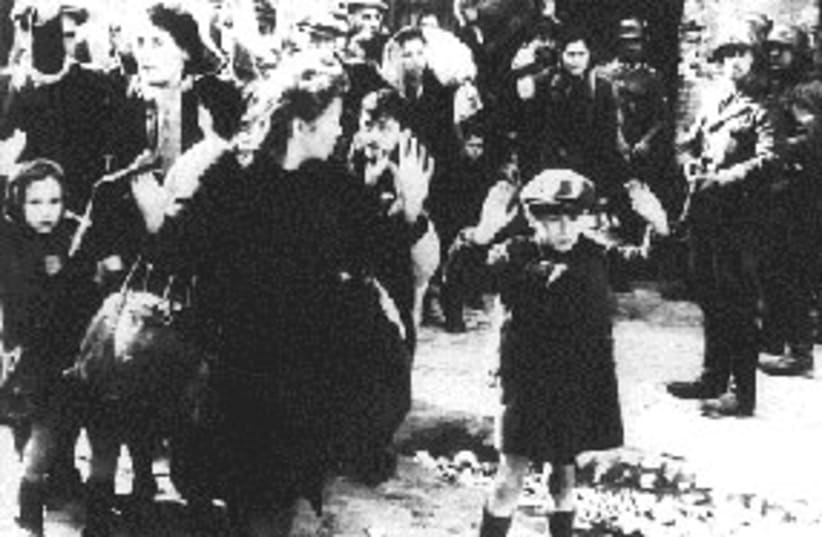
While the Holocaust was “uniquely unique” as Holocaust scholar Yehuda Bauer put it, there are important universal lessons to be acted upon
By IRWIN COTLERholocaust 311(photo credit: Courtesy)
Whenever I write on the Holocaust – the Shoah – I do so with a certain degree of humility, and not without a deep sense of pain.For I am reminded of what my parents taught me while still a young boy — the profundity and pain of which I realized only years later — that there are things in Jewish history that are too terrible to be believed, but not too terrible to have happened; that Oswiencim, Majdanek, Dachau, Treblinka — these are beyond vocabulary. Words may ease the pain, but they may also dwarf the tragedy. For the Holocaust was uniquely evil in its genocidal singularity, where biology was inescapably destiny, a war against the Jews in which, as Nobel Peace Laureate Elie Wiesel put it, “not all victims were Jews, but all Jews were victims.”But while the Holocaust was “uniquely unique” as Holocaust scholar Yehuda Bauer put it, there are important universal lessons to be acted upon. Indeed, I write at an important moment of remembrance and reminder, of witness and warning:· on the 66th anniversary of the liberation of the surviving remnants of “Planet Auschwitz” — the most horrific laboratory of mass murder in history;· on the 66th anniversary of the disappearance of Raoul Wallenberg – Canada’s first honorary citizen – whom the UN called the greatest humanitarian of the 20th Century, and who showed that one person could confront evil, resist and prevail, and thereby transform history;· in the aftermath of the 65th anniversary of the UN, which as former UN Secretary-General Kofi Annan said, “emerged from the ashes of the Holocaust”; and as he reminded us, “a UN that fails to be at the forefront of the fight against anti-Semitism and other forms of racism, denies its history and undermines its future”;· on the occasion of the 65th anniversary of the Nuremberg Principles, which became the forerunner of international humanitarian and criminal law, reminding us also of the double entendre of Nuremberg — the Nuremberg of jackboots as well as the Nuremberg of judgments;· on the fifth anniversary of the International Day of Commemoration in Memory of the Victims of the Holocaust. And so, on this International Day of Holocaust Remembrance — on the eve also of the 60th anniversary of the coming into effect of the Genocide Convention — the “Never Again” Convention — we have to ask ourselves, what have we learned and what must we do?Lesson 1: The Importance of Holocaust Remembrance – The Responsibility of MemoryThe first lesson is the importance of Zachor, of the duty of remembrance itself. For as we remember the six million Jewish victims of the Shoah — defamed, demonized and dehumanized, as prologue or justification for genocide — we have to understand that the mass murder of six million Jews and millions of non-Jews is not a matter of abstract statistics.For unto each person there is a name — unto each person, there is an identity. Each person is a universe. As our sages tell us: “whoever saves a single life, it is as if he or she has saved an entire universe.” Just as whoever has killed a single person, it is as if they have killed an entire universe. And so the abiding imperative — that we are each, wherever we are, the guarantors of each other’s destiny.Lesson 2: The Danger of State-Sanctioned Incitement to Hatred and Genocide — The Responsibility to PreventThe enduring lesson of the Holocaust is that the genocide of European Jewry succeeded not only because of the industry of death and the technology of terror, but because of the state-sanctioned ideology of hate. This teaching of contempt, this demonizing of the other, this is where it all began. As the Canadian courts affirmed in upholding the constitutionality of anti-hate legislation, “the Holocaust did not begin in the gas chambers — it began with words”. These, as the Courts put it, are the chilling facts of history. These are the catastrophic effects of racism.As the UN marks the commemoration of the Holocaust, we are witnessing yet again, a state-sanctioned incitement to hate and genocide, whose epicentre is Ahmadinejad’s Iran. Let there be no mistake about it. Iran has already committed the crime of incitement to genocide prohibited under the Genocide Convention. Yet not one state party to the Genocide Convention has undertaken its mandated legal obligation to hold Ahmadinejad’s Iran to account.Lesson 3: The Danger of Silence, The Consequences of Indifference — The Responsibility to ProtectThe genocide of European Jewry succeeded not only because of the state-sanctioned culture of hate and industry of death, but because of crimes of indifference, because of conspiracies of silence.We have already witnessed an appalling indifference and inaction in our own day which took us down the road to the unspeakable — the genocide in Rwanda — unspeakable because this genocide was preventable. No one can say that we did not know. We knew, but we did not act, just as we knew and did not act to stop the genocide by attrition in Darfur.Indifference and inaction always mean coming down on the side of the victimizer, never on the side of the victim. Indifference in the face of evil is acquiescence with evil itself.Lesson 4: Combating Mass Atrocity and the Culture of Impunity — The Responsibility to Bring War Criminals to JusticeIf the 20th Century — symbolized by the Holocaust — was the age of atrocity, it was also the age of impunity. Few of the perpetrators were brought to justice; and so, just as there must be no sanctuary for hate, no refuge for bigotry, there must be no base or sanctuary for these enemies of humankind. Yet those indicted for war crimes and crimes against humanity – such as President Al-Bashir of Sudan – continue to be welcomed in international fora.Lesson 5: The Trahison des Clercs — The Responsibility to Talk Truth to PowerThe Holocaust was made possible, not only because of the “bureaucratization of genocide”, as Robert Lifton put it, but because of the trahison des clercs — the complicity of the elites — physicians, church leaders, judges, lawyers, engineers, architects, educators, and the like. Indeed, one only has to read Gerhard Muller's book on “Hitler’s Justice” to appreciate the complicity and criminality of judges and lawyers; or to read Robert-Jan van Pelt's book on the architecture of Auschwitz, to be appalled by the minute involvement of engineers and architects in the design of death camps, and so on. Holocaust crimes, then, were also the crimes of the Nuremberg elites. As Elie Wiesel put it, “Cold-blooded murder and culture did not exclude each other. If the Holocaust proved anything, it is that a person can both love poems and kill children”.Lesson 6: Holocaust Remembrance — The Responsibility to EducateIn acting upon the International Holocaust Remembrance Day, states should commit themselves to implementing the Declaration of the Stockholm International Forum on the Holocaust, which concluded: “We share a commitment to encourage the study of the Holocaust in all its dimensions… a commitment to commemorate the victims of the Holocaust and to honor those who stood against it… a commitment to throw light on the still obscured shadows of the Holocaust… a commitment to plant the seeds of a better future amidst the soil of a bitter past… a commitment… to remember the victims who perished, respect the survivors still with us, and reaffirm humanity’s common aspiration for mutual understanding and justice.”Lesson 7: The Vulnerability of the Powerless — The Protection of the Vulnerable as the Test of a Just SocietyThe genocide of European Jewry occurred not only because of the vulnerability of the powerless, but also because of the powerlessness of the vulnerable. It is not surprising that the triage of Nazi racial hygiene — the Sterilization Laws, the Nuremberg Race Laws, the Euthanasia Program — targeted those “whose lives were not worth living”; and it is not unrevealing, as Professor Henry Friedlander points out in his work on “The Origins of Genocide”, that the first group targeted for killing were the Jewish disabled — the whole anchored in the science of death, the medicalization of ethnic cleansing, the sanitizing even of the vocabulary of destruction.And so it is our responsibility as citoyens du monde to give voice to the voiceless, as we seek to empower the powerless — be they the disabled, the poor, the refugee, the elderly, the women victims of violence, the vulnerable child — the most vulnerable of the vulnerable.We remember – and we trust – that never again will we be silent or indifferent in the face of evil. May this International Day of Holocaust Remembrance be not only an act of remembrance, but a remembrance to act.The writer is a member of Parliament and the former minister of justice and attorney general of Canada. He is Emeritus Professor of Law at McGill University, and has written extensively on the Holocaust, genocide and international humanitarian law.
Related TagsElie Wiesel
if(catID != 151){
var cont = `Take Israel home with the new Jerusalem Post Store