That Iran would press the button may be unimaginable, but it is not unthinkable.
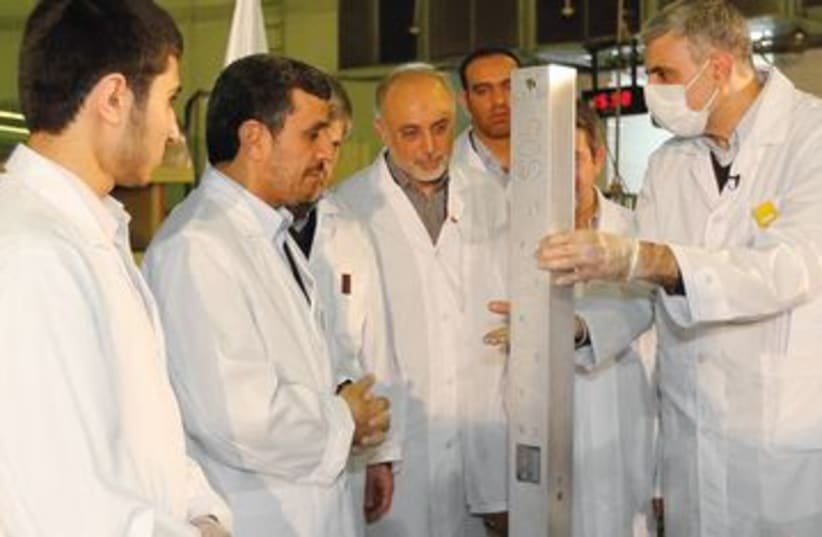
By DANIEL TAUBERAhmadinejad at nuclear ceremony in Tehran 390 (R)(photo credit: REUTERS)
They have accused Prime Minister Binyamin Netanyahu of being “Mr. Terror,” but when it comes to Iran’s nuclear program, for the past few months, various leftist politicians and ex-security officials have worked hard to make Israelis afraid: afraid that we don’t have the capability to act on our own; afraid that we will lose international support; and afraid of how the Iranians will respond.The self-proclaimed pragmatists have taken up their old position: we, the Jews, must do nothing. But given the magnitude of the danger, being too afraid to act is a luxury we cannot afford.That Iran would press the button may be unimaginable, but it is not unthinkable.Fanatical, authoritarian, publicly genocidal and anti-Semitic: this is not the description of a “rational actor” who would wield nuclear weapons responsibly.More than the failure of diplomacy, the Non-Aligned Movement summit in Tehran demonstrated that we are indeed dealing with madmen who seek, as the Ayatolla declared last week, a “new international order,” a declaration which mirrors the Axis powers’ pact “to establish and maintain a new order of things.”Even for “rational actors,” the purpose of nuclear weapons is being prepared to use them when some red line is crossed. Our red line is an existential threat, but that may not be the case for everyone. The US twice dropped the bomb on Japan, for example, long after Japan posed an existential threat to the US. It merely refused to meet the US demand for unconditional surrender.Definitions of existential threat may also differ. For the Iranian regime, a danger to the regime’s existence might be sufficient.And even rational actors take actions which can unpredictably escalate. During the Cold War, actions were taken which could have triggered nuclear war, such as when the USSR deployed nuclear missiles in Cuba or when the US flew nucleararmed B-52s just outside the USSR.The fear of escalation alone would require us to measure each of our own actions against the possibility of triggering a nuclear standoff.Our self-defense would be further checked by a greater need for international support, which would also create massive pressure on us to make dangerous concessions.At the same time, a nuclear weapons capability would put Iran on the offensive, leading the Islamic regime to be more brazen in threatening Western interests and Israel itself, in supporting terrorist groups and undermining budding democracies in the region. Iran’s newfound power will draw other states into its orbit and further encourage them to oppose us.CERTAINLY THIS is not a scenario which the US or the other Western powers desire, and presumably the US can do much greater damage to Iran’s nuclear program than Israel can. Nevertheless, that doesn’t mean it will.American failure to stop proliferation in the past, its reluctance to act militarily against Iran so far, its failure to convince Iran that it will act, the time wasted attempting to renew the peace process, its reluctance to support Iranians who risked their lives to protest rigged presidential elections, the naïve belief that engagement would lead to a diplomatic solution – all of this, as well as America’s general bumbling of Middle East policy since Barack Obama became president indicate that the US will not strike.Even if the US committed to a strike, as time passes, that commitment would fade. The presumed consequences of Israeli action were the prime motivation for US action thus far. If the window for Israeli attack closes, this motivation will disappear.Reelection may also dissolve Obama’s political motivation to appear tough on national security and support Israel. His opponent, Mitt Romney, has not committed to striking Iran. Even if he did, his stump speeches and his presidential policy may be quite different. He would also not take office until next January, after our window to act is said to close.More alarming is the difference between the US and Israel on what must be prevented.As The Jerusalem Post’s Herb Keinon noted, US Defense Secretary Leon Panetta, while in Israel, said the US “will not allow Iran to develop a nuclear weapon,” but did not go as far as the prime minister, who said Iran must be prevented from developing nuclear weapons “capability.”This difference can be found in many US and Israeli statements.With weapons capability, Iran need only await the opportune moment to develop a weapon, for example when the US is distracted by an urgent domestic or global problem. Some predict that Iran is developing a “breakout” capability by which it could develop a weapon before anyone can react.This is not a fate to which we can resign ourselves.If unilateral action only delays the Iranian program a number of years, that is preferable to the emergence of a nuclear-armed or capable Iran in the coming months. A few years might allow for a change in the strategic dynamic. It may allow for sanctions to work or for another military, cyber or other strike. A strike may even provide time for, even encourage, the regime’s internal opponents to attempt a revolt.DESPITE IT ALL – the terrorism, the wars, our own mistakes – since Israel’s establishment, our prosperity, strength and international standing continue to improve. Every year that goes by is another year in which more Middle Eastern children are born into a world in which Israel’s existence is just another fact of life. The status quo is not only sustainable, it favors us.Our stock is rising.But if Iran develops nuclear weapons capability the tide of history could turn against us. The forces that seek to destroy us will be immensely strengthened.The number of existential crises we face will increase.The key to our security and prosperity, the underlying purpose of Jewish statehood, has been our ability to defend ourselves on our own. Now is not the time to naively wait on the benevolence of others or freeze up in fear, whether of our own strength or that of our enemies.The writer is executive director of Likud Anglos.
if(catID != 151){
var cont = `Take Israel home with the new Jerusalem Post Store