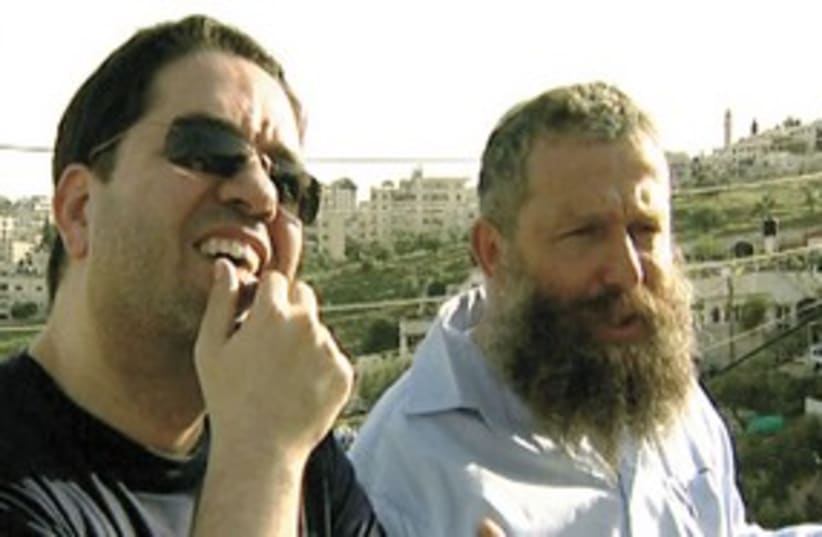
Orthodox Judaism is by far the most diverse stream of Judaism, encompassing such incompatible types as rationalists and mystics, West Bank settlers and peaceniks.
By LAWRENCE GROSSMANReligious and secular Jews 311(photo credit: Courtesy)
Belying the regimented connotation of the word “orthodox,” Orthodox Judaism is by far the most diverse stream of Judaism, encompassing such incompatible types as rationalists and mystics, West Bank settlers and peaceniks, college professors and obscurantists, feminists and male chauvinists.Orthodoxy’s internal critics, too, come in different varieties. Recently, two Orthodox rabbis have leveled serious charges against their religious community, one attacking its theology, the other its primary educational thrust. In important respects they contradict each other.Norman Solomon is a distinguished British academician, recently retired from the Oxford Centre for Hebrew and Jewish Studies, who whimsically claims to belong to the “skeptical Orthodox.” His latest book, Torah from Heaven, certainly exudes skepticism.It argues that the central assumption of classical Judaism – the divine origin of Torah – has become so clearly unbelievable in its literal sense that the only way to keep intellectually honest Jews from abandoning Orthodoxy is to reinterpret the doctrine not as fact but as foundational myth. Solomon, tongue firmly in cheek, tries to reassure the faithful by pointing out that myths are not necessarily false.But he clearly thinks this one is.Solomon painstakingly traces the development of the notion of Torah from Heaven as it mushroomed to include not only the divinity of the Five Books of Moses and the somewhat lesser holiness of the rest of the Hebrew Bible, but also a divinely inspired Oral Torah, eventually written down in the Talmud, that explains and elucidates scripture, and rabbinic decrees and interpretations through the generations that are also alleged to embody God’s will.Solomon then surveys the ancient and medieval critiques of the doctrine, which either denied the Oral Law (Sadducees and Karaites) or superseded or replaced both it and the Bible with a new revelation (Christians and Muslims).The rabbis dealt with problems of internal contradictions, anthropomorphisms and apparent moral blemishes in the Torah through what Solomon calls a “reconciling hermeneutic.” Familiar to students of the Talmud, this mode of analysis employs ingenious interpretations of words and phrases and clever juxtaposition of texts to untangle difficulties. The method was sufficient to satisfy the premodern Jewish mind.But the challenges raised over the past 400 years to the divinity of Torah can no longer be so easily countered, writes Solomon, since we now understand “the relationship between revelation and other sources of knowledge” –archeology, history, anthropology, comparative religion, literary analysis, evolutionary biology. These disciplines throw into doubt not only the veracity of what is related in the Bible and the authority of the rabbis’ Oral Torah but the textual integrity of scripture itself.Solomon deftly catalogs the strategies that Orthodox thinkers have adopted to fend off these threats to tradition. Some – the currently popular ArtScroll publishing project, for example – simply close their eyes to any view that veers from the regnant Orthodox line, even if antecedents for it can be found in rabbinic literature.Others accept elements of modern thought and try to fit them into the traditional framework, reconciling the Big Bang, for example, with the Bible’s Creation narrative. Another alternative, a favorite of the philosophically-minded, elevates Torah to a Kantian conceptual world immune from evaluation by earthbound criteria.Solomon does not find any of this convincing: Torah from Heaven, he claims, “cannot be upheld by the serious historian, scientist, or philosopher.” But how many Jews outside Solomon’s academic ivory tower practice these rarefied professions? Does Solomon’s alternative, appropriating the doctrine as myth, an “interpretation of history through faith,” work any better? It is hard to imagine Orthodox Jews continuing their demanding regimen – of prayer, ritual, study and raising their children to these tasks as well—for the sake of an Orthopraxy built upon myth.Gidon Rothstein, a Yeshiva Universityordained rabbi and Harvard PhD, thinks Orthodoxy’s problem lies elsewhere. He claims that We’re Missing the Point – the title of his new book – by conveying Orthodoxy primarily as a system of commanded behaviors. While Norman Solomon came of age in the mid-20th century, when important elements of Orthodox Judaism sought to address intellectual challenges such as modern biblical scholarship, Rothstein is a generation younger, and his concern is how to square Orthodoxy with the currently treasured value of individual autonomy.Flying in the face of the common assumption that Judaism is a religion of requirements and religious acts, Rothstein claims to find biblical proof that God originally intended to impose very few commands upon humanity, allowing men and women to devise their individual paths to emulate Him. Only after human beings’ repeated failure to find God on their own did He impose an elaborate system of mitzvot on one model people, the Jews.And even now, Rothstein asserts, a Jew is supposed to view those commandments only as a bare-bones framework for developing a relationship with God that is primarily personal and spiritual – as he calls it, in the hackneyed vernacular of contemporary spirituality, a “personal journey.”The relationship that Rothstein advocates is based on the very same theological tenet that Solomon finds unbelievable: the idea that God revealed Himself to the Israelites and gave them the Torah. Blissfully ignorant of or indifferent to the thorny problems that the doctrine has encountered over the last few centuries, Rothstein calls this the “unequivocal core” of Judaism.These two books are incommensurate: Solomon’s is judicious and erudite, Rothstein’s disorganized and somewhat bombastic.Yet their critiques of Orthodoxy, taken together, themselves invite a critical question: If Orthodox Judaism’s core theological claim is weak, and if its commandment- centered approach to religion is so at odds with human autonomy, why is it so much more vibrant and successful than the liberal streams of Judaism, which suffer from neither deficiency?Lawrence Grossman, director of publications at the American Jewish Committee, edited the American Jewish Year Book from 2000 to 2008.
if(catID != 151){
var cont = `Take Israel home with the new Jerusalem Post Store