Murdered at the Olympic Games – a symbol of peace and brotherhood among nations. Murdered because they were Israeli.
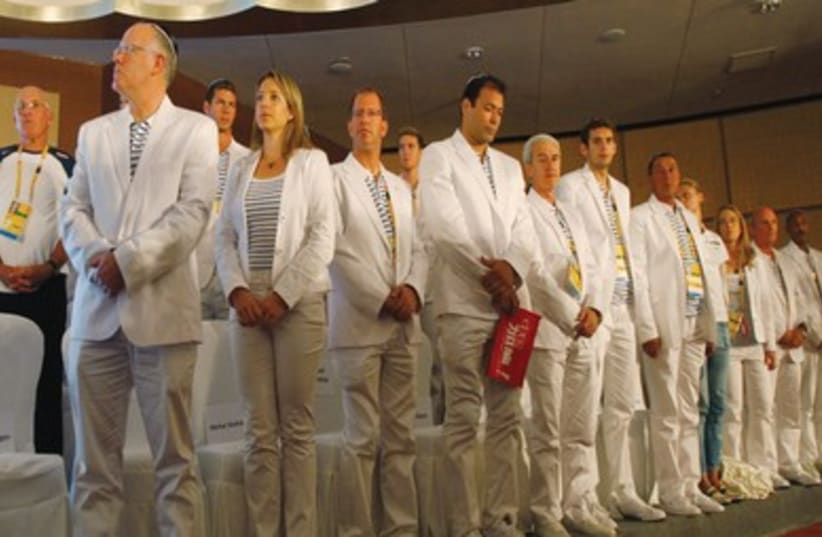
By YORAM DORIIsraeli Olympic Silence (R370)(photo credit: REUTERS)
Along with billions of others from around the world, I watched the opening ceremony of the Olympics in London. Like the vast majority of Israelis, I felt angry that the organizers decided to ignore the murder of 11 of our sportsmen at the 1972 Munich Games.In the beginning of the broadcast, in a kind of protest, I darkened my TV screen for a minute. During this time, I remembered again what happened 40 years ago. When I visualized the Israeli delegation walking – with Shahar Zubari bearing our flag – I remembered his family member, the wrestler Gad Zubari, the only one to escape from the room the terrorists took over in the Munich village.In that moment, two images passed before my eyes. One was of the Israeli delegation in Munich, in its white and blue uniform, marching happily and smiling at the opening ceremony. The other was of 11 IDF cars, on each of them a coffin containing our murdered athletes’ remains.I was then married a year, with my wife at the beginning of her pregnancy with our first son, living in a small apartment in the Yad Eliyahu neighborhood of Tel Aviv.The home black-and-white television, as was customary, broadcast mostly snow, so we had to adjust the antenna for clearer reception.Selected sections from the Olympics were broadcasted from time to time, in black and white, and the main way for me to get informed on the latest events in the Olympic Games was to use a big old radio, which was placed in the half room that served as a bedroom. In the snowy TV broadcasts, I watched the rise of Shachamorov to the 100-meter finals and the wonderful achievements of the Jewish swimmer, Mark Spitz, whom I saw earlier at the Maccabiah games swimming like a dolphin in the Galit pool, in Yad Eliyahu.In this Olympics I had some emotional involvement. The shooting coach, Kehat Shorr, was the rangemaster of the range near the Ramat-Gan stadium, where during my days as a teacher in the Ironi Hey High School in Tel Aviv, my students were training in the Gadna, and the coach and I were talking. Shorr was also friendly with my wife, who was a Gadna instructor in “Ironi Alef” high School at that time.Two of our Olympic coaches in those games – Amitzur Shapira and Mooney Weinberg – were my wife’s teachers when she was studying at the Midrasha in the Wingate Institute for Physical Education, two years earlier. She knew Weinberg’s wife, and Amitzur’s trainee, Esther Shachamorov.Thus, in these particular Olympic Games, we, the newlyweds, had an emotional involvement beyond me being a sports “freak.”On the morning of September 5 we heard for the first time on the radio about the terrorist takeover of the Israeli athletes in the Olympic Village. From that moment on, we didn’t leave the bedroom. Glued to the radio, we listened to the broadcasts and fragmentary news that came from Munich.Initially we heard that one of the dead was Mooney Weinberg, the wrestling coach who tried blocking the terrorists from going through the door with his body, and paid for it with his life. Then came the news of the murder of Yossef Romano, the weightlifter who tried to stop the terrorists using a fruit peeling knife that was in his room, and got shot to death.Every few minutes a new ultimatum by the kidnappers was broadcasted. True and false information of the German willingness to negotiate and the terrorists demands came through. My wife, who was at the beginning of her pregnancy, could not stand the tension and pressure and fell asleep somewhere in the late evening hours. I stayed stuck to the radio.Sometime in the early morning a report aired that the Israeli athletes were taken to the airport, boarded on helicopters, and that the German commando forces were able to rescue the hostages alive. With that knowledge of the evacuation of the athletes, and the tragic deaths of Weinberg and Romano, I fell asleep feeling relief accompanied by great pain.In the morning, as usual, we woke up around seven o'clock on our way to work at the “Gadna.” As soon as she opened her eyes, my wife asked me about the athletes.I replied that it was reported that most of them were rescued and alive. We turned on the radio to hear the details, and then we were exposed to the horrible truth. The rescue operation failed and all our athletes were slaughtered.Murdered at the Olympic Games – a symbol of peace and brotherhood among nations. Murdered because they were Israeli.With their return we went to Ben-Gurion Airport to receive the coffins. My wife and I stood on the porch of the visitors at the airport (there was such a thing once), and we watched the plane land slowly, and from it, carrying out 11 coffins draped with the national flag.Eleven coffins, and inside of them coaches, referees, weightlifters and wrestlers who went to Germany to honorably represent their country and came come in boxes.These are the people the Olympic Committee has refused to mention for the last 40 years. These athletes are the ones that the British Organizing Committee, headed by Sir Sebastian Coe, found not worth mentioning in the opening ceremony.The ceremony honored British history at length, but could not provide one sentence about the athletes who were murdered during the Olympic Games.Many excuses have been made. The murder of our 11 athletes in Munich is part of the Olympics forever. They are a component that has to be mentioned to demonstrate to the world that we all are completely engaged, in our mutual agreement that such a horrific incident will not be repeated ever again.The writer is a senior adviser to President Shimon Peres
if(catID != 151){
var cont = `Take Israel home with the new Jerusalem Post Store