Israeli cities hold "Earth Hour" blackout several weeks after the rest of the world, Tel Aviv to hold Earth Day concert.
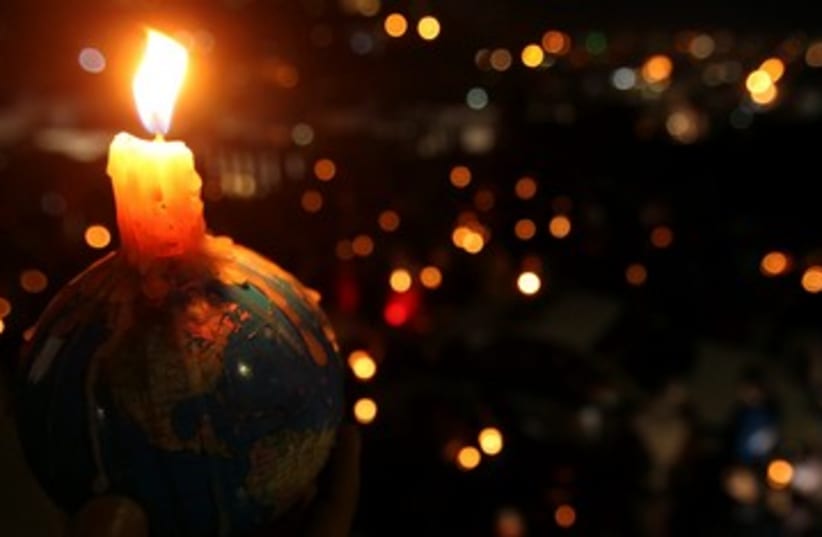
By EVIE SALOMONPeople hold candles during Earth Hour(photo credit: REUTERS/Ali Jarekji)
More than twenty Israeli cities will black out on Sunday for one hour to mark the 42nd annual Earth Day.The event, "Earth Hour," will mean lights off everywhere from Tel Aviv's Rabin Square to Jerusalem's Old City, along with 14 local authorities and Israeli Defense Forces bases. Israel will be joining about 6,000 other cities, albeit several weeks later, in the yearly tradition to raise awareness about energy conservation. The rest of the world held "Earth Hour" on March 31.Israel will also commemorate the holiday with a campaign to clean up beaches and with performances at Tel Aviv's Rabin Square by Rami Fortis, Shlomi Shaban and Geva Alon. Electricity for the event will be supplied by vegetable-oil generators, along with the pedal power of 48 cyclists.In other corners of the world, China, the world's largest fossil fuel emitter, is hosting a climate bicycle race to promote green transport and nomadic people are planting trees in the Kubuqi Desert.In the US, all of the 400 plus national parks are holding guided nature walks and organized cleanups as part of a presidential proclamation.In Thailand, the World Dhammakaya Center is gathering more than 100,000 Buddhist monks from 30,000 temples around the country to promote world peace through inner peace.Since Earth Day's inception in 1970, the holiday has been celebrated in nearly every country, making it the largest civic observance in the world. Despite such magnanimous support, the world still increasingly suffers from pollution and depletion of valuable resources.The most recent estimates of the world's carbon footprint show China emits more CO2 than the US and Canada put together, an increase of 171 percent since the year 2000, according to the US Energy Information Administration. Preliminary estimates for 2009 and 2010 show 2010 was by far a record year for CO2 emissions from fossil-fuel combustion and cement manufacture.Even more notable is the growing evidence of rapid climate change. According to NASA, the global sea level rose about 17 centimeters in the last century, and the global temperature continues to increase. Nevertheless, many countries and blocs are committed to reducing their emissions. The EU, the world's third largest emitter, has the most ambitious climate goal: an 80-95% cut in CO2 emissions by 2050, measured against 1990 levels.Israel too has pledged to make environmental responsibility an economic issue. The Packaging Law, which went into effect last year, requires importers and manufacturers to ensure that a certain proportion of product packaging is recycled. Last month, the Knesset passed a law enforcing Israel's cooperation with OECD pollution-reporting standards and the state is working on a NIS 20 million initiative to remove asbestos from the western Galilee.
if(catID != 151){
var cont = `Take Israel home with the new Jerusalem Post Store