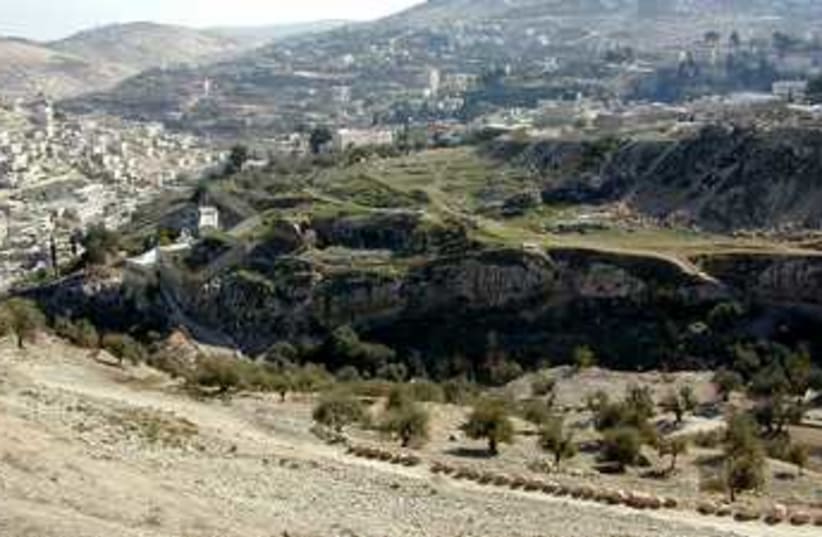
Today the Hinnom Valley offers lush grass, hosts concerts - a far cry from the way it looked during time of Manasseh.
By WAYNE STILESHinnom Valley 370 DO NOT REPUBLISH(photo credit: BiblePlaces.com)Wayne Stiles has never recovered from his travels in the Holy Land. Follow him on Twitter (@WayneStiles) or on his blog at www.waynestiles.com.Every time I’m in Jerusalem, I try to go to St. Peter in Gallicantu. Walking to the balcony in the southwest corner of the area, I can overlook the Hinnom Valley. Inevitably while I stand there, I think of Manasseh and the horrific atrocities he committed in the area before my eyes.King Manasseh ruled for fifty-five years—the longest reign of all the Hebrew kings (2 Chronicles 33:1-2). Even though Manasseh had one of the godliest fathers in history, Manasseh was Judah's worst king. He lived just like the godless nations God destroyed in bringing Israel into the land.He adopted a pagan worldview— idolatry, astrology, child sacrifice, witchcraft, and sorcery. The sin list here is a specific violation of stated sins in Deuteronomy 18. “He made his sons pass through the fire in the valley of Ben-hinnom; and he practiced witchcraft, used divination, practiced sorcery, and dealt with mediums and spiritists. He did much evil in the sight of the Lord, provoking Him to anger” (2 Chronicles 33:6).It's impossible to know why, but Manasseh sought to break God's law with as much passion as his father, Hezekiah, had sought to keep it. Manasseh rebuilt the high places where one would worship idols. He built altars in the temple to idols. He built altars to the stars. In a literal sense he rebuilt what Hezekiah had torn down. Look at how the prophet Jeremiah put it: “And they have built the high places of Topheth, which is in the valley of the son of Hinnom, to burn their sons and their daughters in the fire, which I did not command, and it did not come into My mind" (Jeremiah 7:31).How did God respond to Manasseh? He spoke to Manasseh and his people, but they paid no attention. So God brought in the Assyrian army, “and they captured Manasseh with hooks, bound him with bronze chains, and took him to Babylon” (2 Chr. 33:10-11). When it says they captured him with hooks, the Hebrew word refers to a hook that was put through the gills of large fish. It is used like the ring used in the noses of wild beasts to subdue and lead them. Manasseh's life is shown here to be so out of control, as an unmanageable beast, which the Assyrian generals took and subdued by a ring in the nose.What a great change occurred at that point: “And when he was in distress, he entreated the Lord his God and humbled himself greatly before the God of his fathers. When he prayed to Him, He was moved by his entreaty and heard his supplication, and brought him again to Jerusalem to his kingdom. Then Manasseh knew that the Lord was God” (2 Chr. 33:12-13). In his distresses he called out to God and Manasseh finally let go of the illusion that he was in control—and he humbled himself greatly.Perhaps because of the atrocities of Manasseh, Jesus used the Hinnom Valley as an illustration of eternal torment (Matthew 18:9). Here also, Judas, the betrayer of Jesus took his own life. Hence, the residents later named the place “Hakeldama,” or “Field of Blood” (Acts 1:18-19).Today when I see the Hinnom Valley, it looks far different from the time of Manasseh. Today the valley hosts concerts and offers lush, green grass for children playing Frisbee. How ironic that in times past, children were killed there. Today, they play.It’s almost as if the valley has been redeemed from the horrific acts of idol worship and child sacrifice. Just like Manasseh was redeemed.In Manasseh's wickedness he removed all the fences of God's law, and thus removed the protection and provision God's law intended to provide. Only after Assyrian nose hooks did he discover the value of the fences, and to his credit, he began rebuilding them. Manasseh illustrates the awful results of living without fences and the awesome grace of God toward all who would turn to the Lord in sincerity.How to Get There:On modern Mount Zion in Jerusalem, enter the parking lot of the Church of St. Peter in Gallicantu and walk to the southwest corner balcony. You can overlook the connecting Kidron and Hinnom Valleys here.What to Do There:Read Manasseh’s story in 2 Chronicles 33, as well as the descriptions given of the valley in Jeremiah 7:31, Matthew 18:9, and Acts 1:18-19. Wayne Stiles has never recovered from his travels in the Holy Land. Follow him on Twitter (@WayneStiles) or on his blog at www.waynestiles.com.
if(catID != 151){
var cont = `Take Israel home with the new Jerusalem Post Store