
Since the October 7 Massacre, "ceasefire now" has been the rallying cry for activists demanding that Israel cease its military operations against Hamas in Gaza.
The slogan was emblazoned on banners in street marches, stated in speeches by politicians across the world, and featured in open letters by celebrities. Activists demanded a "permanent ceasefire" to end hostilities, ostensibly to save the lives of civilians caught in the crossfire.
Yet after a comprehensive peace proposal was presented by President Donald Trump on Monday, and it received the backing of major Middle Eastern powers, including Turkey and Qatar, there was silence from the "ceasefire now" activists in the best case, outright rejection at the worst.
Despite Israel agreeing to a phased plan which would end the fighting, release hostages, rebuild Gaza, and lay the groundwork for moderate governance, there have been no mass protests in the street, no flotillas, no building occupations to exert pressure on Hamas to end the war.
While the coalition of radicals and trend followers chanted "ceasefire now" on award stages and in city streets, supposedly because they were so desperate to end a "genocide," the alleged mass murder and ethnic cleansing in Gaza appeared to lose its imperative. A ceasefire is suitable to end a genocide, but apparently, peace is too great a price.
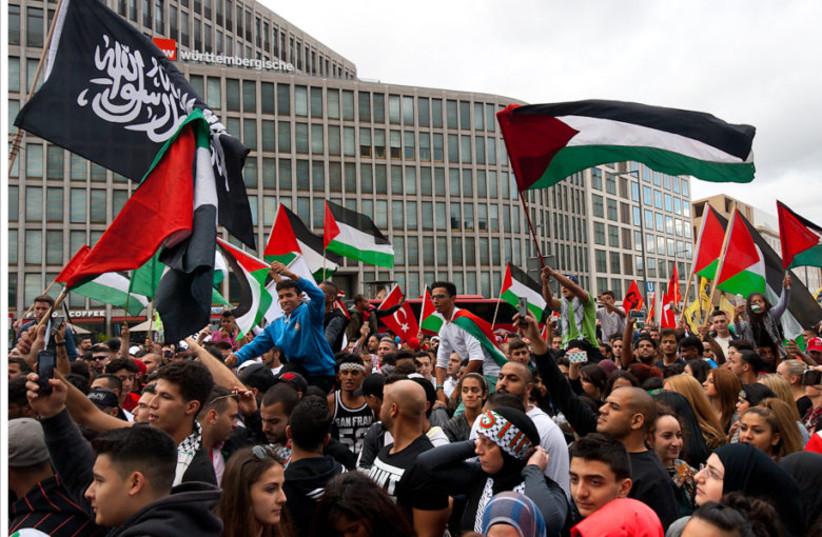
Activists demanded "ceasefire now" of Israel, but seem unwilling to demand "peace now" of Hamas. This is because peace was never the objective.
A ceasefire, even a so-called "permanent ceasefire," is an end to hostilities where the battle lines lie, not a peace that is negotiated to solve the underlying points of conflict between the two parties. The most problematic point of contention between Israel and Hamas, from the perspective of many revolutionary activists in the West, is the continued existence of the State of Israel.
Peace would mean the tacit acceptance of the Jewish state, while ceasefire offers a respite to resume the fight another day. A ceasefire provides the opportunity for Hamas and its ilk to rearm, reorganize, and recruit for a future fight -- in the same cycle of operations 2008 Cast Lead, 2012 Pillar of Defense, 2014 Protective Edge, and 2021 Guardians of the Wall.
Committing to a ceasefire
The commitment to a ceasefire as a first step in a belated war against Israel was made evident in January, when a ceasefire and hostage deal were reached between Israel and Hamas. Activists quickly shifted their slogan from "ceasefire now" to "Ceasefire today, liberation tomorrow."
"The Ceasefire in Gaza is a victory for the Palestinian people and the global struggle for liberation," the People's Forum said Wednesday on X/Twitter. "The struggle against imperialism and Zionism has advanced, and there is no going back. This ceasefire is just the beginning. The struggle to end the occupation and achieve full independence for the Palestinian people will continue with unwavering determination. A new phase in the struggle begins now, and we will not rest until total liberation - from the river to the sea."
The same strategy was echoed by the Palestinian Youth Movement (PYM), the Party for Socialism and Liberation (PSL), CODEPINK, and affiliates of the Shut it Down For Palestine coalition.
"Ceasefire today, liberation tomorrow. We honor the steadfastness, determination, strength, resilience, and courage of the Palestinian people. This is a victory for resistance and those who refused to abandon the path of liberation," said Within Our Lifetime. "We applaud a ceasefire as an effort to preserve the lives of the Palestinian people, and we will continue the struggle for the complete liberation of Palestine from the river to the sea. Since the beginning, we have made clear that a ceasefire is only a first step in the struggle for true justice against the imperialist Zionist and US war machine."
A term repeated by several activists and groups in relation to the January ceasefire was "victory" -- a refrain of military outcome. The strategic objective of Hamas and its Western supporters to survive to fight another day was met by the ceasefire.
The declarations of victory stand in stark contrast to the reactions to the Monday peace plan, which was characterized in a different military framing: "Surrender."
CODEPINK co-founder Medea Benjamin said on Monday on X/Twitter that the plan was a “demand of surrender” to colonial and imperial powers. WOL leader Nerdeen Kiswani called it a “A complete political surrender of Palestinian resistance."
“The Palestinians must reject this surrender deal,” 5Pillars editor Roshan Muhammed Salih said on social media.
The problem of the peace plan was that it did not allow Hamas a strategic respite, but if implemented as planned would remove the terrorist group's abilities to fight and control the Gaza strip. Most of all, the plan would give up on the dream of Israel's destruction.
Activists rejected the deal's proposal to disarm Hamas, because it removed the option of continued fighting. Electronic Intifada director Ali Abunimah said that disarming Hamas but not Israel revealed the plan to be evil. US model Bella Hadid’s sister, Alana Hadid, said in an Instagram video that demilitarization just means stripping Palestinians of any ability to resist occupation while Israel keeps its full military arsenal."
Ousting of Hamas from political control of its territory to a transitional government would likewise preclude the ability to be able to restore its former strength. Far from seeing the potential groundwork for a free and democratic Palestinian polity, activists see the "resistance" losing ground in a long-term war.
“Trump and [Prime Minister Benjamin] Netanyahu call this a peace plan, but it’s nothing more than a blueprint for permanent occupation,” Benjamin said in a video.
Kiswani derided the potential replacement of Hamas with a planned reformed Palestinian Authority, as imposing "Israel’s subcontractor" on Gaza.
With no arms or territory to continue a future fight, activists would be denied the dream of a Palestinian state "from the river to the sea" in Israel's stead.
True peace, it was argued by several groups and activists, came from the "justice" of "liberation," which anti-Israel groups detailed in January meant the destruction and replacement of Israel.
Global Sumud Flotilla steering committee member Yasemin Acar said on Instagram that the plan "offered terms of surrender, not terms of justice.”
Acar, calling on pro-Palestinian activists to stand in solidarity with Gazans in their fight for liberation.
“Colonizers don’t get to define peace,” she said. “Justice comes before negotiation. This is a fight for liberation and for our shared humanity.”
Hadid explained in her video that any end to the conflict had to involve justice – the ending of the blockade and “occupation.”
Disarming and decommissioning Hamas would mean the end of the decades long military campaign against Israel. There are no calls of "peace now" on academic campuses because they would be calls for Hamas to "surrender."
With "Peace" meaning "surrender" and "ceasefire" meaning "victory," anti-Israel activists have shown that the fighting isn't the issue, the problem is who is winning.