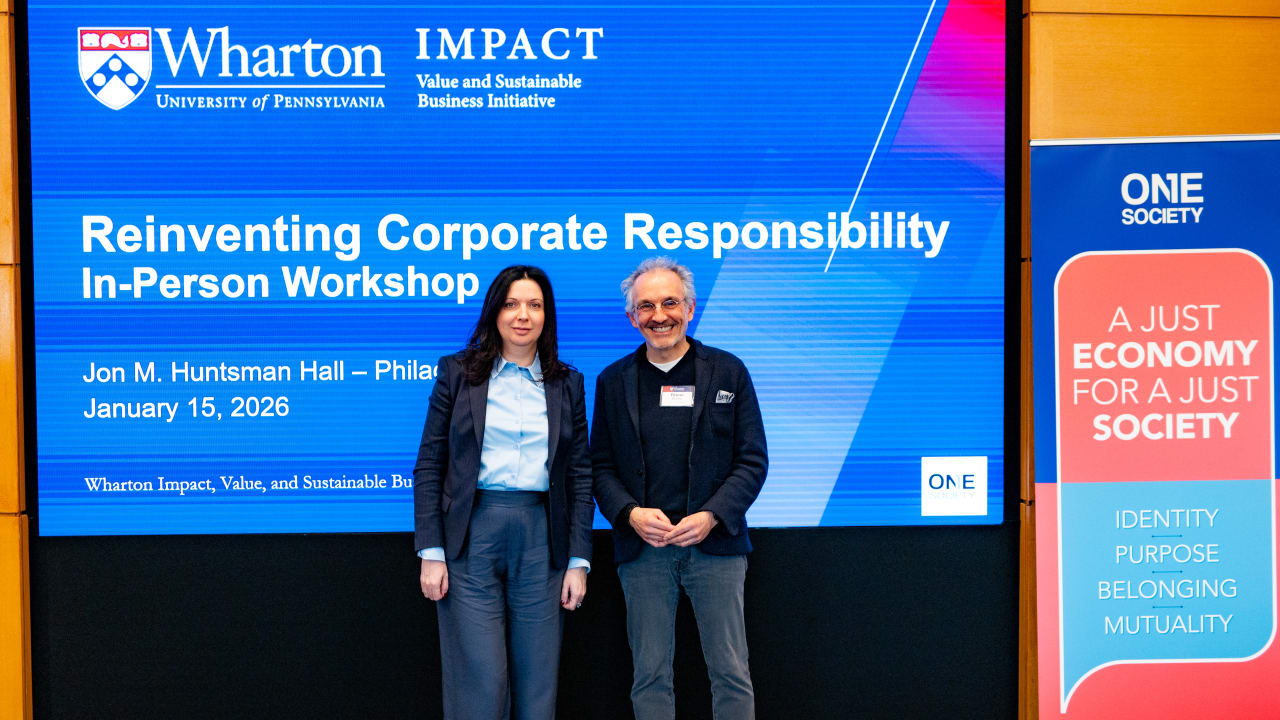
ONE Society, led by Irina Nevzlin, a Jewish-Israeli philanthropist, and Bruno Roche, a French economist, was presented at Wharton as a framework to ease polarization by rebuilding trust through economic incentives and shared identity.
Polarization is reshaping politics, workplaces, and campuses. Trust in institutions keeps slipping, and the social center often looks like it is shrinking. Against that backdrop, ONE Society was presented recently at the Wharton School at the University of Pennsylvania, arguing that economic rules and identity pressures now collide in real life, and leaders need tools that deal with both.
ONE Society’s pitch is simple: help companies, cities, and institutions build long-term trust and cooperation by measuring “value” in a wider way, including how decisions affect employees, communities, and social stability.
The model behind the initiative
Roche’s work grew out of his time as chief economist at Mars, where he helped develop the “Economics of Mutuality” approach. The model argues that businesses and institutions should track whether they create mutual gains for the organization and for the people and communities around it.
The idea is that economies hold together when more people feel the system is fair, predictable, and worth supporting.

The initiative was presented during Wharton Impact Day at Wharton, the University of Pennsylvania’s business school. Wharton trains many of the world’s business leaders, so it is a place where ideas about capitalism and “what counts as value” can spread.
Roche told the audience the goal is to expand how leaders think about value so it includes long-term trust and stability, not only quarterly profits.
Nevzlin’s focus: identity comes first
Nevzlin framed today’s polarization as an identity problem that shows up in politics and economics.
She argues that when people and institutions feel unsure about who they are, trust collapses and everything becomes reactive. She calls her approach Rooted Identity: a clear sense of who you are that makes it easier to cooperate with others without feeling threatened.
Nevzlin also referenced her personal story, from childhood in the Soviet Union to an international career in London and her decision to build her life in Israel, as an example of the tension many people feel between continuity and change.
The Jewish and Israeli angle
Nevzlin brings a clear Jewish identity lens to the initiative. She serves as president of the Nadav Foundation and chairs ANU – Museum of the Jewish People, two roles that focus on Jewish peoplehood, heritage, and shared values.
She also ties her thinking to Zionist ideas. Nevzlin has pointed to Theodor Herzl’s Altneuland as an example of a society built on shared responsibility and prosperity, blending private initiative with a common purpose.
Israel is also part of the initiative’s story. Nevzlin has said Israel’s diversity and energy make it a strong place to test whether identity-based trust building can move from theory into practice.
ONE Society says versions of this approach have been used in global companies including Mars, the Mulliez Group, and Novo Nordisk. The initiative also says it is running city-level pilots, including in Marseille in southern France.
It is also developing tools with BCG (Boston Consulting Group) to help corporations and organizations apply the model in a practical way.
ONE Society argues that polarization grows when people lose trust and lose a shared story about where society is headed. Nevzlin and Roche are trying to respond with a mix of identity language and economic tools, then test it in real institutions rather than leaving it as a conference idea.