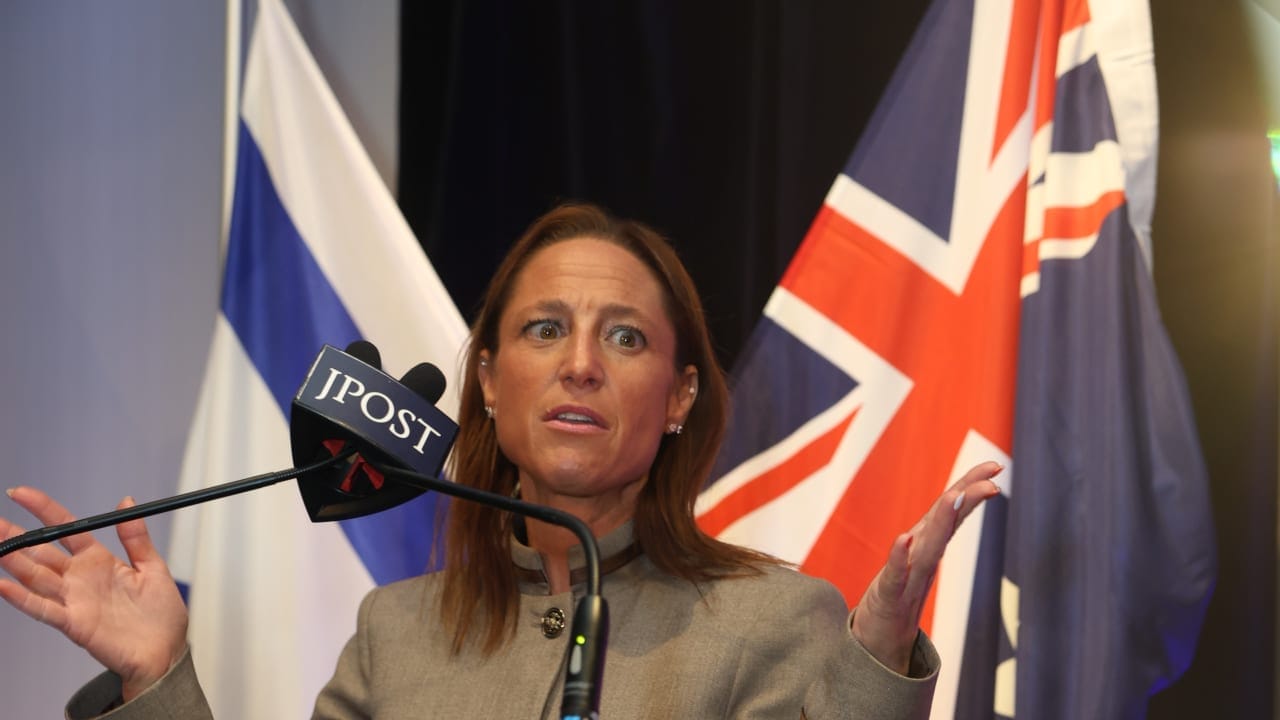
After three years of covering Israel at war, journalist and author Maayan Hoffman found herself asking a question: How are we ever going to heal?
She had walked through devastated kibbutzim, interviewed hostages and their families, spoken with soldiers and survivors, and driven down highways under rocket fire.
“Everywhere I went, I encountered trauma,” Hoffman told attendees at The Jerusalem Post Australia Summit in Sydney on Thursday. “In the stories people told me. In the faces of families waiting for loved ones. In soldiers returning from battle.”
But amid the devastation, Hoffman, who has spent much of her career covering health and innovation, began discovering Israeli doctors, scientists and entrepreneurs developing new approaches to diagnosing, preventing and treating trauma.
Her research led her to interview representatives from more than 70 companies and dozens of other experts, uncovering what she believes is an emerging Israeli industry.
She calls it Traumatech.
Those interviews became the foundation of her new book, Traumatech Nation: How the Start-Up Nation Is Pioneering the Future of Mental Health, which she introduced at the summit.
“Israel, a country struggling with unprecedented trauma, was also becoming a center of innovation in how the world might one day treat it,” Hoffman said.
The need extends far beyond Israel.
According to the World Health Organization, approximately 70% of people experience a potentially traumatic event during their lifetime, while some 1.2 billion people worldwide live with a mental disorder.
Meanwhile, Israel's mental health technology sector is expanding rapidly.
Research by Start-Up Nation Central, ICAR, Bezyl and the 8400 Network identified 178 Israeli mental health technology companies at the beginning of 2026, compared with 124 the previous year and just 27 eight years earlier. Investment increased approximately 150%, from $138 million in 2024 to $352 million in 2025.
“An entire industry is emerging before our eyes, with enormous potential still ahead,” Hoffman said.
The technologies include artificial intelligence to identify mental health challenges, biomarkers to detect biological signs of trauma, neurofeedback and biofeedback to help patients regulate their responses, and experimental psychedelic-assisted therapies. Some are already reaching patients, while others remain experimental.
But Hoffman stressed that developing technologies is only part of the challenge. Promising innovations must also reach those who need them.
That is why she and trauma survivor advocate Manny Waks are developing the Traumatech Network, an international initiative designed to connect researchers, entrepreneurs, investors and healthcare providers.
“Trauma knows no borders. And neither should the solutions,” Hoffman said.
She concluded by recalling someone who criticized her book's title for making Israel sound like a nation in trauma.
“You know how I responded? I said, 'We are.'”
But Hoffman believes Israel's experience could also become a story of post-traumatic growth.
“We cannot change what happened on October 7,” she said. “But perhaps we can help change what happens next.”
Traumatech Nation is available on Amazon and at Avenue Bookstore in Melbourne.