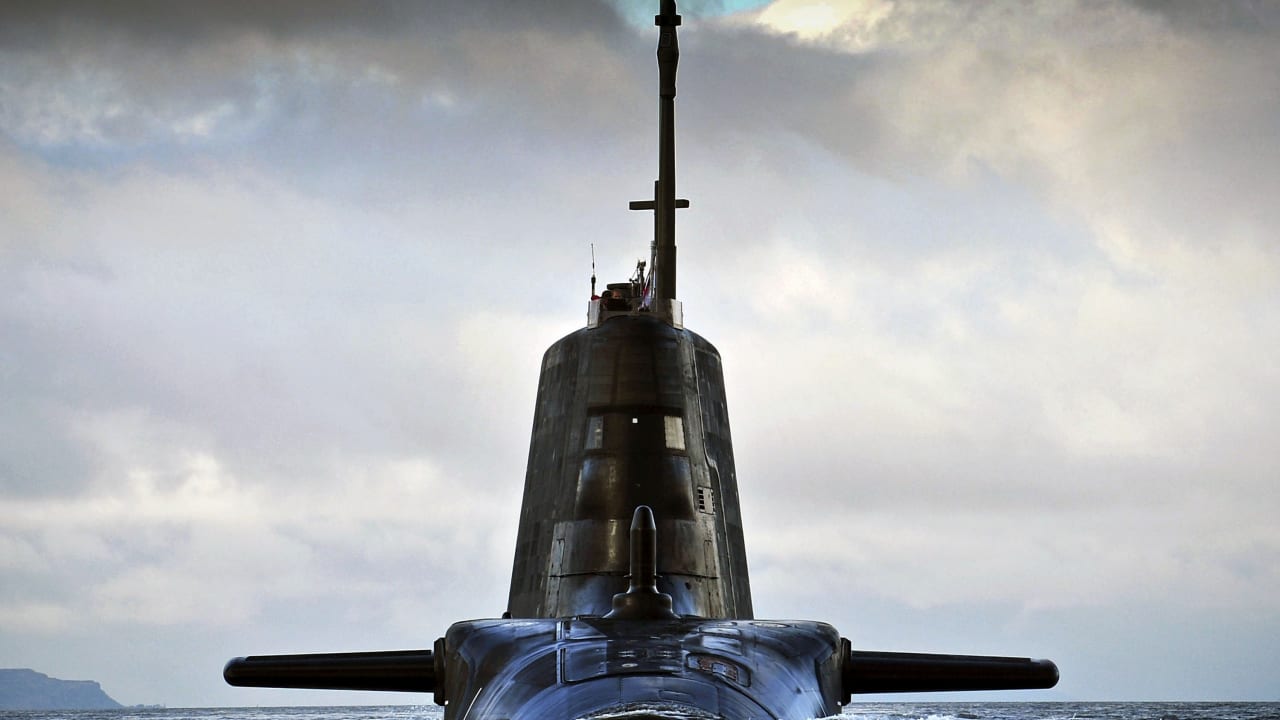
On Wednesday, Elbit Systems put out a strikingly vague statement about the beginning of joint work in Israel with the German maritime vessel manufacturing giant TKMS (the successor company to an expanded ThyssenKrupp) to produce "structural components" for submarines.
As part of the cooperation, Elbit said it will establish a new manufacturing facility for underwater GRP (Glass Reinforced Polyester) components for submarines.
Yoram Shmuely, General Manager of the Aerospace Division at Elbit Systems, said, “This cooperation will expand local manufacturing capabilities and serve as an anchor for global activity in the underwater domain."
What on Earth, or in this case, underwater, does all of this mean?
Are they talking about Elbit merely producing a few small electronic items and trying to make a big deal out of that, but where the vast majority of the submarine is still produced in Germany, whereas Israel has been buying its submarines for many years?
Or is this the largest move Israel has made since the 2023-2025 war into local and eventual, more independent development of a whole new area of weapons manufacturing of one of the key elements in its military arsenal?
To date, Israel has made a few moves to achieve greater weapons independence following a period in mid-2024 when the Biden administration froze various munitions shipments, and a large number of allies completely froze offensive weapons sales to Israel.
Most of these moves have revolved around local production of a much larger volume of munitions and ammunition so as to be less reliant on the US and others for such items.
However, Israel has completely declined to give another try at producing its own aircraft like the F-35, following the multibillion-dollar failure at trying to do so in the 1980s.
Until now, little had been heard about Israel trying to achieve greater naval vessel production independence.
Neither Elbit nor the Defense Ministry would offer any additional details on the record due to Israel generally treating all issues relating to submarines as far more classified than Western militaries like the US, which provide significantly more information.
On one hand, foreign sources have said that Glass Reinforced Polyester (GRP) is increasingly used for critical, non-primary structural, and underwater components in modern submarines. This can include: fairwaters, masts, sensor housings, and control surfaces.
Supporters of using the material for more parts of submarines favored it for its high strength-to-weight ratio, immunity to corrosion, and reduced magnetic/acoustic signatures.
In addition, foreign sources have indicated that S-Glass/Carbon fiber reinforced polymer composite can be used for the design of submarine hulls that can travel down to 7000 meters of sea depth.
Experimental investigations have revealed that the composite material exhibited a combination of strength, stiffness, and density that is comparable to many composites or metals at a lower density.
A foreign study found that the safe depth of travel for crashworthiness for a submarine using such materials was found to be 1750 meters.
All of this seems to indicate an extensive number of items that Israel might be able to start manufacturing itself, with TKMS's advice and expertise.
On the other hand, former defense officials told The Jerusalem Post that there was little in the Elbit press release that indicated that the primary construction of submarines would move from Germany to Israel.
Rather, as with the F-35, where Israeli defense industries have contributed certain elements, this latest move seems to be an attempt to increase the number of pieces of a submarine that Israel can locally, and maybe even eventually independently, manufacture.
New facility will strengthen Israel's independent manufacturing capability
Paul Glaser, CFO of TKMS, stated that the new jointly run facility will strengthen "Israel’s ability to independently manufacture underwater components and create infrastructure that will enable technological progress and deep cooperation, as part of a joint effort to strengthen stability and security in the maritime domain."
Elbit said that the entire initiative is carried out under an industrial agreement between the companies, under which new production facilities will be established and advanced technologies developed based on TKMS’s knowledge and experience.
In addition, the statement said that, "the agreement enables Elbit Cyclone to expand its product portfolio, market them in new international markets, and establish local expertise in the production of advanced underwater components – a field that has not been manufactured in Israel until now."
All of this seems to allude to TKMS imparting significant new fields of expertise to Israel and Elbit.
Sources did indicate that some of the materials that will be used for submarines have an overlap with materials used for items in aircraft, which the Elbit Cyclone division has already used for aircraft.
But there is also a clear admission that this is new ground even for Elbit's experts.
Another plus of the deal, according to the statement, is that "The cooperation strengthens northern Israel as a strategic industrial and technological center. The facility’s activity constitutes a regional growth engine, integrating advanced industry, innovation, and defense manufacturing under one roof.
Ze’ev Landau, Defense Ministry Head of the Directorate of Production and Procurement, noted that, “The partnership with TKMS shipyard spans many years, during which the strength of the Israeli Navy has been built and continues to be built for the years ahead.
The establishment of the facility as part of industrial offset procurement constitutes part of the Ministry of Defense’s strategy to expand the defense manufacturing base as part of the lessons of the war and will assist in strengthening the IDF, promoting Israeli industries, and developing the economy."
In sum, no one is going to see wholly made submarines coming out of Israel tomorrow (in any case, it can take many years to manufacture new submarines), but Israel is trying to jump its game forward in another area of weaponry to continue to increase its defense technology independence.