A few days ago, I stood for a rare quiet moment in a hospital corridor between one siren and the next. I looked at our teams physicians, nurses, support staff, logistics and administrative personnel, security, and leadership and saw in their eyes what, to me, defines true medicine: responsibility, compassion, and determination.
In that moment, I was reminded once again that the transition from routine to war and from war to sustained emergency operations is not merely an operational process. It is a test of identity.
We at Wolfson Medical Center have grown accustomed to performing professionally under pressure. But this past week required an immediate leap into full emergency mode clinically, logistically, and managerially at a pace that allowed no hesitation. We activated a round-the-clock emergency command center without delay, implemented infrastructure adjustments, relocated departments to fortified spaces, and refined protection and clinical protocols to ensure that every patient continues to receive advanced, safe, and highly personalized medical care while both patients and medical teams remain protected.
Historic milestone
For the first time since the hospital’s establishment, we inaugurated a fully fortified underground Emergency Department on level minus one, a historic milestone. For years, our ER operated without comprehensive structural protection, and our teams delivered life-saving care even under direct threat. The swift transition to the protected facility was made possible thanks to intensive infrastructure work and precise cross-organizational preparedness conducted even before the outbreak of the current war across medical, nursing, logistical, and administrative divisions alike. The first shift in the underground ER began at night, in a quiet professionalism that reflected inner strength and readiness. For our patients, the ER represents a promise of safe, uninterrupted care even under the most complex circumstances.
Yet emergency readiness is not defined by reinforced concrete alone.
It is measured by our ability to keep our hearts open.
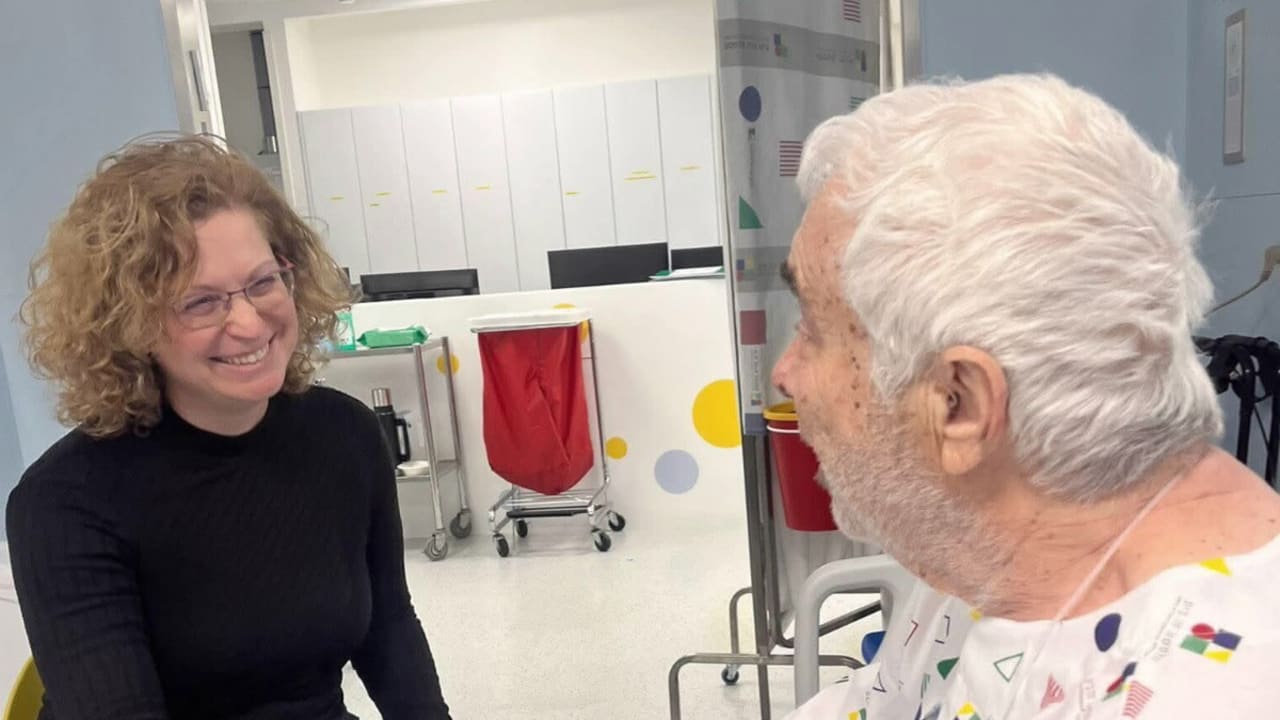
At Wolfson, the person is always at the center. We understand that patient experience is shaped in small moments: pausing beside a bed for a brief conversation, offering a warm cup of tea, providing a small comfort, and speaking reassuringly to an anxious parent. Our Patient Experience and Service teams, together with clinical and nursing faculty staff, move between departments to ensure that no one feels alone. In times of uncertainty, small gestures become profound expressions of care.
Medicine at its finest
I saw this most clearly in our strong Neonatal Intensive Care Unit. Caring for fragile newborns while sirens sound demands not only expertise and experience, but extraordinary emotional strength. Within protected spaces, our teams continue to deliver life-saving treatment with remarkable sensitivity. A calming word. A gentle touch before an examination. A steady gaze that conveys security. The uncompromising professionalism of our physicians and nurses blends seamlessly with deep humanity. This is comprehensive medicine at its finest.
Within our Children’s Hospital which includes multiple protected areas we undertook another complex operation: relocating essential departments and core treatment units to the fortified underground facility in the new building. This was an especially delicate process, requiring precise logistical coordination and full continuity of care for our most vulnerable patients. Led by department and unit heads, teams mobilized quickly, working shoulder to shoulder across disciplines. Every bed was transferred responsibly. Every treatment continued without interruption. Every family received explanation, guidance and presence.
Cooperation within the national healthcare system has also taken on renewed importance. In close coordination with the Ministry of Health and in collaboration with Sheba Medical Center, we facilitated the transfer of internal medicine patients as part of a professional effort to distribute patient load and preserve high standards of care. Those who arrived at Wolfson were received into a comprehensive, round-the-clock framework of professional and personal support. To me, this is mutual responsibility in its deepest sense between institutions, between teams, and above all, toward the public we serve.
Amid all this, we must not forget the people who sustain the system. Our Chief Nursing Officer marked her birthday in the emergency command center after three consecutive days at the hospital. We found a brief moment to pause, to congratulate her, to smile. Organizational resilience is built not only on protocols, but on morale on preventing burnout, on truly seeing our staff. Leadership that is present in the field, that listens and supports, is an essential pillar of that resilience.
As I walk through the corridors and departments between routine and sirens I choose first and foremost to stand with our patients and their families, with the children and newborns in our care, and with our teams.
Human-centered medicine and leadership are not measured solely by protocols and targets. They are measured by presence, adaptability, compassion and accountability.
Our rapid transition into a state of war has demonstrated once again: Wolfson is not just a hospital.
Wolfson is a home.
And even in the most complex hours, this home stands firm protected, professional, and above all, profoundly human.
The wroter is the CEO of the Wolfson Medical Center.