My wife and I spot Mark Jacobi, who is on his way to learn in the kollel, descending the stairs with his stick. From the outside, the Jacobis' home looks no different from any other in the area. There seems very little that sets Mark apart from anyone else: He looks like any other Jew going about his daily routine in Beit Shemesh. However, he is a Holocaust survivor – a survivor of four camps, to be exact, each with a tale of its own. He and his sister Margaret are the only survivor from his family, which included their parents, and four other siblings. JACOBI'S STORY begins in eastern Slovakia. He grew up in a small agricultural town called Leginya, where there were only five Jewish families. His farmer father, David Jakubovic, grew up there. His mother, Leah, was from a larger town called. Žilina. Mark was schooled in his mother's town. Margaret decided she wanted to emigrate to America in 1940, requesting that her aunt send her the papers she required. David was steadfastly against the move, saying: “As my grandmother said, 'The air in America is not kosher.'” The family's life was changed forever when, a day after Passover 1944, Mark and his family were rounded up by the Nazis and, along with other Jews, transported to a ghetto in the nearby Hungarian city of Satoraljaujhely. For six weeks, they were kept in the ghetto, for just as quickly as it had been filled, it was being rapidly emptied. Jews were being marched to the railway lines, where they boarded boxcars. As each boxcar filled, its doors were bolted by locks and chains. There was no water or seating. Sanitary facilities consisted of a bucket. After three days of traveling in these inhumane conditions, the Jakubovic family – David and Leah, Mark and his brothers Zoltan and Yrvin, and sisters Franceska and Alice, arrived at Auschwitz. The doors opened. There were blinding floodlights, shouting SS guards and vicious, snarling dogs. The Jews were forced onto the platform; men and women were made to line up separately. “Raus! Raus!” yelled the guards. In a daze, the Jakubovics marched to the end of the platform, where Dr. Josef Mengele awaited, performing the “selection.” Jacobi, a strong 18-year-old at the time, was waved to the left. His clothes were removed, his head was shaved, and a number – A-10502 – was tattooed on his arm. His father and mother and two youngest siblings, Yrvin and Alice, went to the right. Mark later found out they had been taken immediately to be gassed. His other siblings, Zoltan and Franceska, later perished in the camps. Jacobi's life was saved five times during his Holocaust experience, which can only be described as miraculous. One time, he was helping an elderly Jew harvest crops, using a scythe. Jacobi had grown up on a farm, and using such tools was second nature. However, for others, it was anything but simple. Jacobi knew that by helping this elderly man, he was putting his life on the line. He and the man were quickly spotted by an SS officer, who came running over. He removed his pistol and pointed it directly at Jacobi. For some reason, he did not shoot. Another time, Jacobi hurt his hand and was sent to an infirmary. When he returned to his barracks, he found out that the rest of his Jewish comrades had been killed. In the icy month of January 1945, Jacobi and fellow prisoners were forced onto a death march from Auschwitz to Mauthausen. He recalls that another prisoner had once said to him, “Hang on to your shoes.” Jacobi made sure he had a pair of shoes for the march. As they started the long and arduous journey, he saw dead bodies lined up along both sides of the road. He was ravenous with hunger, so he stepped out from the line and grabbed a bug. If he had been caught, he would have been shot dead on the spot. In the final part of his Holocaust experiences, he was in a camp called Ebensee and extremely ill, weighing only 30 kg. The SS guards regularly did a count of their captives and usually would halt the proceedings until they found a missing person, who was certain to be killed. Jacobi was too sick to move, so he found a place to hide. Miraculously, the Nazis did not find him; they just continued with the counting process. JACOBI'S TRIALS did not stop after the war, when he managed to make it to America in 1948 with the help of Margaret. (Coincidentally, it was the day Israel declared independence.) He was robbed on his first night in New York. Later, he went to work as manual laborer, nailing window sashes in a carpenter's shop. After a while, he went on to become a salesman. His English was still poor, but he steadily improved and later opened his own furniture and appliance store. He was not necessarily the best salesman, nor was his business hugely successful. Rather, he built up a good name with his customers and others living in the Glenville neighborhood of Cleveland. In 1968, race riots created chaos. Jacobi's furniture store was right in the heart of one of the areas affected. A few days after the riots, he and other business owners returned. The pawnshop next door had been gutted, but Jacobi's business remained untouched. He later found out that tenants above his shop had formed a human chain in front of the entrance, telling the rioters: “Stay away from this place. It belongs to a good man!” When conjuring up the image of a hero, you might think of a character who wears a cape, who has super powers and fights against the bad guys. Mark Jacobi is a little-known hero, humble and very likable, whose only superpower is that he just happens to be an extraordinary human being.
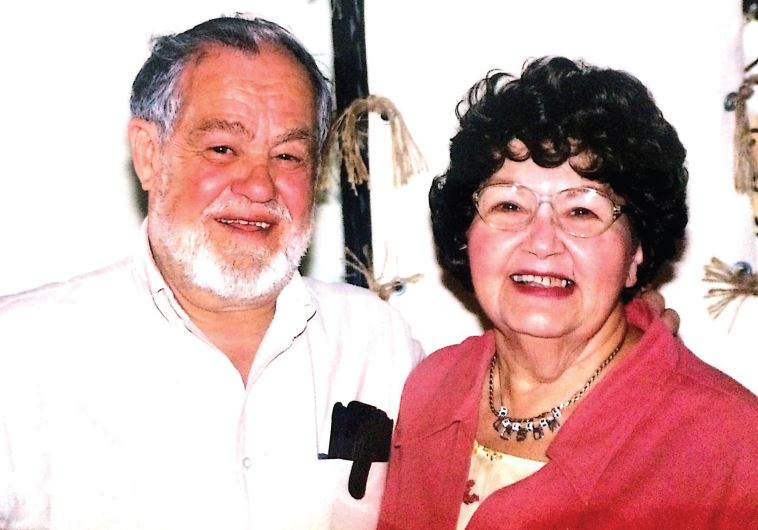 Mark Jacobi with his wife, Arlene