
Hamas will not lay down its arms unless Israel returns to the pre-1967 borders, including Jerusalem, senior Hamas leader Osama Hamdan told Norwegian state broadcaster NRK on Monday.
Hamdan met with presenter Yama Wolasmal in a secret location in Istanbul. This is the second interview Hamdan has given to the channel since the October 7, 2023, massacre carried out by Hamas; the first was on November 16 that year in Beirut.
A significant part of the interview was dedicated to the future of Gaza and phase two of the Trump deal.
Hamdan told NRK that he was not enthusiastic about the plan, saying “it will not give Palestinians freedom” and that “any future of Palestinians must be based on self-determination and end of occupation.”
When asked what part Hamas plans on playing in Gaza’s future, Hamdan said, “We are an important part of the Palestinian people. We still have the support of the Palestinian people.”
He said that while Hamas was willing to hand over political power to Trump’s technocratic committee during phase two, the terror group was not going to disarm.
This is despite the fact that phase two mandates that Hamas disarm voluntarily or face being disarmed by force.
“Hamas did not create the resistance to the occupation, the occupation did,” Hamdan said.
“We will not disarm without an end to the occupation forever, Israel returning to pre-67 borders, including Jerusalem; and the right of return to Palestinians.”
Wolasmal did not significantly push back on this answer.
Hamas remains 'proud' of October 7
Despite two years of war, Hamdan said Hamas remained proud of October 7.
“I’m proud that we’re continuing to resist after 75 years of occupation,” he said.
Interestingly, he said one of the achievements of Hamas was the international isolation of Israel, something he admitted had been part of the strategic planning for October 7.
“The first achievement is that Israel has been isolated. The international community thinks that Israel is not just an occupier but a state that commits genocide,” he told NRK.
“The second achievement is that we have shown that this state, even if they commit genocide, is not as strong as they are claiming.”
Wolasmal pointed out that Gaza was also in ruins and Hamas, too, was isolated internationally and kept out of negotiations.
Hamdan dismissed this, saying that no price could be put on “freedom.”
“We have done our best to stop the war. Every time, the Israelis have avoided a deal.”
He maintained that all suffering – both Palestinian and Israeli – was Israel’s responsibility.
When asked why a Palestinian widow with four children living under a tarpaulin on the beach should support Hamas, given that her suffering was prompted by October 7, Hamdan said “because she understands that her husband was killed by the Israelis. Her house was destroyed by the Israelis. Their suffering was brought on by the Israelis. They understand that 75,000 Palestinians were killed by the Israelis.”
Hamdan denied that Hamas killed any civilians on October 7, saying, “We didn’t kill civilians. It was something the Israelis claimed but was later dismissed.”
Despite Wolasmal’s mention of Al-Qassam Brigades’ videos of the Supernova festival massacre, Hamdan maintained that “they were not our soldiers, it was Israeli forces who attacked the festival.”
Wolasmal did push back on this, saying, “I find this very astonishing. Who were these people if not your fighters?”
Hamdan did not budge, responding that “Israelis made up a story to justify killing 75,000 Palestinians.”
The Hamas leader also continued to claim that Hamas legitimately represents the Palestinian people.
“I believe that legitimacy is based on elections,” he said.
Wolasmal pointed out that the last elections in Gaza were in 2006, but Hamdan said that Hamas doesn’t need to hold elections, given that they had them in 2006 and won.
He also denied that Palestinians are afraid to express criticism of Hamas, telling Wolasmal: “Anyone can criticize Hamas. I challenge anyone to say that they are refused [the right] to criticize Hamas.”
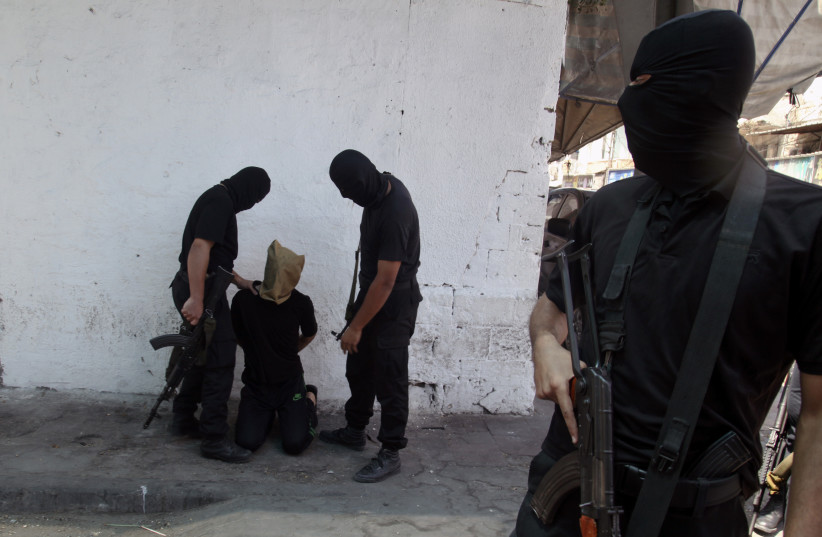
Nevertheless, he admitted to the multiple extrajudicial killings of Gazan civilians that Hamas claimed were part of Israeli-backed militias.
“This is justified under the law, as they were traitors who supported the occupying power in their own country. This is the result of betraying your own people.”
Wolasmal probed this, pointing out that many were executed by firing squad less than 48 hours after their capture.
“Field trial for traitors is legal under Palestinian law,” Hamdan said.
Platforming Hamas
Wolasmal’s interviewing style with Hamdan was strikingly different from the way he interviewed Israeli figures such as government spokesperson David Mencer and Knesset member Boaz Bismuth. Wolasmal’s approach in these two cases was considered by many to be overtly pugnacious. Bismuth later called him a disgrace and an antisemitic journalist and accused him of defending evil.
While Wolasmal did push back on some of Hamdan’s assertions, he moved on from others without comment.
Israel’s embassy in Norway condemned NRK for giving Hamdan a platform to “spread propaganda and cynically deny its own atrocities to the Norwegian public.”
It raised the hypocrisy of Hamas denying its actions on October 7 while simultaneously telling its own people of its intentions to commit the same horrors again.
“Rather than ‘challenging’ the Hamas spokesperson, as NRK claims to do, perhaps the broadcaster should focus on the stories of thousands of Israeli civilians who were murdered, wounded, and kidnapped by Hamas terrorists,” the embassy said.
Norwegian Jewish community leader Ester Nafstad told The Jerusalem Post that she found the interview “shocking,” not because NRK spoke to a Hamas leader, but “because Osama Hamdan was given a platform to repeat claims that are demonstrably false and deeply inflammatory, with very little real pushback.”

This included, as mentioned, framing October 7 as a legitimate “resistance operation,” denying that Hamas killed Israeli civilians, and claiming that Israel killed its own people and fabricated the attack to justify the Israel-Hamas War.
“These aren’t just his perspective, they are core elements of Hamas propaganda,” Nafstad added. “What really worries me is that these exact claims are already circulating widely here in Norway. I’ve personally encountered them in conversations with pro-Palestinian activists and in public debate.”
“So the effect of the interview isn’t just to ‘hear the other side.’ It risks normalizing narratives that deny documented atrocities and recast a mass attack on civilians as fiction.”
“I keep coming back to the question: ‘How does NRK think this contributes constructively to public understanding of the war?’ Without clear fact-checking or contextual framing, it feels less like critical journalism and more like amplification.”