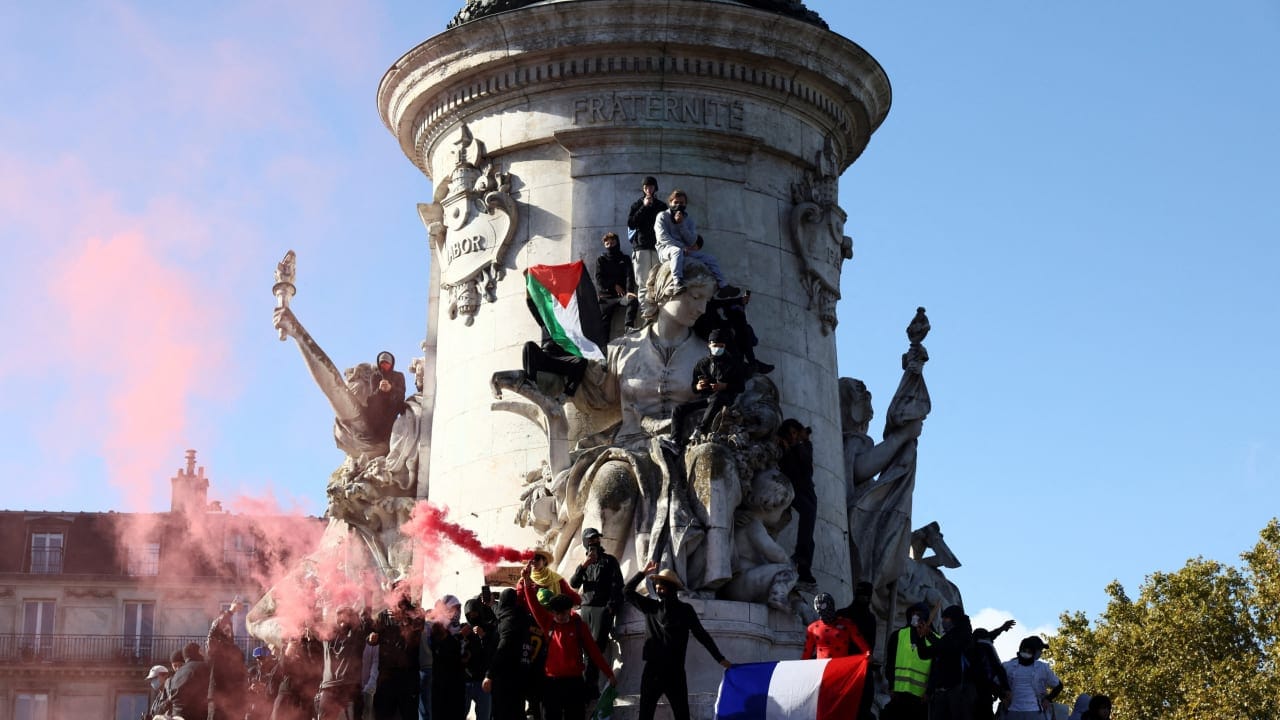
France was warned! For years, its government documented Islamist networks building influence through institutions, foreign funding and alliances with the radical left. The United States is witnessing comparable developments.
In May 2025, the French government published a landmark report on the Muslim Brotherhood and political Islam. Its central warning was not about terrorism. It was about something quieter, more systematic and potentially more enduring: entryism, the infiltration of established institutions to steer them toward one’s own political goals.
The government's most important warning concerned what it called “municipal Islamism.” Although the Brotherhood's core membership was relatively small, its surrounding networks were capable of influencing public life from the bottom up.
The danger was not an imminent Islamist takeover of France, but the gradual development of parallel institutions and political identities that could weaken the country's national cohesion.
The report also traced Brotherhood-linked religious and educational projects to financing from Qatar and other Gulf states.
The Islamists were also finding political allies.
A subsequent French parliamentary inquiry documented ideological and political convergence between Islamist-oriented organizations and the French left. It found that “most movements or parties of the left” could develop activist partnerships with Islamist movements.
This was the red-green alliance in practice.
Islamists and revolutionary socialists have fundamentally different visions of society. Yet they cooperate around a common political vocabulary: anti-colonialism, anti-imperialism, anti-capitalism, hostility to the police, antisemitism and disapproval of the State of Israel, and opposition to Western power.
The contradiction is striking. Activists who champion individual freedoms, women's rights and religious pluralism align with Islamist movements whose ideologies reject those principles.
In October 2026, this alliance took to the streets. Protests that began with high school students demanding more teachers and safer classrooms grew into a broader “convergence of struggles” over living costs and fuel prices, drawing in labor unions, Islamist groups, and immigrant communities.
On October 17, the demonstrations escalated into some of the country’s worst riots in decades, with businesses looted, public buildings torched, vehicles set ablaze, and police officers attacked. Nearly 2,400 people were arrested.
In Paris, a synagogue was vandalized; in Marseille, Jewish-owned shops were burned. Palestinian flags and anti-Israel slogans appeared alongside the student and labor demands; the same convergence French investigators had linked to Islamist-oriented groups and parts of the left.
What French investigators described in 2025 as Islamist entryism had been outlined as a goal by a Brotherhood figure in America 35 years earlier.
In 1991, Muslim Brotherhood figure Mohamed Akram authored an internal memorandum describing a “Civilization-Jihadist Process” aimed at transforming American society from within. The memo, later entered into evidence in the Holy Land Foundation terrorism-financing trial, described the Brotherhood’s work in America as “a kind of grand Jihad in eliminating and destroying the Western civilization from within.”
Foreign financing offers another parallel. Funding for the headquarters of the Islamic Society of North America, named in the 1991 memorandum, reportedly came partly from Qatar's emir and Brotherhood spiritual leader Yusuf al-Qaradawi, according to a 2009 Hudson Institute study by researcher Steven Merley.
Islamist-oriented organizations have joined forces with revolutionary-left groups, including the ANSWER Coalition, The People's Forum and Democratic Socialists of America (DSA), in protests and political campaigns that rally around the same causes as in France.
As France's warning about municipal Islamism demonstrated, institutional influence also enters electoral politics. On November 3, Michigan elected Abdul El-Sayed to the U.S. Senate.
El-Sayed served as vice president of the University of Michigan Muslim Students Association; his father-in-law, Tayeb Jukaku, sits on ISNA’s Founders Committee (listed as an unindicted co-conspirator in the Holy Land Foundation case) and donated heavily to a supporting super PAC, giving $300,000 by mid-2026. Both organizations were named in the 1991 memorandum.
El-Sayed was not alone. On November 3, a record number of candidates backed by the DSA won seats in the House. At least five new DSA members will join Reps. Alexandria Ocasio-Cortez, Ilhan Omar, and Rashida Tlaib in what DSA calls the largest bloc of socialists in congressional history.
Several bring the red-green convergence with them. Darializa Avila Chevalier, elected in New York’s 13th District, helped organize Columbia’s 2024 encampment, according to the ADL.
Melat Kiros, elected to Congress from Denver, called the October 7 massacre the “inevitable consequence of apartheid.” In New York, Aber Kawas, a DSA-endorsed former intern at the Council on American-Islamic Relations, won a state Senate seat after expressing solidarity with a man who pleaded guilty in a plot to bomb a Manhattan synagogue.
America now has its own version: an organized socialist bloc inside a new Democratic majority.
In France, elected officials marched alongside Urgence Palestine and lent its slogans legitimacy. In Washington, the new bloc can do the same from inside Congress: recasting terrorism as resistance, opposing aid to Israel and challenging the police whenever protests turn violent. When lawmakers share a movement’s vocabulary, the line between protest and confrontation becomes harder to hold.
The bloc remains small, and most of its members won safely Democratic districts. But France shows that radical movements do not need majorities to destabilize a country. They need allies in power. On November 3, they gained more of them.
There is nothing wrong with demanding better schools, affordable living or accountable government, and in a free society people have every right to protest. But there is a fundamental difference between demanding that a country live up to its ideals and demanding that it be dismantled.
Martin Luther King Jr. understood that distinction. He appealed to America’s founding promises and demanded that the country honor them. The movements now converging in France and America reject those foundations.
That is the difference between reform and revolution: one seeks to build a better America, the other to replace it.
America has received its warnings. It must confront them before the divisions that have shaken France erupt on American streets.
A free society cannot survive if those who wish to destroy it are the only ones willing to fight for its future.
Adam Milstein, an Israeli-American “Strategic Venture Philanthropist.” He can be reached at adam@milsteinff.org, on Twitter @AdamMilstein, and on Facebook www.facebook.com/AdamMilsteinCP.