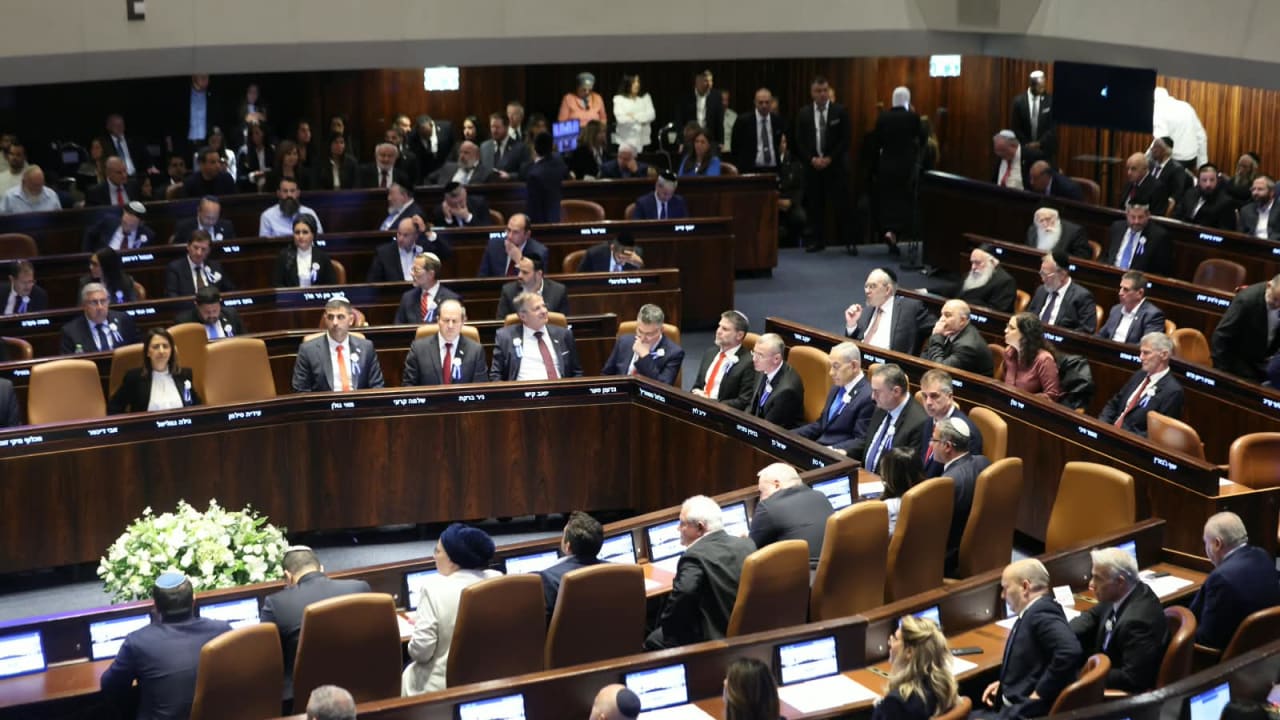
Both religious Jews and West Bank inhabitants were disproportionately represented in the 26th Knesset, according to a breakdown of the newly sworn-in members conducted by the "Choosing Wisely" project on Tuesday.
Out of 101 Jewish Knesset members, 27 were religious (26.7%), compared to only 12.4% of religious Jews over the age of 20 nationwide.
When it came to representatives from the West Bank region, the difference was even more egregious: 13.3% of the Knesset lives in the West Bank (16 members), while only 5.1% of Israel's population lives there.
Choosing Wisely also found that the majority of the new Knesset members skewed older, with the average age being 53.3 and only 12 members (10%) being below the age of 40.
Less than one-third of the new Knesset members are women (33 members, 27.5%). Nearly all of them (32 members, 97%) possess an academic degree, with the majority (26 members, 79%) also possessing a master's degree or doctorate. This is in stark contrast to the male Knesset members, of whom only 74% (64 members) possess an academic degree, and fewer than half (41 members, 47%) possess a master's degree or doctorate.

While men and women were equal when it came to having served in the IDF (74% and 73% respectively), male Knesset members served in combat roles at far higher rates, with only a single woman noted as having done so, compared to 37 men.
Record number of women sworn in to Knesset
A record number of female MKs were sworn in to the Knesset, the 5050 Initiative announced, citing data from the "Choosing Wisely" project.
The announcement comes after the initiative's CEO, Yael Yechieli, sent a letter to party leaders and President Isaac Herzog, in which she demanded equal participation in meetings between party leaders, the drafting of coalition agreements and government guidelines, and the allocation of ministerial portfolios and areas of responsibility.
According to the 5050 Initiative, which operates under the Centers for Social Justice, 21 of the total 33 female MKs are members of parties with equal representation between men and women, including Yashar, B'Yachad, and the Democrats.
In contrast, Likud, the Joint List, Yisrael Beytenu, Otzma Yehudit, the Religious Zionist Party (RZP), and Ra'am each have fewer than five women in their parties.
Jerusalem Post Staff contributed to this report.