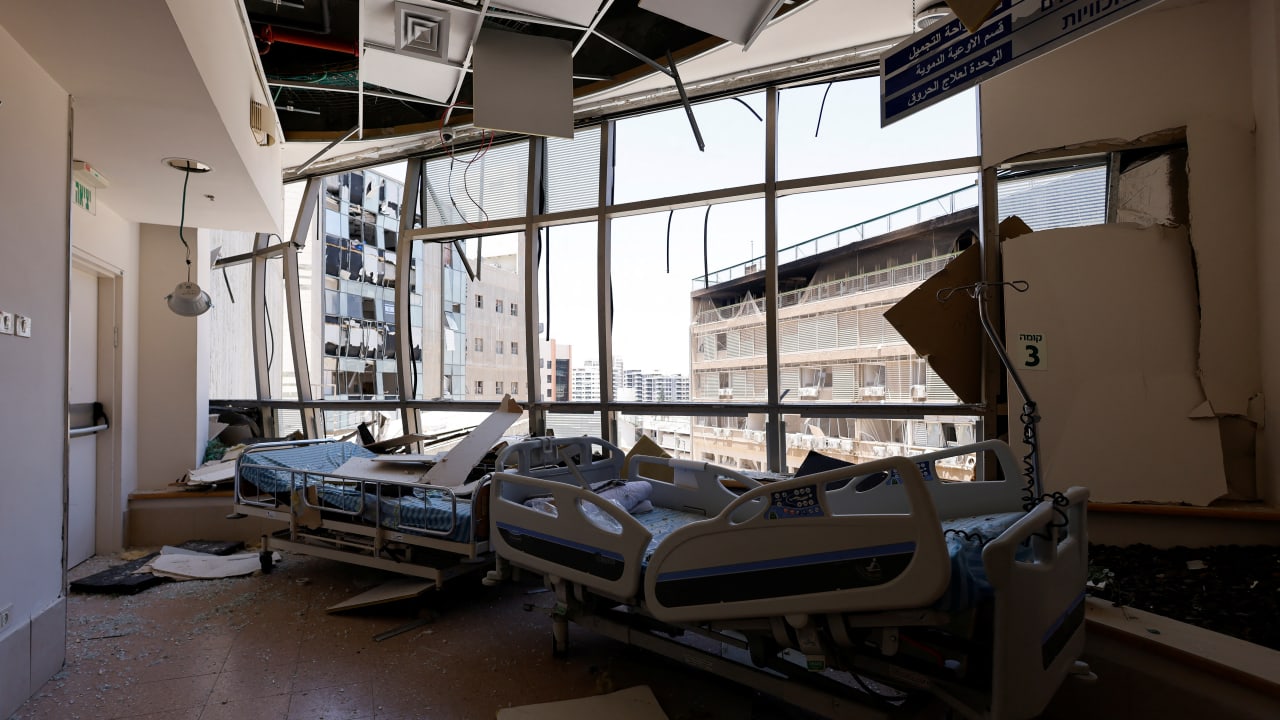
Soroka Medical Center was seriously damaged by a direct hit from an Iranian ballistic missile on Thursday in an unprecedented attack on the country’s healthcare system.
There were only very minor injuries and anxiety attacks, as the old surgical building that suffered the most damage was evacuated on Wednesday.
Soroka management called on the public not to come to the hospital except for urgent and life-saving medical cases. They are ready to receive women for births, but at this stage, asked that, preferably, they contact other hospitals.
The medical center’s management, together with Health Ministry officials, the Home Front Command, and security personnel, worked in full cooperation to manage the incident and maintain safety, the ministry said.

The hospital after the attack
The number of inpatients has been drastically reduced, and under instructions from the Health Ministry, several medical centers around the country, including Samson Assuta Ashdod University Hospital, Kaplan Medical Center in Rehovot, Tel Aviv’s Sourasky Medical Center, and the two Hadassah-University Medical Centers in Jerusalem, are accepting evacuated patients.
Soroka, – the only teaching hospital in the South, which serves as a catchment area of a million Israelis – is currently closed to receiving patients, except for life-saving cases.
In cooperation with the Home Front Command, a scan of all buildings was carried out, including the affected operating rooms.
The Environmental Protection Ministry denied reports of a suspected leak of hazardous materials at Soroka. Its Southern District units rushed to the area to conduct monitoring and measurements on the hospital grounds, which ruled out the leak of hazardous materials and the risk to the population.
Prof. A. Mark Clarfield, emeritus professor of geriatrics and director of Ben-Gurion University’s Center of Global Health, who worked at Soroka for 25 years, told The Jerusalem Post that he didn’t know if Iran intentionally aimed at the hospital, but they are clearly targeting civilian populations.
“Attacking hospitals is in violation of international law, but that is on condition that there are no military resources under it. We must not drop bombs on Iranian hospitals, but this is only if they are free of military resources.
Response to the Soroka Medical Center hit
“I can attest to the fact that there are no such weapons under Soroka, but there has been clear evidence that terrorists and weapons have been under all the hospitals in Gaza, which is why the Israel Air Force attacked them. There are also no military bases close to Beersheba.”
Clarfield added that Soroka is “a very good hospital. This is amazing, given its location in the periphery in a city with a low tax base and relatively low socioeconomic level. It’s a miraculous vision in the desert.”
He explained that it’s hard for hospitals in the periphery to compete with those in the center of the country.
“Medical staff want to live where there’s a higher standard of living, so it’s hard to get good people. Soroka is owned by Clalit Healthcare Services, the largest public health fund, but it’s the job of the Health Ministry, and not the insurers, to provide incentives to work in the periphery.”
Naftali Kober, director of volunteer organization Ezer Mizion’s Southern District, told the Post that “since the announcement of the damage to Soroka, dozens of volunteers from the Ezer Mizion association have been working there in cooperation with the hospital in all departments, with an emphasis on the oncology departments.
“We are accompanying and assisting patients, some of whom need special help following the damage. Our volunteers are transferring patients within the hospital and to other medical centers, putting out a fleet of ambulances available to assist in the possible evacuation of patients to other locations.”
Kober added that the organization will provide cooked meals to hospital visitors in addition to Ezer Mizion’s cafeterias now operating at the hospital.
The medical center suffered terrible damage, he continued.
“There is a lot of broken glass, missing acoustic panels, and damage to medical equipment. At 7:10 a.m., I got a phone call, and we rushed over. We have 60 volunteers in the hospital all year round, every day. When something happens, we are called by doctors and patients. We are in close personal contact [with them].”
Israel Medical Association chairman Prof. Zion Hagay declared that “the eyes of the whole world should be on Soroka this morning so as to understand what a war crime really looks like.”
“I send encouragement and hugs to all our friends in Soroka who are working day and night, and I wish a speedy recovery to all the wounded and in all the arenas. I call on the international medical community to strongly condemn this horrific act by Iran.”