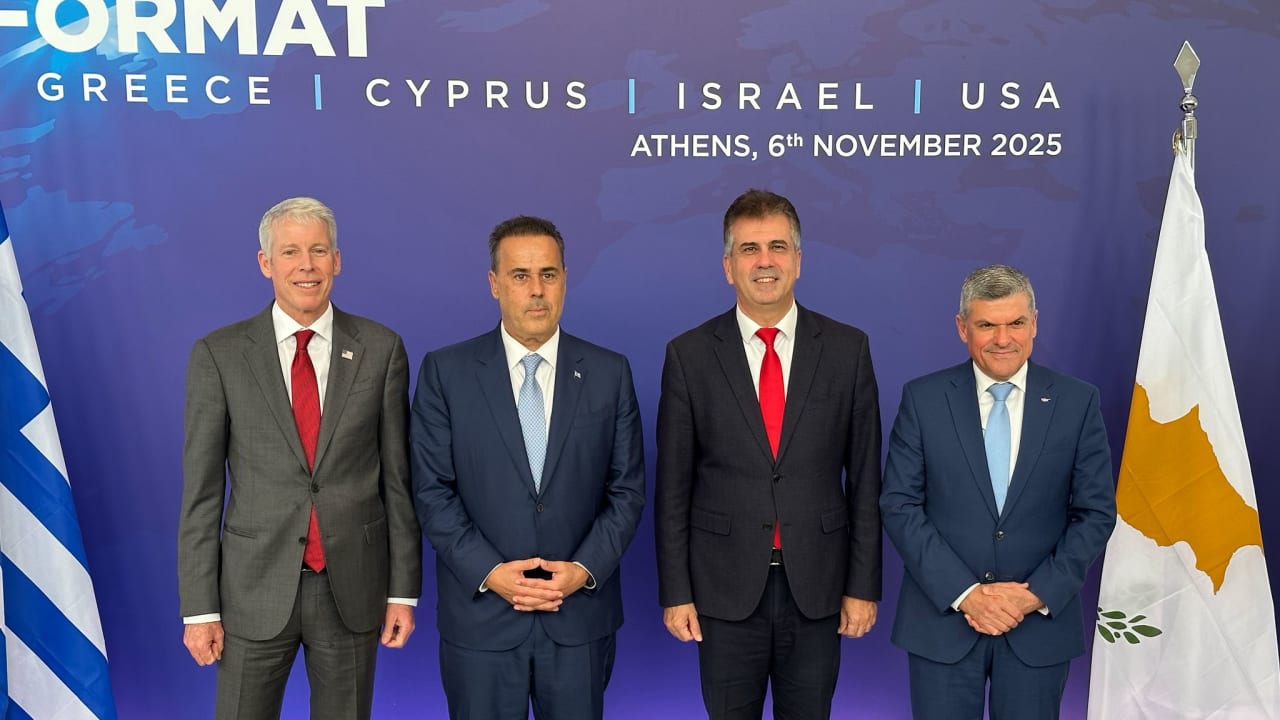
The idea of laying a gas pipeline from Israel’s offshore reservoirs to Europe is back on the agenda, Energy and Infrastructure Minister Eli Cohen said Thursday.
“There has been very significant progress on the possibility of building a gas pipeline,” he told The Jerusalem Post after meeting with energy ministers from Greece, Cyprus, and the United States in Athens. “This is an idea that was discussed in the past, and now it’s back in play. The Americans are now willing to take on a major role.”
The possibility of constructing a pipeline to move gas from Israel’s offshore fields through Cyprus and Greece has surfaced several times in recent years, but it was shelved due to its high costs or because of the technical challenges.
For the Trump administration, however, energy is considered a matter of national security, which gives a boost to the project’s feasibility, Cohen said.
“The goal is to build an infrastructure corridor that provides an alternative to the Russian energy route and bypasses the Houthis as well,” he said. “For the Europeans, the goal is, of course, to reduce prices.”

Earlier, Cohen met with US Energy Secretary Chris Wright, Greek Energy Minister Theodoros Skylakakis, and Cypriot Energy Minister George Papanastasiou. US Interior Secretary Doug Burgum, a close ally of Trump, also participated.
Some nations were excluded from the project
Not everyone welcomed the initiative. Turkish President Recep Tayyip Erdogan, who wishes to be involved in any Mediterranean gas pipeline project, was excluded, as Israel, Greece, and Cyprus have no interest in Turkish participation.
“The war in Gaza is over, and the goal now is to expand the Abraham Accords, so this is an important step,” Cohen told the Post. “There’s the IMEC infrastructure corridor plan, proposed by both the Biden and Trump administrations, which is supposed to connect India to Europe. The main idea is to transport resources from Gulf countries such as Saudi Arabia and the UAE to Europe, from where energy is produced to where it’s needed.”
Last week, Wright canceled his planned visit to Israel because Prime Minister Benjamin Netanyahu and Cohen had refused to approve a gas export agreement with Egypt valued at $35 billion. Under the deal, Israel would export a total of 130 billion cubic meters of gas from the Leviathan field to Egypt by 2040.
“The Americans wanted us to sign the export agreement with Egypt, but we wanted to ensure both the security aspects and fair pricing,” Cohen said. “We insisted on receiving a fair market price for our gas.”
Israeli officials have said they also want to ensure that Egypt fully upholds its peace treaty obligations, especially amid reports of extensive military construction in Sinai and alleged violations of the ceasefire agreement by Cairo.
“After the Egyptians understood our determination, they are very eager to resolve the issue,” Cohen said. “I believe a solution will be found.”