
The government has failed to improve hospital security in the face of deadly aerial threats, the State Comptroller’s Office said on Tuesday.
Despite an Iranian ballistic missile striking Soroka Medical Center in Beersheba in June 2025, wounding over 80 people and wrecking eight operating rooms along with six research laboratories, adequate security measures were not then taken, State Comptroller Matanyahu Englman said.
“We must address the gaps in defending hospitals – the Iranian missile strike at Soroka should have caused the government to tremble,” Englman wrote.
The report is based on statistics from 27 of the country’s 52 hospitals, which hold 70% of the country’s medical beds. According to the report, 56% of hospital beds and 41% of surgical beds are completely unprotected from aerial attacks.
In raw numbers, that means 10,500 regular beds out of 18,900 are unprotected. It also means that 168 of 406 surgery beds are unprotected.
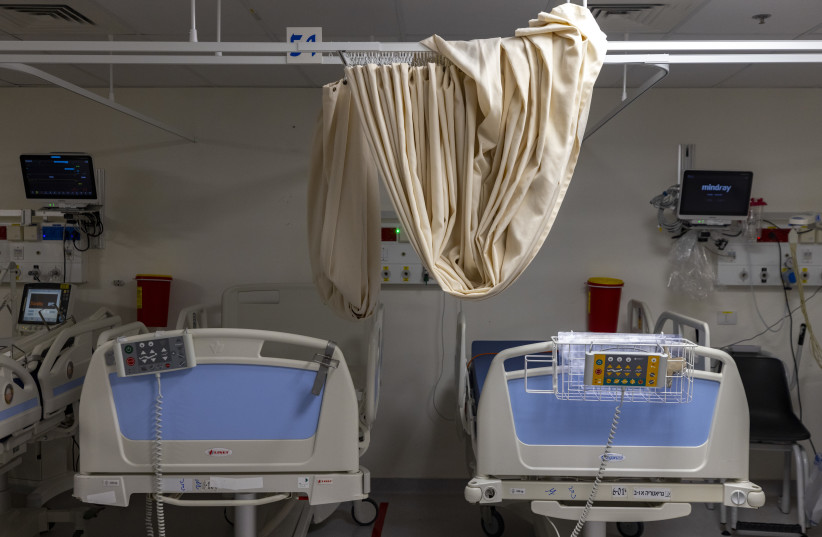
Some individual hospitals are in much worse shape. For example, 86% of the hospital beds in the Meir Medical Center in Kfar Saba are unprotected.
Comptroller: Hospitals face collapse in future aerial wars
In medical centers near the borders, 56% of catheterization rooms and vascular imaging rooms are unprotected from aerial threats.
Because of the unshielded hospital areas situation, during much of the war between 2023 and 2025, and especially during the intense missile fire from Iran in June 2025, many hospitals sent whole departments to underground garage areas.
However, many hospitals lack underground or protected garage areas, and even areas considered the best protected are not, in fact, viewed by security experts as providing sufficient basic protection.
The report said that due to the government continuing to downplay the issue, there is a real likelihood that in the event of future wars with aerial attacks, many hospitals will cease to be able to continue operating.
Englman added that the Israel-Hamas War and the June 2025 war with Iran, each war separately, proved that the entire country is now part of the battlefield, due to the proliferation of aerial threats.
He said this underscored the urgent need for much greater protection for hospitals, an issue the government has stunningly ignored even after the Soroka strike.
The report said that NIS 4.8 billion would be needed to bridge the gap of deficiencies in hospital protection.
However, only 10% of that was actually allocated to hospitals during the war, despite warnings the comptroller sent to the government starting in December 2023, the report stated.
Of the four categories on the spectrum of “from properly protected to property completely unprotected,” many areas that hospitals use in an emergency as “the most protected available space” are not remotely considered properly protected, but are just viewed as slightly better than nothing at all.
For example, this refers to spaces deeper within a hospital with more ceilings and walls between them and the hospital’s outer walls, as opposed to portions of a hospital that are closer to the outer walls.
Part of the issue, the report noted, is that more serious home front protection requirements were only endorsed in 2013, 2016, or later – meaning after many of the existing hospitals were already built.
Despite the new standards, the hospitals, the Health Ministry, the IDF Home Front Command, and the government have been slow to think through and implement changes that apply to existing hospitals, the report said.
In addition, Englman noted that newer buildings have nevertheless included rooms and areas with glass walls and windows that are easily damaged and can pose a hazard to people when they crack, and shards fly outward.
Regarding Soroka, the incident could have been much worse, but the hospital administration had ordered an evacuation the day before.
While this saved lives, it meant that the one million people Soroka is supposed to serve had no viable nearby hospital.
For several months afterward and even now, the South remains underserved because Soroka is still not fully repaired and operational.
There are also long-term concerns that Soroka is losing current staff and will likely lose future workers because it is not viewed as fully operational, and that fewer significant medical procedures are occurring there since the attack.
All of this shows that a hospital being struck and even the potential danger to those in the hospital when the public knows it is not adequately protected presents multiple levels of problems to the country.
The government was slow to provide funding to Soroka to repair the damage, with various public and private bodies competing to shift costs to others.
Only recently was the issue resolved, and also only recently did a project to build a new, more protected building for the hospital – projected to take at least six years – move forward.
To reduce the risk of mass-casualty events and build resilience in the medical sector, the comptroller suggested streamlining less complex medical services away from a small number of extensive facilities toward a larger number of smaller medical centers nationwide. In the event of war, fewer patients would be required to receive medical care in fewer large facilities.
All of this demonstrates the scope of the problem and the time, energy, and resources the government would need to address it effectively.
The Health Ministry responded by blaming a lack of cabinet funding for its inability to provide the necessary funds in a timely manner to address the safety issues flagged by the comptroller.
At the same time, the ministry said it had used its funds to address the situation as much as possible and thanked the comptroller for raising the issues publicly.
However, there was little sense from the ministry that it or the government had shifted gears on the issue since Soroka was hit in June 2025.
The IDF Home Front Command said the issue is the Health Ministry’s responsibility.