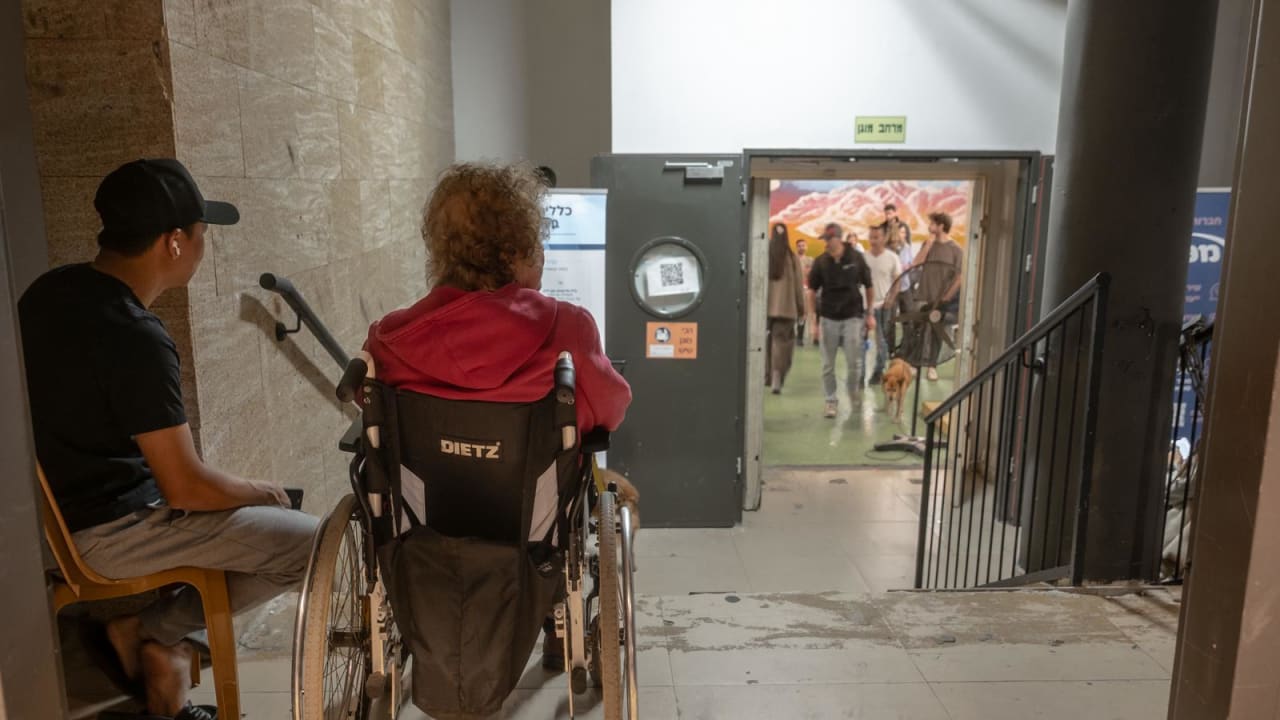
While the country has relied on urban renewal projects to ensure residents have access to protected spaces during missile attacks, a lack of investment in public shelters has forced some to seek refuge in unsafe parking garages or run for cover at the risk of their safety, people affected by the lack of shelter access told The Jerusalem Post on Thursday.
While Israel has required buildings since 1969 to include a communal shelter and, since 1993, to include safe rooms, the Israel Builders Contractors Association estimated that 56% of homes did not have a mamad as of 2024.
The Media Line also reported in 2023 that almost 28% of Israelis do not have a bomb shelter in their immediate vicinity.
Nataly Blenford made aliyah from London eight years ago and has enjoyed living in Tel Aviv’s Kerem Hateimanim, a largely Yemenite neighborhood established in 1906.
While Blenford is a fan of the community’s old charm, she said that it “famously has no bomb shelters.” She moved into her apartment in March last year, when she thought the war was “quietening down,” only a month before Operation Rising Lion.
Without access to a proper shelter, Blenford and many of her neighbors have taken cover in a car park during sirens. However, the structure is not designed to withstand a missile strike, particularly not the ballistic missiles Iran has launched at Israeli civilian areas over the past week.
“When I moved, I was aware that I didn’t have a shelter, but I was like, ‘Look, I’m relatively young and able-bodied. I will just go down the stairs and go wherever I need,” she said.
“However, since I moved here, there’s been two wars with Iran, which obviously has upped the stakes somewhat,” Blenford continued.

Beyond the safety concerns, the car park’s familiar faces cannot make up for the lack of basic features that make spending nights in a shelter bearable. It is not possible to leave mattresses, water, or food there, as residents often do in community shelters.
A day before Operation Roaring Lion, Blenford’s 79-year-old mother, Carol, flew to Israel to celebrate her birthday with her daughter. Less nimble than her daughter and with some mobility issues, the pair have spent part of the past week staying in hotels so Carol can reach a protected space in time.
The first hotel they stayed in closed as tourists were no longer able to reach Israel. At the second hotel, they were reunited with neighbors from Kerem Hateimanim during the first two days, who had also sought accommodation with shelter access.
The reunion was short-lived, as the cost of staying in a hotel indefinitely is something few people can afford, Blenford noted.
“People were throwing money at the situation and just thinking, ‘It might be a few days.’ Now, almost everybody’s back home, because how long can you stay in a hotel? You can’t cook there... It’s a very strange existence,” she said.
As a British tourist who has never experienced war, Carol told the Post that she did not worry when she heard the sirens. She got dressed, went to the bathroom, and was ready to go in “five minutes.”
Her daughter, noting that five minutes was still too long, added that helping her mother understand the urgency without causing additional stress has been difficult.
“The problem is, we don’t have five minutes. I sleep next to her so that I can explain to her we’ve got to go now, now, now, now, and she’ll say, ‘I need to go to the loo (bathroom).’”
“I say: ‘There’s no time.’ So it is stressful. Like, she is so sweet… but if there is a way to also explain that it’s hard on her... she’s 79, it’s bad for the stress,” Blenford said.
“We always come back from the shelter, [and] her breathing is out. It takes 20 minutes for it to regulate. And then I sit there, watching her breath, to make sure that it’s not what I call a ‘medical event,’ and it’s not, but it’s the stress. It’s highly, highly stressful.”
Urban renewal projects ignore public shelter options
Noting that her “humble neighborhood” has been the subject of urban renewal attempts, which Blenford described as “gentrification,” she said new shelters were not being built by the municipality because of an overreliance on the private sector.
“Sweet, little buildings are being torn down and rebuilt,” but “why is the [municipality] not insisting that in the basement of one of these buildings, the car park is a public shelter?” Blenford continued.
“Why isn’t the [municipality] buying one of these plots of land and building a massive public shelter, then putting a playground on top? Of course, it’s because ‘money rules the world or money rules the day,’” she said, indicating that such an approach is problematic when there is a crisis like the current war.
Tamarah Rosenberg lives in an apartment building in the old part of Jaffa, where a shortage of protected spaces is a feature of the city’s historic character.
As a 55-year-old New Yorker who moved to Israel only days after Hamas’s October 7 massacre, Rosenberg said she was used to long walks, though previously under very different circumstances.

Every time a siren goes off, she told the Post, “I have to go to my door through my courtyard, [go] out a gate downstairs, cross one street through a kind of square area of houses all around it, then cross another street, then walk a little bit through the neighborhood, until I get into this other square, where the shelter is.”
Knowing she needs to move quickly, Rosenberg said she no longer sleeps in her loft bed and instead rests on her couch, slightly closer to the door. The lack of sleep has left her feeling “foggy,” like being “borderline high without the fun of actually being high.”
In addition to the missiles, Rosenberg said crossing a busy road during sirens made her feel unsafe, as drivers panic and may fail to notice her. “So I worry about being hit by a car and making it in time,” she said.
On one occasion, Rosenberg used a now-famous shower app that indicates relatively safe time frames to take one, but she was caught off guard nevertheless by the siren and forced to run in her underwear and a top to the shelter, where someone handed her a scarf to cover herself.
Moreover, as a teacher, Rosenberg described how difficult it has been for her to witness the impact of the situation on her students. On Wednesday, she had to abruptly end an online lesson when a siren sounded.
“Walking to the shelter, I was more worried about my students being concerned for me and whether or not they knew what was happening. And I didn’t want them to think that I was hurt,” she recounted. “It actually kind of chokes me up to think that they might have thought that something had happened to me.”
Both Rosenberg and her daughter, who lives next door, have decided not to renew their leases despite loving their neighborhood. Rosenberg said having access to a protected space has now become a top priority for both of them.
Asked what she would like to see to better protect the public, Rosenberg said the cost of retrofitting buildings with shelters was too high and that requiring private residents’ consent often stalls the process. The government, she said, needs to take a more assertive role.
Despite her criticism of the broader system, Rosenberg said she found the bureaucratic process of organizing a mamad to be surprisingly accessible and available in multiple languages.