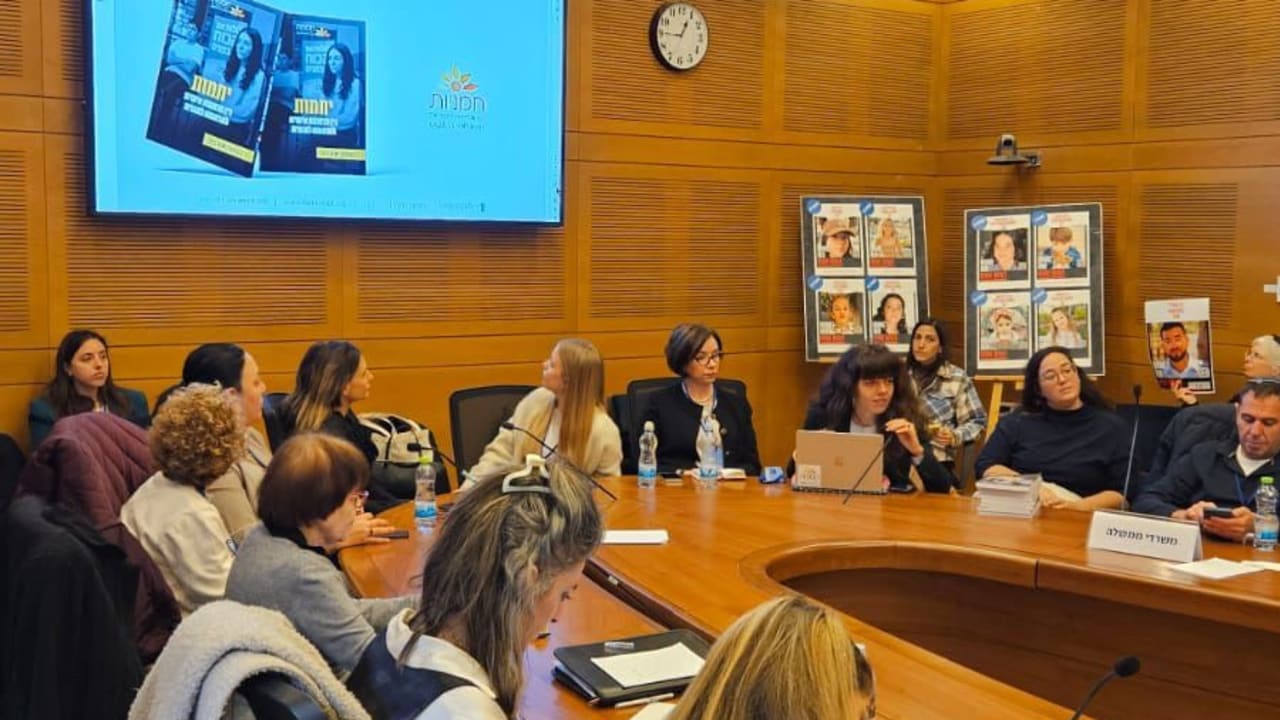
The Sunflowers annual report, presented last month at the Israeli Knesset, highlights concerning trends in the resilience of Israeli orphans, with 63% reporting mental health difficulties and 56% experiencing academic decline.
Sunflowers (Hamaniot), an organization supporting thousands of families of orphaned children across Israel, began operating immediately following the October 7 massacre, responding to the needs of children who became orphaned by the murders. Within a matter of weeks, the organization established emergency and trauma centers in cities directly affected. In recognition of its exceptional humanitarian work, Sunflowers has received awards and public recognition in Israel and internationally, including the Shimon Peres Award for Social Organizations, granted in partnership with the German government. The organization’s founder and CEO, Hadar Kess, was named Woman of the Year for 2025 by the Peres Center for Peace and Innovation and was included in Israel’s list of 40 most promising young leaders.
Last month, Sunflowers issued its Annual Orphanhood Report, reviewing the state of orphanhood in Israel in 2025. The report, based on survey data collected from hundreds of orphans and led by senior researchers and professors from Israeli academia, was presented during a special discussion at the Knesset, attended by ministers and members of Knesset. At the same time, the organization launched a large-scale public awareness campaign featuring prominent public figures and leading artists, aimed at raising awareness of orphanhood and its far-reaching consequences.
The research findings presented in the report point to a severe deterioration in the situation of orphaned children since the outbreak of the war. 44% of parents reported a worsening in their children’s emotional state, with 63% indicated an escalation in emotional difficulties and 49% noted significant psychological distress. The impact is also evident in the education system: 56% of parents reported a decline in their children’s academic achievement, and 46% reported impaired functioning in educational settings since the beginning of the war. Despite the scale of the distress, 43% of children who are experiencing significant emotional difficulties are not receiving emotional or psychological treatment, a figure that highlights a serious gap between existing needs and the support currently available.
Among widowed parents, a continued deterioration in emotional and functional well-being has also been observed as a result of the war. 77% reported ongoing emotional distress that has intensified against the backdrop of the conflict, and 62% noted a worsening in their mental or psychological condition since the war broke out. At the same time, the war has exacerbated difficulties in daily and economic functioning: 68% reported impaired occupational functioning, 58% reported increased daily burden and functional difficulties, and 59% reported worsening sleep disturbances during the war. These findings point to a cumulative and ongoing strain that undermines parents’ ability to serve as a stable anchor for their children during a period marked by uncertainty and prolonged trauma.

Amor Assoulin, an eleventh-grade student from Rishon LeZion and a participant in Sunflowers programs, lost her father, Lior Assoulin, in the October 7 massacre. “On his 43rd birthday, on October 6, my dad went out to celebrate with friends, continued to the party in Re’im, and since that moment, our family’s life changed in an instant. The moment we were told he had been murdered, I understood that our lives would never be the same again,” she says, describing a life that continues in the shadow of loss. “I cling to life, choose it every day anew, and try to follow my father’s path, a man who knew how to laugh at everything. But the situation in the country does not make it easier for me, or for my family, to move forward.”
Amor speaks of the close bond she shared with her father, who was both a parental figure and a close friend. “When things were hard for me at school, when I was bullied or felt alone, my dad was always there. A short phone call, a kind word, a joke. He made sure I would never feel alone.” She describes returning to routine as a daily struggle. “I went back to school, I was a new girl in a new place, without a father, without support. Even when people ask if everything is okay, it is clear that nothing can truly be okay.” Alongside her personal coping, she watches her mother struggle to secure basic rights. “Instead of just being a mother, she has to deal with bureaucracy, go to the Knesset, and fight so that we receive what we are entitled to.”
According to Amor, Sunflowers has become her safety net. “There, you do not need to explain what it means to lose a parent. Everyone understands. Today, I also want to be there for orphans younger than me, so that no one will feel alone the way I once did.”

Hadar Kess, founder and CEO of Sunflowers, told us: “Amor’s story is one of many, and it brings to life the data presented in the Orphanhood Report. Behind every statistic and every figure stands a child, an orphan, trying to choose life within a reality of loss, war, and uncertainty. We are waiting for the State of Israel to truly choose to be there for them, and until that happens, we will continue to do so ourselves. This is the responsibility of all of us, Israelis and Jews of the Diaspora alike. We are one people, one family, with one shared obligation, to care for those who paid with their lives so that we may live in security anywhere in the world.”