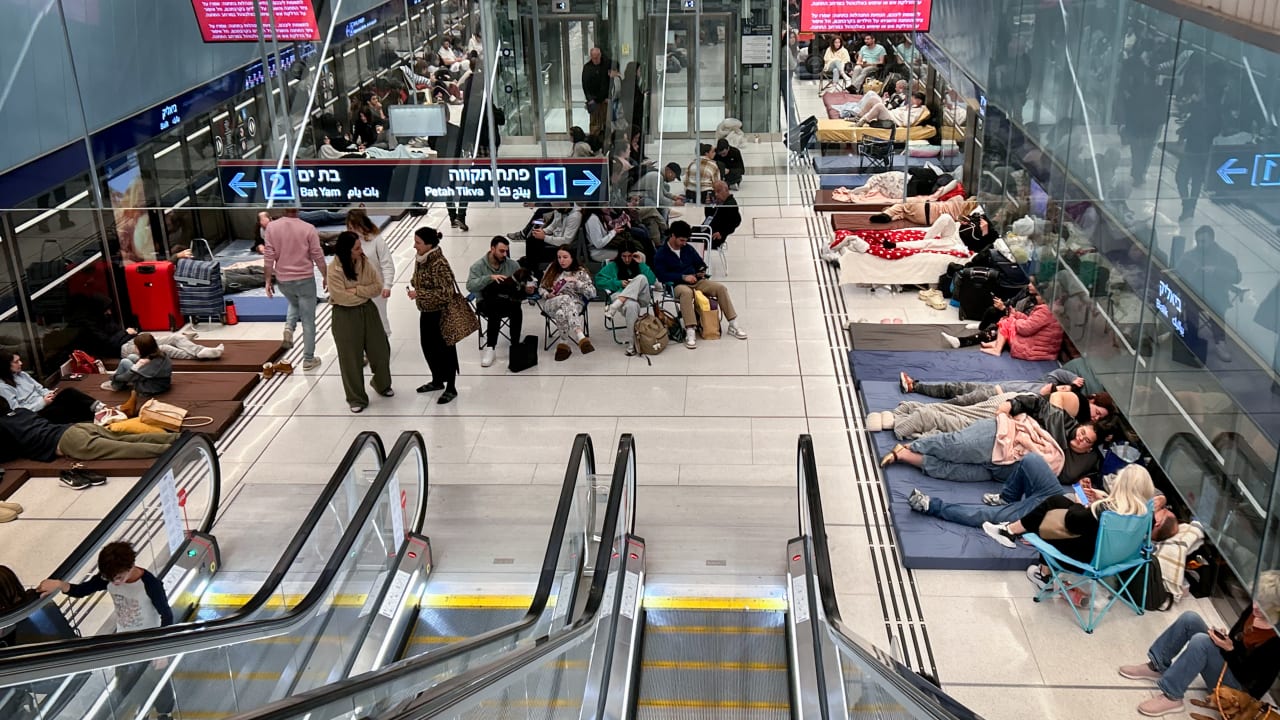
As Iran’s missile barrages sent sirens slicing across Israel this weekend – and as emergency responders once again reported injuries sustained while residents ran for cover – a State Comptroller audit published in January feels less like a backward-looking review and more like a still-unfolding diagnosis.
The pattern is familiar by now: sirens, a scramble for shelter, injuries on stairwells and sidewalks, and a direct hit somewhere that punctures the illusion of full interception. In the latest wave, emergency services treated dozens, many hurt on the way to protected spaces.
None of this was unforeseeable. In January, State Comptroller Matanyahu Englman concluded that Israel’s civilian authorities had entered October 7 and the months that followed without the structural readiness required to protect residents, maintain essential services, and deliver timely relief. The audit, the ninth in his series on wartime failures, argued that the gaps exposed after the Hamas attack were not born that morning. They were years in the making.
The most sobering finding remains the simplest: As of January 2025, roughly 3.2 million Israelis, about a third of the population, lacked access to standard protective spaces. Under missile fire, that statistic stops being abstract. It means that when the siren sounds, a significant share of the country is still left to improvise.
Responsibility for that gap is diffuse. Homeowners are tasked with maintaining private shelters. Municipalities oversee public ones. The Home Front Command sets standards but does not control local budgets. The comptroller described a system in which national planning stalled, and municipal implementation drifted. A second phase of a nationwide protection program was frozen years ago, leaving local authorities without a funded, binding framework to close the gaps.

In addition, the consequences are not evenly distributed.
In Bedouin communities in the Negev, the audit found, standard shelters were effectively nonexistent before the Israel-Hamas War, with only partial temporary solutions introduced afterward. That disparity is not incidental; it is embedded in how protection has been financed and enforced.
Education gaps leave hundreds of thousands of students at risk
The same structural weaknesses ripple outward. In education, protection gaps become continuity gaps.
As of March 2024, more than 466,000 students were attending schools without standard protective infrastructure. Even in buildings that technically have protected spaces, warning-time realities complicate the picture. In close to 40 percent of schools sampled, not all students could reach protected areas within the allotted time because the spaces were too small, too distant, or accessible only through narrow corridors and stairwells.
Under the sirens of the past two days, “warning time” is not a bureaucratic term. It is a margin between impact and safety. And the comptroller’s point is that the state has tolerated a system in which that margin is structurally insufficient in too many places.
Hospitals present a more sobering layer.
Missile defense systems reduce risk, but they do not eliminate it. The question then becomes whether critical medical infrastructure can function under sustained fire. According to 2024 data cited in the audit, more than half of general hospitalization beds in Israel’s 27 general hospitals were unprotected. So were roughly 41% of operating rooms and 43% of ICU beds.
In past escalations, hospitals improvised by shifting wards, relocating services, and leaning on private facilities. But those workarounds were never fully institutionalized into a permanent, regulated model. They remain contingent solutions in a system that still lacks comprehensive fortification.
Economic relief tells a similar story. Compensation did arrive – billions of shekels flowed through the system – but the audit found it moved via temporary legislative arrangements rather than standing rules. In one case, 92 days passed before the legal mechanism enabling indirect-damage claims took effect. Appeals lasted an average of 851 days. As well, the comptroller identified over NIS 3 billion in excess payments, much of it still unrecovered.
Taken together, the audits outline a civilian front sustained less by durable national planning and more by patchwork adaptation: municipalities stretching budgets, hospitals rearranging wards, schools compressing schedules, and businesses waiting for regulatory fixes to catch up with reality.
The comptroller’s recommendations were clear: binding multi-year protection programs, enforced shelter inspections, accelerated fortification of schools, and permanent statutory compensation frameworks.
What the time that has passed since Saturday morning underscores is not simply that implementation is incomplete but also that the gap between policy and practice becomes visible only when sirens return.
Israel’s home front has normalized living under intermittent fire, but normalization does not equal preparedness, and as long as structural vulnerabilities remain embedded in protection, education, healthcare, and compensation systems, each renewed barrage will continue to expose the same unresolved fault lines.