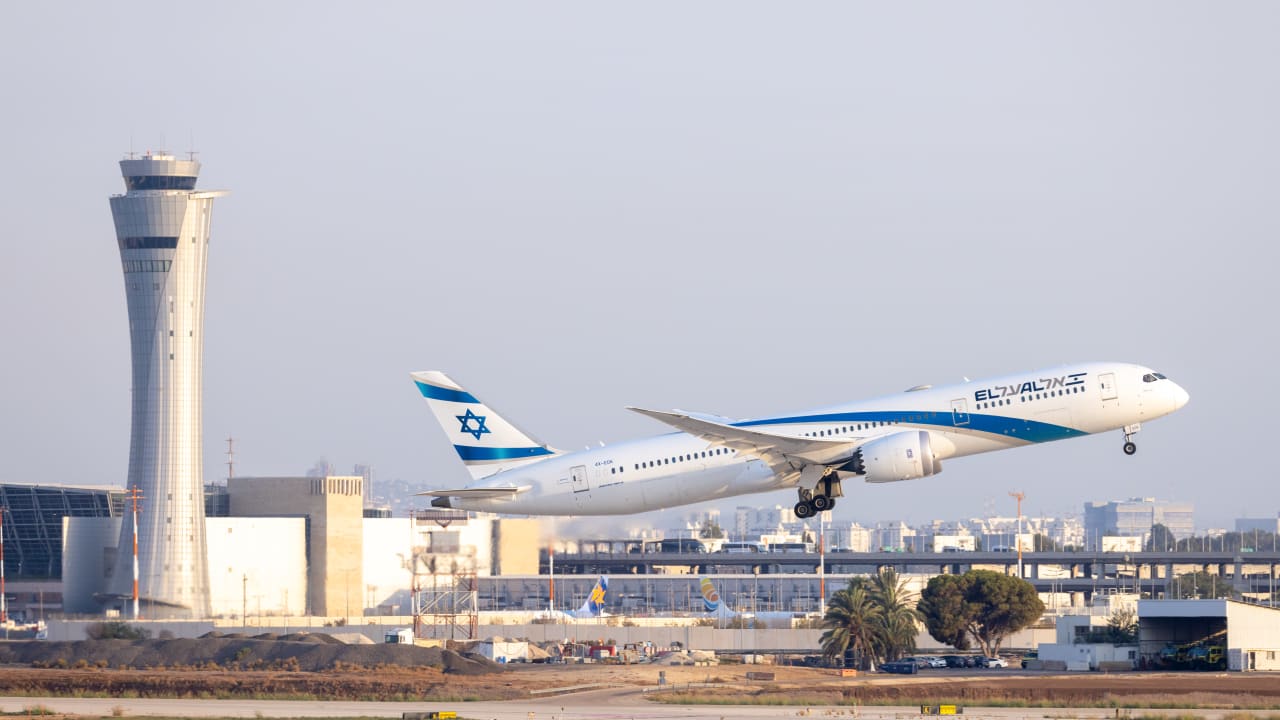
Israeli industry groups urged aviation and security authorities on Tuesday to reserve part of the limited outbound flight capacity at Ben-Gurion Airport for business delegations, warning that the wartime restrictions are disrupting exports, investment ties, and the ability of Israeli companies to operate normally in global markets.
Recent wartime rules have sharply limited departures from Ben-Gurion, with authorities allowing only one outbound flight per hour and capping many departing flights at 50 passengers.
In a formal letter sent to the head of the Home Front Command, the director-general of the Civil Aviation Authority, the Israel Airports Authority, and El Al CEO Dina Ben Tal Ganancia, the Manufacturers Association of Israel, and the Israel Export Institute called for a dedicated mechanism that would set aside some outbound seats specifically for business travelers.
The letter was signed by Israel Export Institute chairman Avi Balashnikov and Manufacturers Association of Israel president Avraham (Novo) Novogrocki. The Export Institute lists Balashnikov as chairman of the board, while the Manufacturers Association’s official English-language site lists Novogrocki as its president.
According to the two organizations, many Israeli business owners and executives have been unable to secure seats on international flights because of the restrictions imposed since the outbreak of the war. They argued that the business sector should be formally recognized as essential, saying the current situation threatens serious damage to Israeli firms that depend on overseas clients, suppliers, investors, and partners.

“The Israeli economy is deeply anchored in international business ties, from exports and investment flows to supply chain management and ongoing operations in global markets,” the letter said.
“At a time when flight availability is limited, and demand is surging, there is a real and immediate risk to the ability of Israeli companies to sustain their business activity, hold critical meetings, finalize agreements, and maintain operational continuity with partners and clients worldwide,” the letter continued.
Capacity limits rise, then fall within days
The appeal reflects a broader aviation squeeze that has shifted repeatedly in recent weeks as the security situation changed. Earlier this month, the Transportation Ministry briefly eased some outbound restrictions, allowing up to 120 passengers on flights to Europe and lifting the passenger limit on routes to North America.
Days later, tighter limits were reimposed after interception debris from an Iranian missile strike damaged private aircraft at Ben-Gurion Airport, underscoring how fragile the operating environment remains.
Business leaders said the damage extends well beyond delayed travel plans. Israeli exporters often rely on in-person attendance at international trade fairs, investor meetings, procurement sessions, and negotiations that cannot easily be replaced by video calls, especially in sectors where sales cycles depend on trust, demonstrations, and direct contact.
The groups pointed to a recent cluster of major international exhibitions where Israeli participation was seen as strategically important, including Cosmoprof Worldwide Bologna in Italy, XPONENTIAL Europe in Düsseldorf, and the RSAC cybersecurity conference in San Francisco.
Those events, held in late March, drew companies from sectors central to Israel’s export economy, including beauty, autonomous systems, defense-related technologies, and cybersecurity.
According to estimates cited by the Israel Export Institute, about half of the Israeli business representatives planning to attend key industry events had still not secured flights. Many companies had already invested thousands of dollars in exhibition booths, logistics, and marketing, raising fears that the travel bottleneck could translate into immediate financial losses and longer-term commercial harm.
“Even in times of war, Israel must remain present in the global marketplace,” Balashnikov said in a statement released alongside the appeal.
“Our exporters are not just representatives of individual companies; they are ambassadors of Israel’s economic resilience, innovation, and strength. Ensuring their ability to operate, travel, and engage with the world is not a luxury; it is a strategic necessity. The continuity of Israeli exports is vital to the stability of our economy and to our long-term national strength,” continued Balashnikov.
The Manufacturers Association has described Israeli industry as accounting for more than 90% of the country’s industrial output and employing roughly 400,000 workers, underscoring the sector's scale, and now warns that aviation policy is becoming an economic issue as well as a security one.
For now, the business groups are asking authorities for a narrow but urgent solution: a formal channel that would allow a portion of the scarce outbound seats to be allocated to delegations whose overseas travel is tied directly to exports, contracts, and business continuity.
They warned that without such a mechanism, Israel risks losing deals, weakening commercial relationships, and ceding ground in competitive industries at the very moment it is trying to project resilience abroad.