
“We try to help Holocaust survivors with whatever’s needed,” Yoel Provisor, the Jaffa Institute’s Volunteer Services & Accompanying the Elderly Coordinator, told The Jerusalem Post on Monday.
Established in 1982, the Institute for the Advancement of Education in Jaffa (“the Jaffa Institute”) is a private nonprofit organization that assists severely disadvantaged families living in impoverished neighborhoods in Israel, including in greater Tel Aviv-Jaffa and Beit Shemesh.
This has been particularly important during the recent war with Iran, when the institute ramped up its outreach to ensure no one fell through the cracks, including by holding weekly wellness calls for 400 participants, even those who typically required only monthly check-ins.
One of the Jaffa Institute’s programs serves Holocaust survivors living in south Tel Aviv and Jaffa. Provisor said the institute works with about 220 survivors living in the area, all of whom are elderly people referred by social services. The oldest is 100 years old. The institute provides the survivors with food packages twice a month. It also sends therapeutic staff to get to know the individuals, understand their families, and assess their home situation. Two of the staff members are therapists who conduct house visits, phone calls, and group meetings.
Helping wherever needed
“The bottom line is we try to help wherever needed,” Provisor told the Post. “Often, their families are not around to help them. So we find volunteers to come and spend time with them. We also help with home repairs and installing special equipment at home.”
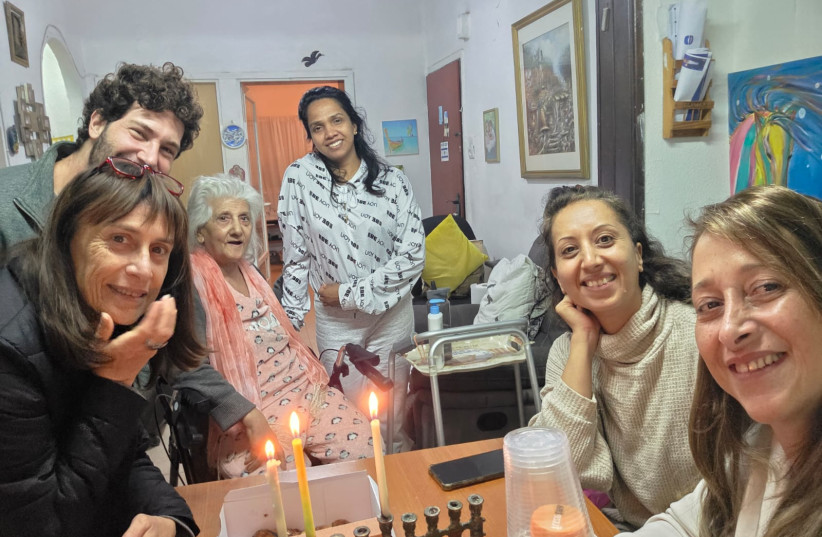
Provisor said there are many cases of survivors living in poverty for years, even before old age. Some of them are estranged from their families.
He also said that for many survivors, the war demanded more than they could physically manage.
“Many struggle without the ability to go into the safe room because they were living in these very old buildings in south Tel Aviv, Jaffa, built quite often in the early 1950s, and they might be stuck on the fourth floor with no lift. And so during the sirens, some of them don’t even bother leaving the house. Sometimes they go into the stairwell. And so it brings back the trauma.”
The institute has been ensuring that volunteers and therapeutic staff have been getting in touch much more than usual during the last few weeks. “We’ve heard from a few people that the war now has been more traumatic to them than previous wars,” he added.
These volunteers are therefore indispensable.
“All of our work is based on volunteers,” Provisor said. “We have volunteers who come and help us pack the food packages and deliver packages to people’s houses. And also just coming to visit the survivors at home and to sit with them, either on a one-off basis or on a regular basis. They very much look forward to things like that.”
For more, see the website: https://www.jaffainstitute.org