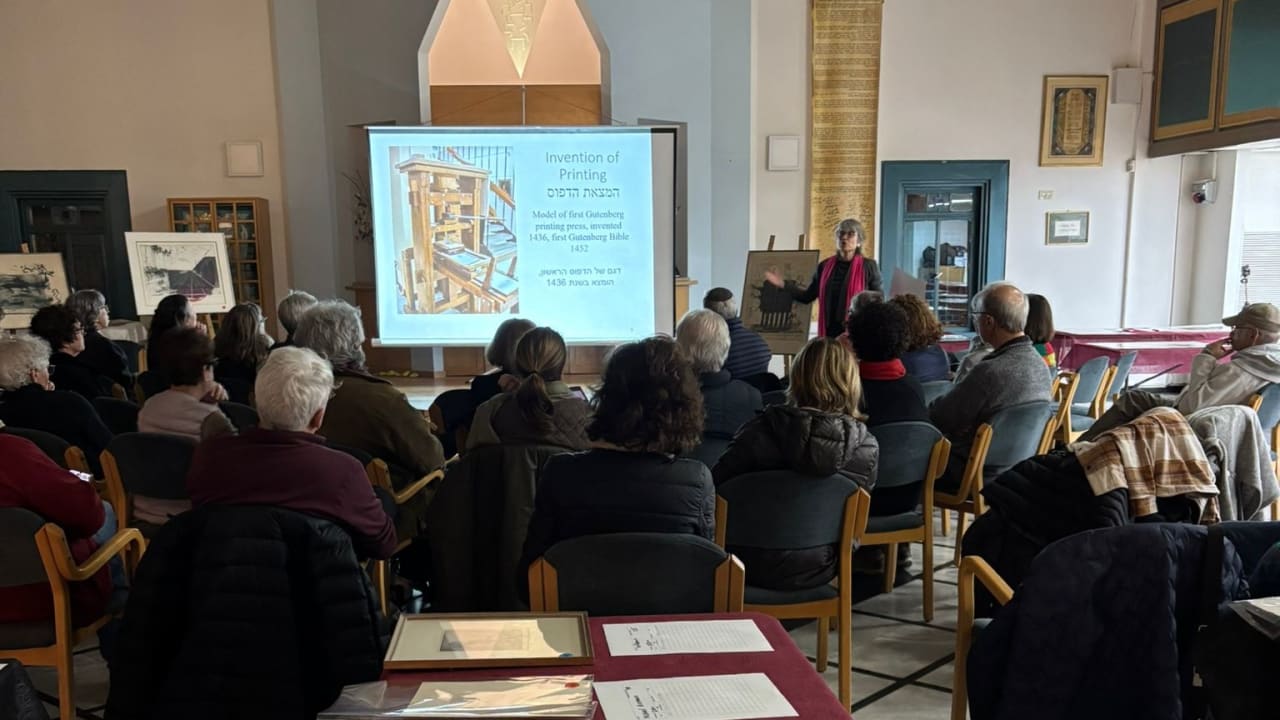
On the evening of January 29, Kehilat Kol HaNeshama in Jerusalem’s Baka neighborhood was transformed into a vibrant gathering place where art, learning, and communal responsibility converged.
Canvas for a Cause, an art auction benefiting the synagogue’s charitable fund, Keren Tzedakah, drew community members, art lovers, and supporters of social justice for an evening that demonstrated how creativity can be mobilized for meaningful impact.
Kol HaNeshama’s Rabbi Debi Shoua-Haim commented, “This event holds the essence of Jewish community – Torah, avodah, and gemilut hasadim [“acts of loving-kindness”].
“Bringing North American rock music posters to dwell alongside delicate sketches of the Israeli landscape in our synagogue is a form of Torah study. Taking the time to take in and enjoy the art is a form of avodah [“spiritual practice”] that brings us closer to the divine.
“And finally, doing all this for the cause of raising funds for tzedakah is what makes the world sustainable,” she said.

The event was anchored in the personal art collection of synagogue member Sally Oren, who partnered with Kol HaNeshama’s Keren Tzedakah to offer more than 100 works of art for sale. The collection was composed primarily of prints by internationally renowned Israeli artists such as Yigal Tumarkin, Ivan Schwebel, Tamara Rikman, and Amos Kenan, alongside a striking group of iconic Fillmore West concert posters from 1960s San Francisco.
Together, the works traced a cultural arc spanning Israeli art history, countercultural America, and the evolving role of printmaking as an accessible artistic medium.
From the moment the doors opened at 6 p.m., the synagogue took on the atmosphere of an art gallery. Guests moved slowly through the space, studying the works, exchanging impressions, and placing silent bids.
Kehilat Kol HaNeshama, a progressive Reform Jewish community, has long served as both a place of prayer and a hub for social action.
Located at 1 Asher Street since 1984, the synagogue emphasizes pluralism, equality, peace, and volunteerism. Its Keren Tzedakah plays a central role in translating those values into concrete support for people in need.
Financial assistance to individuals, families
Money raised through the Keren Tzedakah is used to provide financial assistance to individuals and families within the congregation and beyond. This support includes help with medical expenses, scholarships, emergency economic needs, summer camp tuition, and the distribution of mishloach manot (gifts of food) during Purim to those who may not receive food for the Purim seuda (festive meal) through any other framework.
The fund also responds to personal requests from vulnerable populations, such as the elderly, lone soldiers, at-risk youth, and victims of domestic violence, and extends assistance to neighbors in need, including in Beit Safafa.
For many recipients, this help arrives at moments of acute need, making the work both immediate and deeply consequential.
Midway through the evening of the art auction, Oren addressed the audience in a talk titled “From Haight-Ashbury to Jerusalem: An Introduction to the Collection.”
She spoke about the origins of the works and the journey that brought them together, weaving in personal stories.
Oren would go to at least two concerts a week when her father owned a San Francisco clothing store that became one of the first concert ticket outlets in the city.
Ticket buyers were given free posters, and her father collected and saved them in pristine condition, bringing them to Israel when he and his wife made aliyah in 1976.
The posters from the renowned Fillmore West rock venue, Oren explained, were artifacts of a moment when art, music, and social change were inseparable.
The Israeli prints, on the other hand, reflected decades of artistic engagement with identity, politics, and place.
Donating the collection for the benefit of the Keren Tzedakah felt like a natural continuation of those histories, Oren said.
The evening’s program continued with a gallery talk by Susan Nashman Fraiman, an independent researcher, lecturer, and curator of Jewish and Israeli art.
She noted that she only knew of three synagogues in the world that “actually bring art into the synagogue and combine it with a sale for the benefit of the community. What is being done here tonight is just amazing and very beautiful.”
Nashman Fraiman’s presentation, “The Art of Printmaking: Works from the Early Years of the Jerusalem Print Workshop,” offered historical and artistic context for many of the pieces on display.
She highlighted printmaking’s unique role in Israeli art, describing it as a medium that balances technical sophistication with accessibility.
Her remarks encouraged attendees to see the works not only as objects for acquisition but also as part of a broader artistic and social narrative.
As the final bidding took place toward the end of the evening, the mood in the room reflected more than the usual quiet intensity of an auction.
There was a shared awareness that each bid represented both an appreciation for art and a tangible contribution to communal care, even as friends outbid one another for some of the works.
In this sense, Canvas for a Cause functioned as both a cultural event and an expression of collective responsibility.
While the words “art auction” conjure impressions of wealthy people bidding for expensive works, the starting bids were as low as NIS 100 to NIS 500.
Overall, organizers noted, bids had been placed on a significant portion of the collection, underscoring the appeal of the works and the community’s strong commitment to the cause.
While several pieces are still available for sale, at the end of the evening almost NIS 20,000 had been raised.
In a city often marked by social and political tensions, the evening offered an opportunity to gather, rooted in generosity, learning, and shared values.
By the time the last bids were placed and the works began their transition to new homes throughout Jerusalem, in some cases to local art institutions and a few to collectors abroad, Canvas for a Cause had succeeded in its dual mission: celebrating art, and strengthening the Keren Tzedakah’s ability to respond to those who need support most.
For Kehilat Kol HaNeshama, the event was not an isolated fundraiser but a reflection of an ongoing commitment to ensuring that creativity and compassion remain deeply intertwined.
For information about the remaining artwork for sale, contact canvasforacause26@gmail.com.