You might think that a musical artist as successful as Idan Raichel would have a battery of aides and assistants taking care of his every whim.
But ahead of a professional pinnacle next month – hosting and performing multiple roles in a two-day festival combining live music with art and sound installations – Raichel is involved in every detail, from arranging his own interviews to choosing the photos that accompany articles.
The event, labeled “Fata Morgana,” is slated to take place on April 30 and May 1 in the dramatic landscape of Kfar Hanokdim, which lies between Arad and Masada in the Judean Desert. “Fata morgana,” the term for a complex form of desert mirage visible in a narrow band right above the horizon, captures the intended vibe of the immersive festival, which will combine sculpture, art, and food with live music and performance.
In addition to being the fuel behind the engine of the festival, Raichel is scheduled to perform on a double stage. On one side, he will appear with the Haifa Symphony Orchestra, conducted by Yaron Gottfried, in sweeping orchestral arrangements of his extensive repertoire, while on the other, he’ll lead a diverse lineup of virtuoso musicians in a more familiar world music setting.
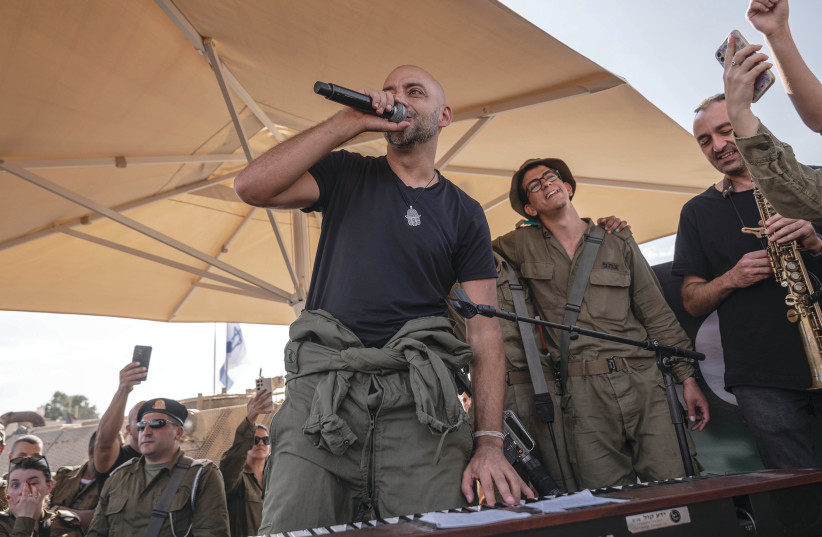
Amid the second Israel-Iran war, Raichel was handling all the preparations remotely. He wasn’t able to get back to Israel from the countryside of Lower Austria, where, every month, he visits his four children, who live there with their Austrian mother.
The 48-year-old Raichel takes it all in stride. The Zen quality of his multiethnic music – a forceful yet calm oasis of tranquility and warmth – and his philosophical demeanor convey the notion that the events of life will work themselves out.
When he burst onto the Israeli music scene in 2022 with his expansive band the Idan Raichel Project and its massive single “Bo’ee” (“come with me”), sung in Hebrew and Amharic, a dreadlocked, hippie-clad Raichel reinvented the term “world music” to encompass wherever the muse takes him.
His incorporation of Ethiopian singers and hosting a slew of musicians onstage, often taking a sideman’s role, was unique in Israeli music, and did more to break down social barriers in Israel than a thousand conferences on integration.
“Twenty years ago, in February 2006, I stood beside him at the funeral of the legendary Shoshana Damari,” recalled Menachem Granit of 88 FM and longtime radio and TV music presenter.
“Raichel had written a song for her, ‘Aleh Nidaf Ba’ruah’ [A Leaf Drifting in the Wind], insisting on connecting with the roots of the ‘Queen of Hebrew Song.’ In doing so, he built a bridge between the past and the future, proving that for him, Israel is a land of multicultural roots. His professional bond with Israel’s Ethiopian community further cements his status as a multicultural creator who champions the idea that the world is his oyster.”
Today, the dreadlocks are long gone, but the Kfar Saba-raised Raichel, who wears his Zionism on his sleeve, is one of those handful of Israeli musicians who appeal to everyone – Tel Aviv hipsters, West Bank settlers, Mizrahim, and North American olim. As such, he is easily able to cross invisible borders and bring diverse audiences together through music.

“I consider Idan to be the last of the Mohicans – and not just because of the dreadlocks that once adorned his head,” Granit said.
“I belong to a generation that grew up and fell in love with Israeli music in the post-military band era. My heroes were Arik Einstein, Chava Alberstein, Shalom Hanoch, Yehudit Ravitz, and Matti Caspi – musicians for whom the written word was a guiding light. They were artists who mastered the art of blending global trends with the unique heartbeat of Israel, remaining loyal to their Hebrew roots while weaving in international motifs. By the end of the 20th century, this essence had almost vanished for me. And then, Idan Raichel appeared.
“Since he arrived, I have struggled to find that same sense of musical transcendence elsewhere,” Granit stated.
Due to the current war, plans for a live, face-to-face interview with Raichel gave way to a video call between Vienna and Jerusalem in between alerts and sirens. Raichel discussed the upcoming festival, the psychic wounds of Oct. 7, his first foray into TV’s musical reality show glitz as a mentor on this season’s The Voice, and what it means to be a public Israeli figure today.

It must be difficult for you to be away from Israel while it’s fighting this war with Iran.
It’s a different kind of war, compared to Oct. 7.
Duty to be in Israel after the October 7 massacre
From the morning of October 8, I realized that it was my duty to be in Israel because I could go and play for the active soldiers and the wounded soldiers. I could play at the locations where the evacuated residents of the South and North had gathered. So I left Austria and my kids and returned right away. And I was in Israel for a long time.
But this is a different kind of war. There’s no call of duty that I feel I need to be around this time. If I were there, I’d most likely be in a shelter with the rest of the country. I would be doing Zoom with my parents in Tel Aviv, so I’d be doing the same thing [there as] from here. It’s not like the last time, when it just wasn’t acceptable for me not to be in Israel.
I live in Israel, and I live only in Israel, and I come to visit my kids in Austria. It’s very important for me that the kids understand it, that I’m coming to visit them in Austria; I’m not living in Austria.

I could have gotten an Austrian passport. I don’t want it. I could have gotten Austrian residency. I don’t want it. And it’s very important also by the choice of words, how we speak. ‘Papa lives in Israel. He comes to visit us because Mama wants to live in Austria.’ I don’t want them to feel that Papa lives in Austria.
Did you discover anything about the music you were performing during the Oct. 7 war that you didn’t realize before?
It was a wake-up call to – or just a reminder of – what songs are valuable and what isn’t. You definitely wouldn’t go to perform for wounded soldiers and sing them some silly pop song, right? Suddenly, a song means a lot. And the words take on a different connotation.
A few months ago, you did a short tour in the US. Do you feel that you’re representing Israel when you perform abroad?
I’m representing part of Israel, the Israeli reality. Because Israel is a big thing to handle. It can be the politics, it can be the army, but, yeah, we are showing the face of the beauty, the beautiful side of the Israeli society, the strength, the resilience.
I’ve been standing up to anti-Israel protests and BDS for the past 15 years.
I remember once, in Amsterdam, it was freezing, and people were outside the venue protesting my show. And I went out there and invited them in for the concert and told them that to mute the artist will not help, it will not do anything good. And I told them that I’m a very proud Israeli, I’m very pro-Israeli, and I think that dialogue is better than their pointless way of protesting.
Some of them were very open and willing to talk, and it’s an interesting dialogue; and some of them were just antisemitic, and nothing you say will help.
How did you come up with the idea for the festival, Fata Morgana?
It was during the Oct. 7 war; the country was opening up and you could travel. I noticed that the hotels were empty, and then I heard on the radio that one of the hi-tech companies took their employees for a weekend, hundreds of them, for a weekend in Greece.
And I thought it’s absolutely terrible that our hotels in the North are empty, and an Israeli hi-tech company is taking their employees to Greece. They should have been sending a message of unity, to support our economy and our tourism.
In the South, I visited Sde Boker and read the beautiful quote by Ben-Gurion: ‘The State of Israel will be judged not by its wealth or military strength, nor by its technology, but by its moral worth and human values.’
Then I arrived at this beautiful area between Masada and Nokdim – an empty, flat piece of land – and I thought that this could definitely be a place for a festival, to bring people in for a night or two, or just the day. It’s only an hour and half or two away from the Center.
And why Fata Morgana? Because it’s taking place in the wilderness, you know, just totally desert. And then, the cliché is to have Bedouin music or something native in the desert, right? But I thought, no, we should do something crazy, like bring a classical symphony orchestra to the desert.
So we’re building a special stage to hold the orchestra and a grand piano in the middle of the desert. And we’ll have art installations and bring in the country’s best chefs. And we’re going to bring in artists from the Gaza border communities to help support them. And, hopefully, companies will bring their employees here instead of to Greece!
We’re doing this from the belief that Israel has the best ingredients for art, a position of strength, that we have something to offer.
There must be tons of logistics that go into a festival like this. Are you hands-on? Are you directing it? Or do you have people taking care of that?
When I start every project of mine, I’m hands-on, and I’m on top of everything.
One of the most inspiring interviews that I read around 20 years ago was by Bono. At the beginning of the interview, just before they [U2] were launching a tour, he said that it was important that the ticket price will be X. And I thought to myself, Wow, he starts from the ticket price, [so] that it will be accessible, right?
Sometimes, when you go to a Vegas show or to a philharmonic concert, most people cannot afford it. It’s become kind of an exclusive phenomenon. So it’s important for me that this will be accessible and affordable, so I’m involved in all of the aspects.
How is it – as a musician who often plays solo, or you can change things in the middle of a song – to perform with a symphony orchestra, where there’s very little space for improvisation?
I enjoy both! We’re going to have a main stage that is actually kind of split into three sections. There is a grand piano on one side; there is the symphony orchestra in the middle; and the Middle Eastern musicians on the other side.
So the focus will go just between total improvisation of solo performance by the piano, and then combining everyone together with the orchestra, and then just going to some Middle Eastern vibe. The music won’t be only classical or only Middle Eastern or only piano. It will be combined from all of the worlds.
For the orchestra, the arrangements have to be written and arranged many months before, and we already almost finished the arrangements. And just before the Iran war, I started the rehearsals with some of the Middle Eastern musicians, and then we will combine it all later on. Right before Passover, we’re going to connect all the pieces together.
You’re going to appear as a mentor on this year’s edition of ‘The Voice.’ You’ve had some not so positive things to say about the musical reality genre in the past. So what prompted you to change your mind?
I want to say in general that I’m very happy that there is music on prime-time Israeli TV. It’s great.
But I felt throughout the years that it had become too much entertainment and not focused on the music. The musical values were put on the side, and it was another competition, like the food shows. There’s a reason why, after hundreds and hundreds of singers participated through the years, we can name them maybe on two hands. Because I think that they lost the values of the depth of the music.
I think that Oct. 7 was a wake-up call, not only in regard to defense and security but also to the idea of our moral compass. What is the food that we’re eating? What is the spiritual world that we’re living in? Can we allow ourselves too much fast food or too much pop music?
Every song is three minutes long, right? But what depth does it hold inside? For example, a song of three minutes in a synagogue holds inside it the values and spirituality of 3,000 years. So, it lasts much more than three minutes. And I think, in recent years, the lifespan of pop music is three minutes, if not less. By the time you get to the chorus, the verse isn’t even in your mind anymore.
In Israel, we’re not, say, 14-year-old kids from Denmark. We are building and educating a new generation that will defend the country, and I think that after Oct. 7 we are realizing that also in the realm of music.
The Voice is actually the only show of its kind where the mentoring is important, and not just the host or the lights. You listen to the voice, the person, and the song he or she chose. You hit the buzzer and turn the chair around and start a path with the singer to a whole new world. It’s a very, very first step in a long journey. So I’m really looking forward to it.
Did you imagine back, when you released your first album, that you’d be able to sustain a thriving career?
No, it’s a miracle, and I never take anything for granted that people actually come to see me perform. When I go onstage, I think of all the audience out there – they took babysitters, fought the traffic, paid good money to come here. And I realize what a privilege and responsibility it is, to be able to be onstage and play for them. It’s not an ego trip; it’s the opposite. And I take it with the utmost seriousness.
Are you optimistic about Israel?
One, I believe in the country; and two, we don’t have a choice. ‘Hatikva’ is an amazing anthem, and, if you read the words, it actually says only two things: As long as there is a Jewish living soul and as long as our eyes are directed toward Zion, there is hope. It’s a simple recipe.
For tickets to Fata Morgana, click here.