
‘A sheltered space nearby, and everything is subject to and in accordance with the guidelines of the Home Front Command,” I heard from the artist, who opened her first solo exhibition during the ongoing war. The war forced me to conduct the interview remotely, a siren interrupted the conversation, but after 15 minutes the artist came back from her shelter, and we returned to talking about art.
Despite the obvious obstacles, Israeli artists continue to create and present their art, and this March some of them even opened their exhibitions in Israel and abroad (in this case, the artist was unable to attend the opening due to flight cancellations).
Following that spirit of resilience shown during the Iran war, I selected artists for this column who explore the use of color in their art, often to find a path to a positive, optimistic outlook on life or to encourage viewers to action, to, as they told me, give them strength and optimism.
The three Israeli artists, whose works are now on view in Tel Aviv, Kaunas (Lithuania), and Holon, respectively, agreed to answer my three questions:
What inspires you?
What do you call art?
What, in your opinion, makes your artwork different from that of other artists?
VERA KUNIS
A data engineer and artist, Vera Kunis was born in Moscow in 1982. In 1990, just before the collapse of the Soviet Union, her parents decided to immigrate to Israel with the entire family. She currently lives in Tel Aviv.
She studied art with private teachers. Her style is closest to postmodern artists, although it also draws on other periods in art history.
Kunis explores art through various media. “In watercolor, I explore airy, stain-like effects and transparency that allow light to ‘breathe’ through layers. Acrylic, on the other hand, allows me to create matte, expressive surfaces that retain vitality without being heavy. In oil paints, I discover the depth of matter, which allows me to create rich and complex textures.”
It is the use of expressive, strong colors that seems to unite her work. Colors, by their very nature, are also a source of her inspiration.
Her work has been featured in group exhibitions, and on March 10, during the war with Iran, Kunis opened her first solo exhibition, Imagination Algorithm, at the Global Art Gallery in Tel Aviv.
Kunis told the Magazine: “They say that when the guns roar, the muses fall silent, but precisely in these difficult times, which we are all going through again, it’s nice to come together, consume art, and enjoy a bit of escapism.”
Inspiration
“I seek inspiration from expected sources, such as the work of other artists, and from less expected ones, such as my children’s drawings, which allow me to connect with the child within and create a childlike image, which, in my opinion, is one of the greatest artistic achievements; or from a strong desire to use a specific color or shape.
“Triangles are my favorite shapes; I feel they have endless possibilities, so I can use them in endless ways. And sometimes even three parked cars create a wonderful composition, which I translate into an abstract painting.
“My creative process usually begins with a strong desire to use color – sometimes as a background, sometimes as an image. An image can emerge from anything, and within this process it often connects with color through associations.”
Meaning of art
“For me, art is a mode of human expression and creativity that evokes certain feelings within a person.
“I’m most moved by beautiful metaphors, and while this is a tool most often found in literature and poetry, I believe they can be more than just verbal; and beautiful symbols and metaphors can also be found in dance and painting.
“I also believe that a work of art can never be fully understood. There are poems I can read over and over again and always discover something new.”

Kunis’s art
“Thanks to my mother, a pianist, I have been immersed in art since childhood – from classical music, sculpture, painting, dance, to poetry and literature in various languages.
“[All of this] definitely speaks through my canvases. My work is, in a sense, a dialogue with the masters; viewers often detect echoes of the artists who inspire me, woven into my own personal interpretation.
“I feel my works offer viewers a sense of infinite possibilities. My works don’t have a single, universal style – some are more childlike, others more geometric, and still others completely abstract.
“Thanks to this vast diversity of styles and wide range of inspirations, my art is not static but rather versatile, light, and airy, yet engaging, always making the viewer feel something they didn’t expect.
“After Oct. 7, I felt a universal need to regain control over a shattered reality. Now, faced with another war, we are once again trying to make sense of it all.
“Opening an exhibition in this atmosphere won’t restore certainty, but I hope it will bring a breath of fresh air and a spark of optimism. For me, it certainly did.”
www.verakunis-studio.com
AVRAHAM KAN
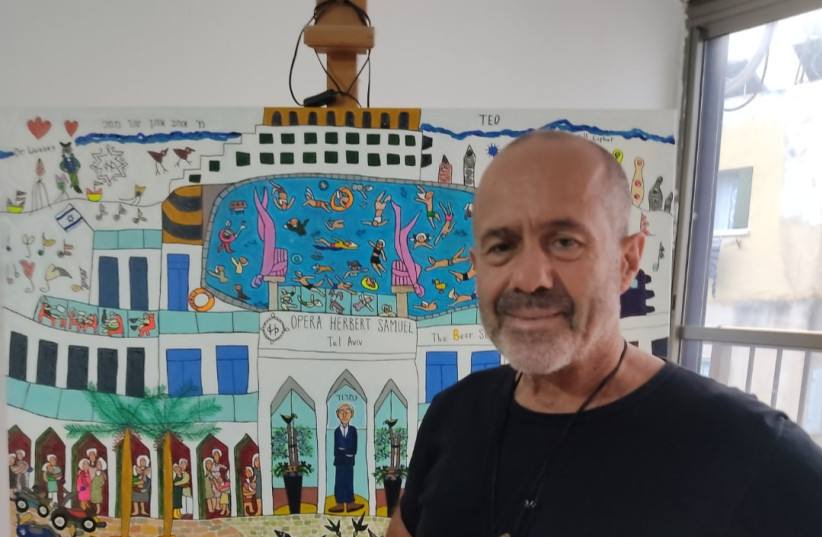
Avraham Kan was born in Batumi, Georgia (then part of the former Soviet Union), in 1968. He emigrated from the Soviet Union in 1991. Until recently, he lived in Jaffa-Tel Aviv, now in Bat Yam.
He is a self-taught, naive art artist who has developed his own painting style. He paints in oils, acrylics, and watercolors. His works are colorful, joyful, multi-layered, rich in detail and urban elements (e.g., recognizable motifs known from Tel Aviv and Batumi, Georgia), and reference numerous cultural traditions.
His paintings combine real stories and characters with fairy-tale, mythical creatures.
Kan does not use light or shade, but his “flat” paintings are full of expression and motion.
His works, which I have been observing for several years, strike me as joyful and dynamic, yet simultaneously addressing life’s challenges.
What is not readily apparent in his work is the artist’s family’s past. In the interview for this article, Kan repeatedly mentioned that his mother was a Holocaust survivor with strong Litvak and Yiddish traditions. How important it is to him!
Kan’s paintings have been exhibited in Israel, Georgia, France, other European countries, and the United States. His current solo exhibition, Returns, opened on March 18 at the Hey Art gallery in Kaunas, Lithuania.
Due to the war with Iran, the artist couldn’t be present at the opening of the exhibition, but, as he told me, he rebooked his flight and plans to arrive there soon. “War is bad, but art is stronger,” he noted.
Inspiration
“Everyday life. It’s like a natural phenomenon, even the most ingenious in its simplest form.
“Humans have needs: to eat, to drink, to breathe.... Drawing is an essential part of my life. It’s like a sponge that absorbs the experiences around [it].
“I create all my works with the most delicate brushes. Patience, diligence, step by step.
“Almost always when starting a new project, I prepare myself mentally, morally, and spiritually. The work consumes me, and I dissolve into the canvases, becoming one whole. In comparison, perhaps it’s like meditation. Finding myself in another world, another dimension. Sometimes I live several lives simultaneously – that is, my earthly life, and I think about compositions, colors, paints, canvases (but all of this is natural, not forced).
“When it comes to color, the colors themselves allow me to come closer. Maybe at night I wanted to apply a cool color to an object in a painting and went to sleep. In the morning, I woke up, swirled around the painting, and, like air, craved blue or purple.”
Meaning of art
“The best of it [art] is primitivism. If you can compare, it is like finding precious stones deep in the earth, untouched by human hands.
“[But] among my favorite artists are Henri Rousseau, Niko Pirosmani, Paul Gauguin, Frida Kahlo, Marc Chagall.”
Kan’s art
“[I have] my own unique style, like writers and musicians. But it took me 40 years of doubt to get there....
“I choose to bring the audience love and humor. Darkness has no place in my art – life is complicated enough.
“The magic happens when you manage to put all you love, dream about, and are driven to in one place, creating an indelible memory.”
avrahamkanart.com
TAL TENNE CZACZKES
A multidisciplinary pop artist, entrepreneur, and TEDx speaker, Tal Tenne Czaczkes was born in Petah Tikva in 1971, lives in Ramat Hasharon, and works from her studio in Tel Aviv.
She studied visual communication at the Bezalel Academy of Arts and Design in Jerusalem (BA, 1997), where she received a scholarship to study at the School of Visual Arts in New York.
Before pursuing her independent artistic career, she worked as a graphic designer in print for many years.
Her work has been exhibited at the Israel Museum, the Tel Aviv Museum of Art, Rabin Square, and in galleries throughout Israel.
Anyone who visited Tel Aviv’s coast in 2019 and 2022 remembers the 3.5-meter-tall sculpture Beach Ball, made (twice) from thousands of plastic items collected along the Israeli coast.
The artist’s goal was to raise awareness about reducing single-use plastic on beaches and to provoke reflection on consumer culture and the responsibility of entertainment.
Tenne Czaczkes is also the proud creator of Popeyit – The Strongest Believer, a contemporary artistic figure inspired by the cartoon characters Popeye and Olive Oyl. Popeyit embodies the idea that strength comes from combining broken parts into a new whole and represents faith, inner strength, and the courage to act.
Since February, viewers have been able to see two of her works depicting this figure at the Israel Museum of Caricature and Comics in Holon.
Inspiration
“For me, inspiration is not so much about searching for something extraordinary but rather about noticing what already exists and connecting with it. Ideas and possibilities emerge everywhere – in objects, people, shapes, sounds, and unexpected encounters along the way. I’m particularly drawn to things others might overlook: discarded materials and everyday objects that carry stories within them.
“This sensibility naturally connects with traditions like ready-mades and pop art, where ordinary elements of everyday life become a springboard for new meaning. Many of my works begin there, with a small observation or a material that reveals a hidden possibility.”
Meaning of art
“Art is a way to translate inner questions into visual language. It begins with intuition, not planning. I rarely start with a ready-made concept. Instead, I follow my curiosity and let the materials guide me. In this process, ideas are born.
“Art is not just about creating objects; it’s about giving meaning. It helps us see reality differently and sometimes imagine something new.
“For me, it’s more than that. Art is not just about creating for its own sake but also about conscious choice – using art as a tool for influence and change, a way to transform imagination into reality, both in the artwork and in our lives.”
Tenne Czaczkes’s art
“I hope that when people see my work, they experience a moment of recognition – something that connects with their own history and sense of possibility.
“My work often begins with what already exists, not with a blank canvas or new materials. I create from fragments – broken toys, used objects, discarded elements – using what already exists and combining them into new hybrids.
“This approach is both aesthetic and philosophical. It reflects the belief that strength lies not in the absence of fractures but in the ability to reassemble a new whole, while also sparking discussions about sustainability and the value we can create from existing resources.
“What truly distinguishes my work is the conscious choice to use art as a tool for influence. My works are designed for exhibition and collection; but beyond their visual appeal, they aim to evoke meaning – to stimulate reflection, inspire faith, and sometimes motivate someone to new action or decision.
“The figure of Popeyit embodies this idea. She symbolizes the moment when imagination meets action. Her two eyes symbolize this balance: one for vision and imagination, the other for focus and action – also with a touch of humor, as a nod to Popeye, who only had one eye.
“In today’s war, this idea seems even more relevant. Reality may seem fragmented and uncertain, yet people continue to create, rebuild, and act. I believe that every upheaval is also an opportunity.
“Art cannot fix everything, but it can remind us that transformation is always possible – and that even small choices can shape the reality we live in.”
www.instagram.com/tal_tenne_czaczkes ■