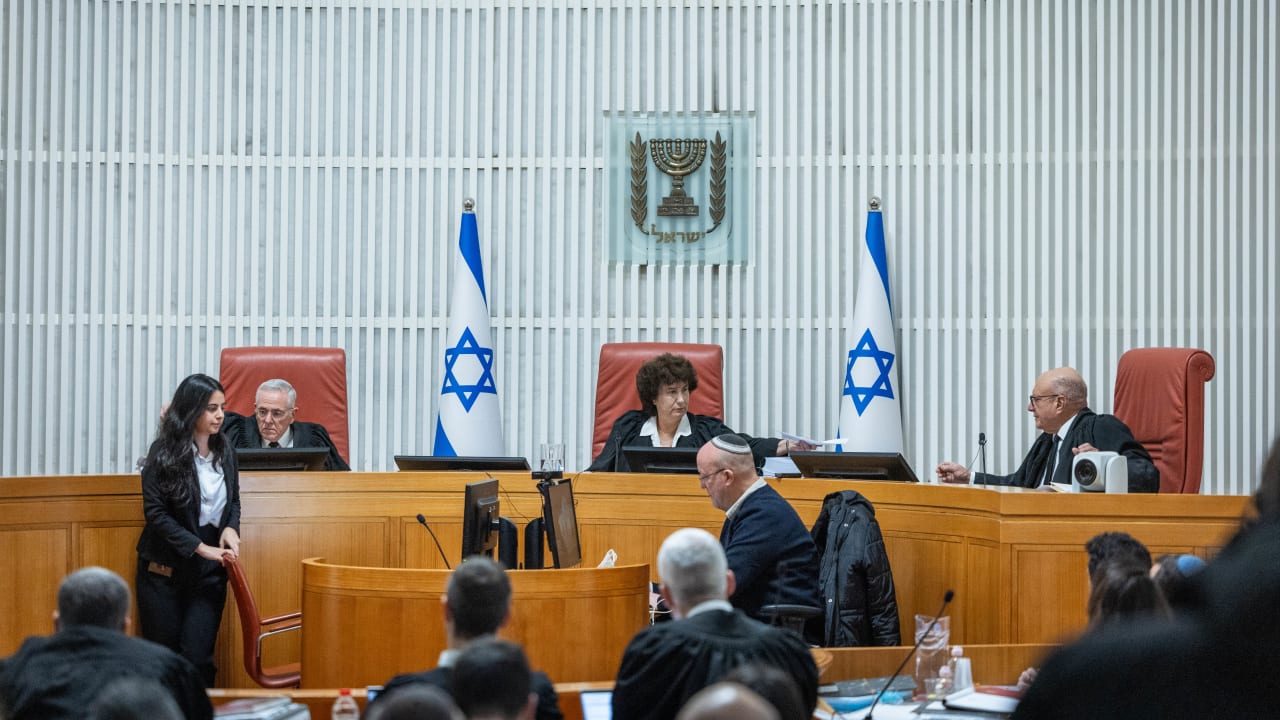
State Comptroller Matanyahu Englman on Thursday filed a 163-page sworn response with the High Court of Justice, urging it to reject two petitions that prompted the court late last year to freeze a set of central audits into the failures surrounding the October 7 attack and the ensuing war.
Englman asked the justices to convene an urgent hearing whose first segment would be held behind closed doors so that he could personally present draft findings, including material classified at the level of “top secret.”
In the filing, submitted on Thursday in response to a conditional order issued by the court on December 31, 2025, the Comptroller’s Office also asked that the three-justice panel currently hearing the petitions be expanded, arguing that the issues raised now require a constitutional interpretation of Basic Law: The State Comptroller that goes to the heart of the institution’s authority and its ability to independently audit the political, military, and civilian echelons of government.
In response, the Prime Minister’s Office said that Prime Minister Benjamin Netanyahu had published cabinet protocols under his authority in order to expose the truth to the public after the High Court halted the comptroller’s review. “The only way to expose the full truth is through an equitable and independent commission of inquiry that will represent the entire public and before which all materials will be presented,” the statement said.
The December ruling did not permanently bar the comptroller from auditing the events of October 7 but temporarily froze work on eight defined “core” audits while the court considers whether reviews that touch on matters of national security decision-making, wartime policy, and potential personal responsibility at senior levels fall within his statutory remit or should instead be reserved for a future state commission of inquiry.
Those petitions, filed by the Military Defense Counsel on behalf of IDF personnel and by the Movement for Quality Government, argued that audits dealing with policy and strategy or requiring broad investigative fact-finding risk exceeding the comptroller’s mandate and may undermine the procedural rights of individuals whose actions are being scrutinized.

The court’s interim injunction followed, ordering Englman to explain why he should not refrain from examining such issues in the context of October 7 and the war.
In his sworn response, Englman rejects the premise that the audits seek to evaluate the substance of national policy itself, arguing instead that they examine the processes by which decisions were made and implemented and the systemic gaps between established standards and operational reality.
Reviews of decision-making frameworks, intelligence coordination, and implementation failures, he contends, fall squarely within the traditional domain of state audit and are consistent with international standards governing supreme audit institutions.
The right to cross-examine witnesses
He further disputes a key demand raised in the petitions that audits touching on possible individual responsibility adopt the procedural framework used by state commissions of inquiry, including the right to cross-examine witnesses. According to the filing, the legislature’s selective incorporation of certain inquiry-type powers into the State Comptroller Law creates a negative arrangement that precludes importing the full procedural regime applicable to commissions into audit proceedings.
A central institutional concern raised in the response is that narrowing the comptroller’s authority to exclude issues labeled “policy” or “strategy” would create what the filing terms “immunity zones” in precisely the areas where failures on October 7 are alleged to have occurred, allowing strategic-level decision-making by senior political and military officials to evade independent oversight while leaving only tactical questions subject to review.
The Comptroller’s Office argues that such an outcome would create a structural gap in parliamentary supervision of the executive branch and risk long-term harm to the system of checks and balances.
The filing also asserts that the harm is already materializing on the ground.
Since the issuance of the conditional order and interim injunction at the end of 2025, the office says, some officials and agencies have cited the pending litigation as grounds to delay meetings or withhold documents even on matters not covered by the freeze, exposing the public to partial accounts of the audit process through media disclosures rather than the finalized reports themselves.
According to materials submitted alongside the response, the frozen audits address decision-making processes and preparedness at the political, intelligence, and military levels in the years leading up to October 7. This includes the functioning of the security cabinet, coordination between the political echelon and the intelligence community, defensive readiness along the Gaza border, and the formulation and implementation of understandings with Hamas from April 2018 until the outbreak of hostilities.
Other topics under review include wartime stockpiling targets for ammunition and the use of economic tools against terrorist organizations.
A table attached to the filing details meetings held between audit teams and senior officials across 2025 and early 2026, including with Netanyahu, former defense minister Yoav Gallant, former IDF chief of staff Herzi Halevi, and former Shin Bet (Israel Security Agency) chief Ronen Bar, where prewar intelligence processes, border defense doctrine, and the events of October 7 were discussed as part of the ongoing audits.
In requesting that the court hold the initial portion of the next hearing in camera, Englman argues that the publication of preliminary findings is legally barred unless expressly authorized by the comptroller, and that at least two draft reports – dealing with the defense of cities and aspects of the Nova festival attack near Re’im – contain material classified at the highest level.
The motion proposes that only representatives of the Attorney-General’s Office with appropriate security clearance be permitted to attend the confidential segment, given that the draft findings may touch on third parties not represented in the proceedings.
Englman also pushes back against claims that the existence of the audits conflicts with the potential establishment of a state commission of inquiry into October 7, maintaining that the legislature envisioned the two mechanisms as complementary rather than mutually exclusive and noting that past commissions have relied extensively on comptroller reports in carrying out their mandates.
The filing comes against the backdrop of a broader debate over accountability for the failures of October 7 and the still-unresolved question of whether and when a full state commission of inquiry will be formed.
Englman is asking the High Court to dismiss the petitions, lift the interim injunction freezing the eight audits, and schedule an expedited hearing to allow the audit process – which his office says has already consumed more than 300 person-years of work across multiple reviews – to proceed without further delay.