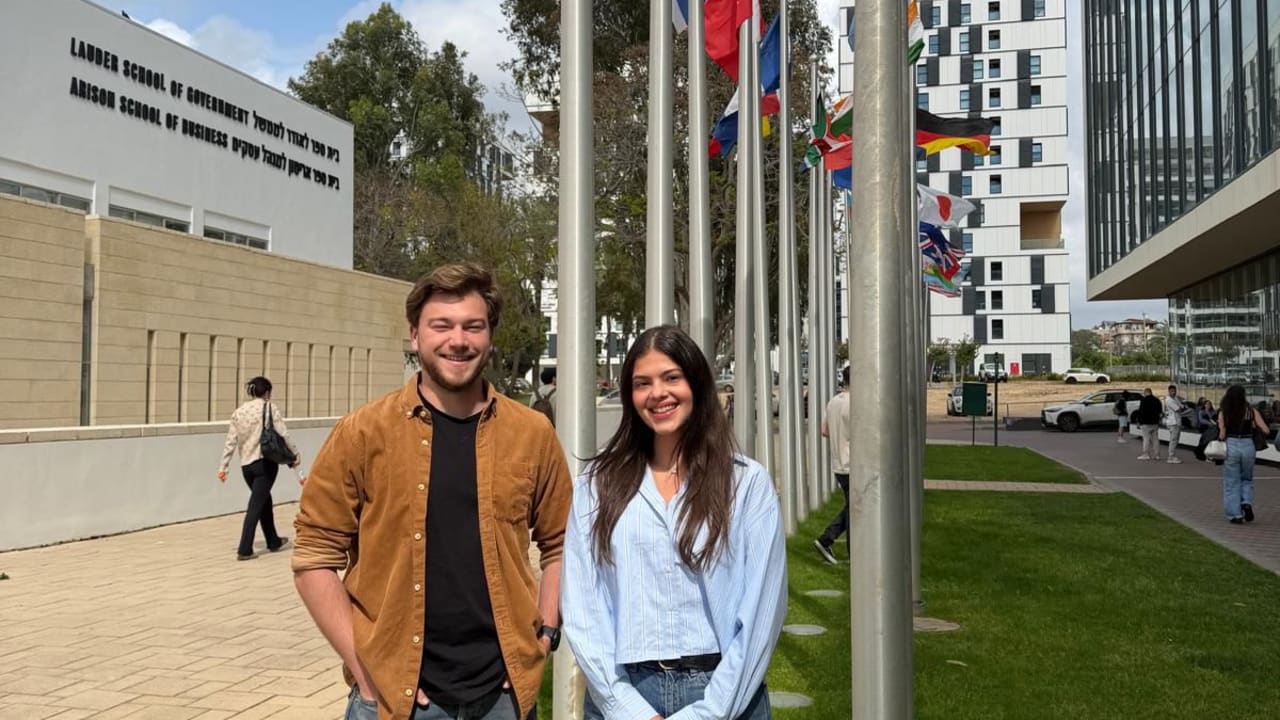
Studying in Israel comes with its own challenges, especially for olim and lone soldiers balancing academics, military service, and life in a new country.
For Levi Preger and Rachel Eskandry, choosing a university here was about much more than academics. It was about whether an institution could support them not only as students but also as new immigrants and lone soldiers navigating war, military service, and the transition into Israeli life.
Preger, 27, grew up in a small town in the Netherlands in a Christian household. When he was 17, he discovered that he was Jewish, learning that since the Holocaust, his great-grandmother had hidden the family’s Jewish identity.
What followed was a journey of self-discovery: learning Hebrew, celebrating a bar mitzvah at 18, making aliyah at 20, and enlisting as a lone soldier in the IDF’s Nahal Reconnaissance Unit.
Although he was accepted to several Israeli universities, Preger decided to delay his studies, anticipating repeated military reserve call-ups following the Oct. 7 Hamas-led mega-attacks on Israel. He is now in his second year, studying international relations and government at Reichman University in Herzliya.

“One of my most important criteria was how a university treats its reservists,” he said. “Reichman really goes above and beyond when it comes to reservists.”
That flexibility proved essential. During extended periods of reserve duty, Preger was unable to attend classes. Rather than his falling irreversibly behind, his professors adjusted deadlines, reorganized coursework, and met with him to help him catch up.
“At Reichman, missing months because of reserve duty doesn’t mean you fail; they work with you until you succeed,” he said. He recalled professors offering to meet him off-campus, even on Fridays. “They told me, ‘If you want me to sit with you in a coffee shop on a Friday morning, I’ll do that.’”
Campus life, he added, helped offset the strain of military service. International events, such as the annual food festival showcasing students’ home cuisines, fostered a sense of belonging and community.
Beyond his academic and military commitments, Preger is closely involved with Growing Wings, a nonprofit founded by and for lone soldiers, providing housing, advocacy, and community support before, during, and after military service.
“It is for lone soldiers, by lone soldiers – that’s the idea,” he said.
The university encouraged his initiative. When he proposed a pre-draft workshop for soldiers, administrators helped him organize it on campus. “That’s such a special thing, and they didn’t have to do it,” he said. “It’s very welcoming, very homey.”
Preger also addressed the personal cost of making aliyah and joining the army. Many of his friends in the Netherlands distanced themselves from him after learning that he served in the IDF.
“A lot of people whom I considered close friends – they said I would take part in what they call a ‘genocide,’” he said.
Rachel Eskandry, 22, is also in her second year at Reichman, studying international relations and government. Raised in Aventura, Florida, within a strong Jewish community, she grew up surrounded by peers who [later] made aliyah and studied in Israel. Long before the tragic events on Oct. 7, she knew she wanted to build her future here.
“I knew that if I wanted to end up in Israel long term – raising a family here or working here – then coming to the army was very obvious for me,” she said.
Eskandry made aliyah by herself in 2021 and enlisted through Garin Tzabar, a program for lone soldiers. She was released from the army three months after the Gaza war began, and then started her studies at Reichman.
After Oct. 7, returning to a university in the US was not an option. “I don’t think I could stand there and witness that,” she said, referring to the anti-Israel protests that swept college campuses.
Reichman appealed to her not only because of its English-language programs but also because of its values and atmosphere.
“The fact that the university was very strong in its Zionist values, and had a really strong stance with the hostages was really important to me,” she said. “These are the values I want in an institution.”
She described a warm, supportive environment where professors are approachable and know students personally. Campus life also gave her the opportunity to connect with peers from around the world who share similar values and outlooks.
A university-led delegation trip to Poland, she said, helped her grasp the weight of Jewish history and her own place within it.
“Only after the trip did I really understand and process everything that we went through.”
Support for lone soldiers
Reichman University is small by Israeli standards, with approximately 8,500 students. Some 2,400 are international undergraduates – an unusually high number in a country where most degree courses are taught in Hebrew. According to national data, Reichman enrolls nearly half of all international students pursuing full undergraduate degrees in Israel, despite representing only a small percentage of the overall student population.
Jonathan Davis, head of Reichman’s Raphael Recanati International School, attributes these statistics to a deliberate institutional strategy.
“We carved into our mission statement that we would like to embrace international students here,” he said. “But we have to work hard for it.”
The university offers full degree programs in English without requiring prior knowledge of Hebrew. Since the war began, this commitment has expanded to include individualized academic plans for reservists, financial support for wounded soldiers, and mental health services for students returning from combat.
Reichman also facilitates connections between students interested in IDF service and International School alumni already in the army, such as on-campus fairs that introduce students to relevant units.
“We have a person here who has contacts in the IDF, and we match them with units. Those who studied psychology – we want them doing psychology in the IDF. Communications – the Spokesperson’s Office. Economics – working on budgets in general headquarters.”
Since the Israel-Hamas War began, 18 Reichman students and alumni have been killed, and hundreds more wounded.
“This is a campus with at least 100 amputees. Out of 200 severely wounded soldiers, many have PTSD,” Davis said, adding, “Not one wounded soldier on this campus who’s an amputee pays one penny of tuition.”
Students who miss semesters due to military service are given personalized academic pathways to complete their degrees, regardless of whether they are Israeli or international.
“We have close to 500 international students who are former lone soldiers here,” Davis said. “We take care of those kids. We’re not going to leave one student behind.”
The commitment to student welfare begins with senior leadership. Davis himself is personally involved, hosting regular roundtable discussions with students from countries such as Brazil, Chile, Germany, and Belgium.
What’s more, many couples meet on campus, and Davis says he receives wedding invitations weekly. He describes his role as “a huge privilege to be in that driver’s seat.”
Since Oct. 7, a growing number of international students have arrived not solely for academic reasons but also because they no longer felt safe on their home campuses. Some transferred mid-semester after experiencing harassment or social exclusion.
This does not mean that every Jew should come to Israel or make aliyah, Davis emphasized. But for those who want to, the opportunity exists. In that sense, the International School functions as a sort of mini-absorption center.
“Sixty percent of our students make aliyah; some will ultimately serve in the army after they’ve completed their studies.”
For Davis, the formula to encourage international students’ eventual aliyah is straightforward. “If we provide tender loving care, if we embrace these people and take them by the hand – everything else follows.”
For students like Preger and Eskandry, that support is not an abstract policy. It is the difference between putting life on hold and moving forward – studying, serving, and building a future in a place that, at least for now, feels like home.■