
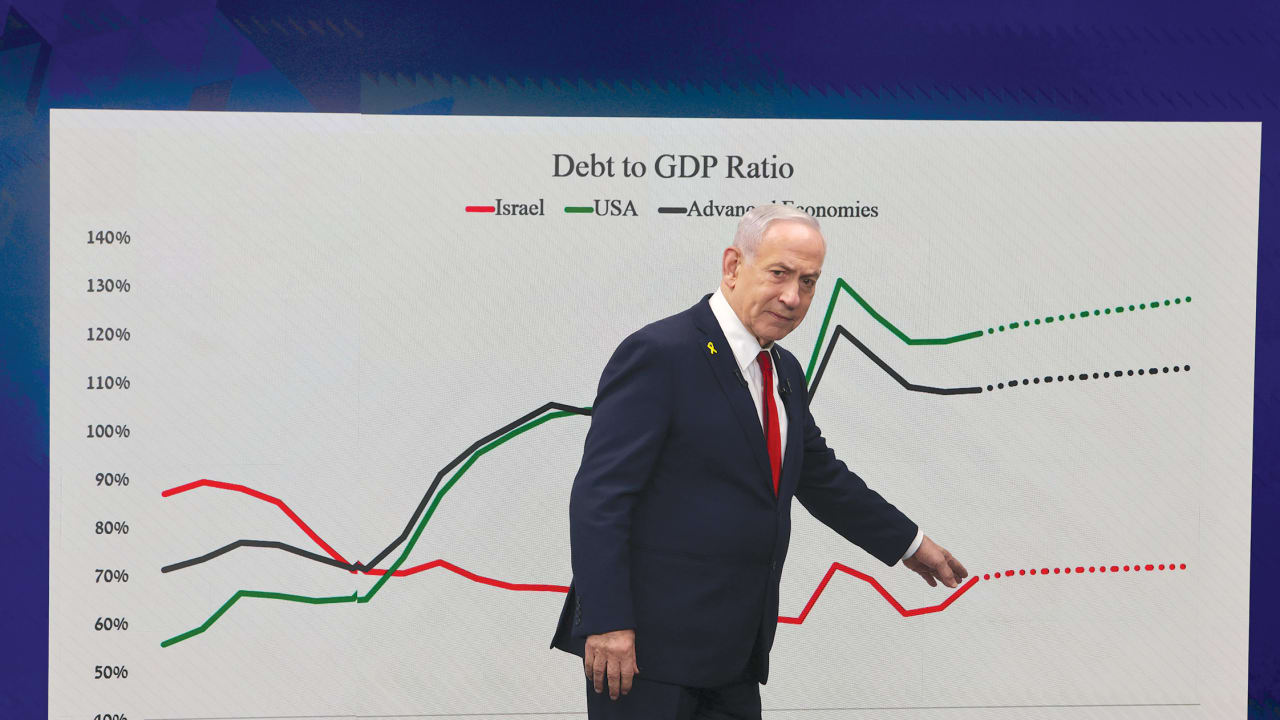
Not too long ago, Prime Minister Benjamin Netanyahu commented on the isolation Israel is facing on the world stage, noting that “we will increasingly need to adapt to an economy with autarkic characteristics.”
The prime minister quickly clarified his statement, saying he was referring only to the country’s defense industries. As the country’s leader, however, he did not lay out a plan to minimize the damage and return Israel to a path of economic stability and prosperity.
The impact of his comments was felt immediately.
The market’s response underscored the seriousness with which it was taken, shortening the path to a credit rating downgrade. Even additional attempts by the prime minister to reassure the public and the markets did not help: The TA-125 index fell by about 3.5% in the two days following his statement.

Trade decline
To make matters worse, while the Israel-Hamas war was still raging, the European Commission recommended suspending sections of the free trade agreement with Israel.
While the ceasefire might offer a reprieve, if such measures are approved this could mean tariffs on Israeli exports to EU countries, which would be a substantial economic blow.
Regardless of these official moves and the possibility that they may be walked back, now that the situation is calmer the damage to Israel’s foreign trade is already in motion: Israeli exports have been declining since the beginning of the year.
Should political and economic isolation persist, Israel could indeed be forced into an economy with autarkic features.
But what does that mean?
An autarkic economy is one that meets all its own needs and does not rely on foreign trade (including imports and exports) for growth. Israel conducts most of its trade not with its neighbors but with markets around the world.
Crucially, Israel’s growth over the years has been driven primarily by exports, which have become one of the main engines of its GDP. Export growth has allowed Israel’s economy to expand faster than its population, alongside a sustained rise in living standards (measured as GDP per capita).
Israeli exports are characterized by high added value, meaning that their contribution to GDP per unit of output is especially significant. Therefore, harm to exports means harm to growth, employment, tax revenues, and living standards for Israelis.
Limited output
Behind the prime minister’s insinuation that Israel might have to supply all its needs domestically lies the assumption that Israeli industry will be completely self-reliant and meet every need as a substitute for imports.
Until now, the state’s economy has relied on a mix of imports and domestic production. Moving to an autarkic model would mean abandoning imports and relying only on local output, which is extremely limited given the absence of many raw materials for production, and considering the current shortage of skilled industrial workers.
In effect, the prime minister’s declaration presented an economic philosophy that could lead Israel backward, retreating from the benefits of globalization and exposure to imports, back toward a closed economy where prices will inevitably be higher.
Many Israelis recall, for example, the early 1990s, when a policy of opening the textile sector to import competition led to much lower pricing in clothing.
It is also important to remember that even domestic production requires importing raw materials and fuels, since Israel is not rich in natural resources (except for natural gas).
Let there be no misunderstanding: “Made in Israel” products have real national and strategic importance in terms of security, jobs, food security, and resilience.
There is indeed a need to strengthen and support domestic industry, especially in strategic sectors such as food, defense, and other vital goods. But there is a vast difference between promoting Israeli industry and forfeiting the benefits of globalization for Israel’s economy.
The ability of the Jewish state’s economy to trade with the world allows consumers and producers to purchase goods according to the comparative advantage of where they are produced. This reduces prices in Israel by lowering local production costs and by forcing local producers to compete with imports.
In his follow-up remarks, as noted, the prime minister attempted to clarify that he was referring only (or mainly) to the defense industries. This, however, is far from reassuring. Israel’s defense industry exports are estimated at $15 billion, and behind every defense plant are numerous suppliers of goods and services, each a component of the broader production chain.
The potential damage from halting defense exports is therefore enormous – in terms of economic growth from exports and of employment, since the defense industries employ tens of thousands of workers directly and indirectly.
Toll of boycott
In practice, the growing international boycott is already taking its toll on Israel’s economy. Data published recently by the Central Bureau of Statistics show that during the first half of the year, exports of goods and services fell by 2.2% (a 4.3% annualized decline).
Exports dropped alongside an even sharper fall in private consumption, down 2.7% (5.3% annualized). Together, these explain most of the decline in business-sector GDP, which shrank by about 1% (2% annualized).
The bottom line: The standard of living is already falling for Israelis. In the first half of the year, GDP per capita dropped by 1% in real terms (2% annualized). But the real price hikes are still ahead.
Therefore, it is imperative for Israeli leaders to be proactive in the face of economic threats, and to safeguard the professional independence of the internationally respected Bank of Israel.
At a time of turmoil and uncertainty, the last thing the Israeli economy needs is leaders willing to accept the economic blow of isolation on the global stage and who politicize monetary policy at home.
Instead, we need leaders who carefully guard over Israel’s strategic security assets while never losing sight of the fact that our economic strength is directly linked to the hard-earned place that generations of political and business leaders have forged in the global marketplace.■
Daphna Aviram-Nitzan is director of the Center for Governance and the Economy, and director of the Eli Hurvitz Conference on Economy and Society at the Israel Democracy Institute.