
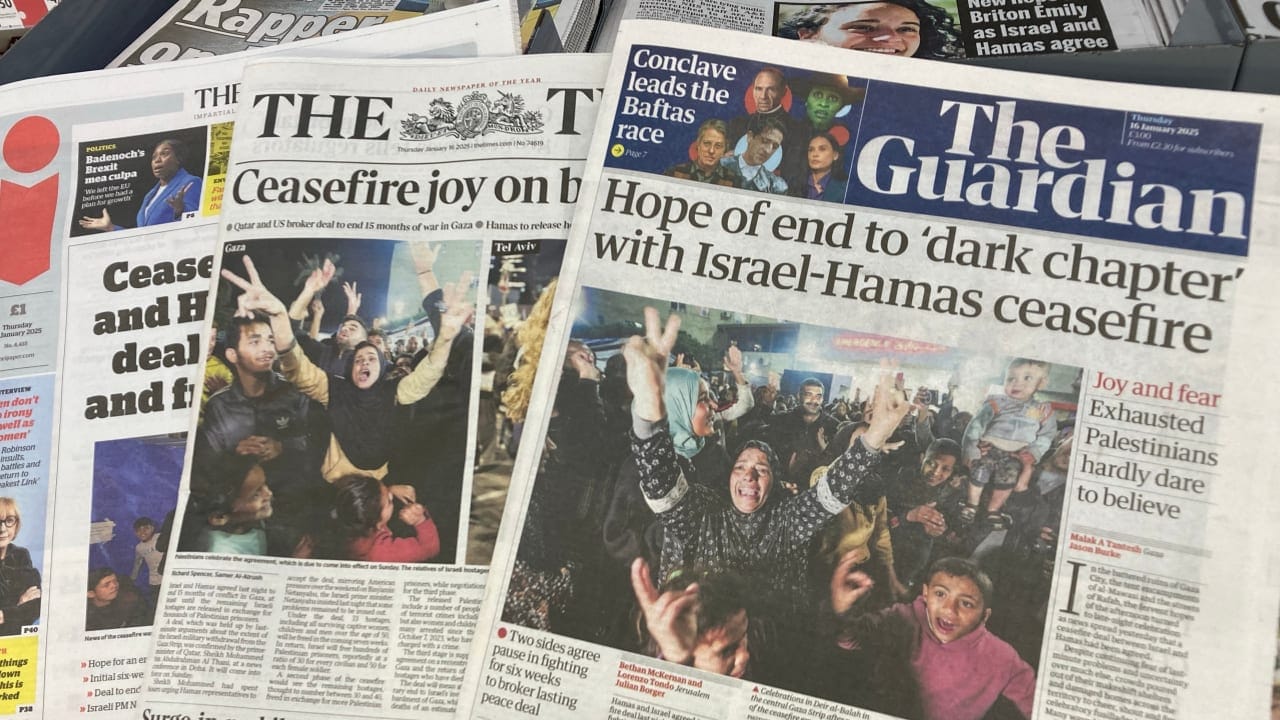

When arguments about international coverage of Israel arise, they almost always begin in miniature. They circle around language. Is it a “settlement” or a “neighborhood”? A “security fence” or an “apartheid wall”? Was 1948 a war of independence or a Nakba? These debates have the feel of forensic disputes, as if the great drama of the Middle East might finally be settled by the correct choice of noun.
They are not unimportant. Words matter. But they are also a distraction. They keep us arguing on the surface of the story, while the deeper, more corrupting structures shaping it remain largely untouched, and thus unseen.
There are two such structures, two distortions so large that they become strangely invisible. Together, they help explain why Israel occupies such an outsized and morally charged place in the media’s imagination, particularly in the West.
Obsession with Israel
The first is the sheer scale of attention. Not criticism, attention. A systemic fascination, bordering on obsession, with covering Israel as though it were the gravitational center of world affairs. The fascination is both disproportionate and scalable.
For example, as Prof. Gil Troy noted in his 64-page The Essential Guide to October 7 and Its Aftermath: Facts, Figures, History, published by the Jewish People Policy Institute (JPPI), “In the first nine months after October 7, 2023, the New York Times published 6,656 articles about the Gaza War. That compared to 80 articles about the American-led battle to free Mosul [Iraq] over nine months in 2016-2017, [some] 198 articles about the Tigray War in Ethiopia, which killed 600,000 in a year, and 5,434 articles during the first 13 years of Syria’s civil war. One Microsoft Copilot Artificial Intelligence analysis found [that] between 50,000 and 70,000 articles about Gaza were written worldwide in nine months – compared to 1,000 articles about Mosul in nine months.”
Former Associated Press reporter Matti Friedman observed that AP employed more full-time journalists covering Israel than it did covering China, India, and Russia combined.

The imbalance becomes even more bizarre at AP when extended further. Israel is covered by more full-time staff than all of sub-Saharan Africa combined, which is made up of dozens of countries, encompassing hundreds of millions of people, multiple wars, famines, mass displacement, and – in some cases – genocidal violence.
If news coverage were meant to be a rational analysis, this is not. Even if news were merely supposed to be the coverage of suffering, power, and danger on planet Earth, this would still be indefensible. You cannot plausibly cover Israel more than an entire continent without warping the reader’s sense of reality.
Illusion of centrality
This saturation coverage creates the illusion of centrality. It trains audiences to believe that whatever they see most frequently must be the most important event in the world. Israel becomes not just another country among many but a kind of moral index of the age – a stage upon which the world’s conscience is imagined to be tested and revealed.
Meanwhile, catastrophes of far greater scale and brutality – such as the ongoing genocide in Sudan – flicker briefly, if at all, across the screen before disappearing into silence a week later.
This is not accidental. The Israeli-Palestinian conflict occupies a peculiar and disproportionate place in the West’s political imagination, unmatched by conflicts that are deadlier or more brutal. Israel is small enough to be grasped symbolically, but complex enough to absorb endless projection.
It is intimate, familiar, and endlessly legible to Western eyes in a way that “distant” tragedies are not. And so it becomes over-seen, over-examined, intensely dissected, and uniquely moralized until the examination itself becomes both activism and a substitute for understanding.
Regional conflict
The second distortion is conceptual. Israel’s wars are routinely framed as the “Israeli-Palestinian conflict,” as though the entire story were a localized struggle between two neighboring peoples, one strong and one weak, one powerful and one victimized. This framing is tidy, emotionally resonant, and yet profoundly misleading.
Most of Israel’s wars have not been fought against Palestinians but against Egyptians and Jordanians, Syrians and Lebanese, Iraqis and, increasingly, Iranians. Israel’s most significant enemy today is the Islamic regime in Iran – a non-Arab, non-Palestinian regional power pursuing its own ideological, nuclear, and strategic ambitions. The rockets fired at Israel during the war did not come only from Gaza. They came from Lebanon, from Yemen, from Iraq, and from Iran itself.
Imagine for a moment a satellite photograph that does nothing but trace the arcs of ballistic missiles and rockets fired at Israel over the past years – a dark map illuminated by red lines streaking inward from multiple directions. Such an image would reveal instantly what the dominant narrative conceals: the contours of a regional war. A multi-front conflict involving state and non-state actors, militias and proxies, ideologies and regimes, stretching across the Middle East.
Yet this is not how the story is told. Instead, a vast and intricate regional struggle is reduced to a single dyad: Israelis vs Palestinians. In this reduction, Israel is cast as the dominant actor, the controlling force, and ultimately the villain. Power flows in one direction only. Agency belongs almost exclusively to Israel. The wider forces shaping the conflict fade into the background or vanish altogether.
Shrinking facts
This is how media distortion always works – not by inventing the facts but by shrinking and enlarging them selectively. A small story is made to seem enormous. A large story is compressed until it fits the awaiting political template.

The result is a narrative that is both emotionally compelling and intellectually impoverished, a morality play in which a villainous country called Israel comes to embody the worst sins of the modern age, while the broader regional dynamics dissolve into abstraction.
Once this narrative is established, it becomes self-reinforcing. The more Israel is covered by the media, the more it seems to matter uniquely. The more it is framed as the central actor in a simplified conflict, the easier it becomes to load it with symbolic meaning. Israel ceases to be a state acting within a volatile region and becomes instead a metaphor for everything the imagination fears about power and injustice.
That is why disputes over terminology feel so intense and yet change so little. The problem is not whether a journalist chooses one word over another. It is that the story being told is already too small to hold the truth, and too large to escape moral projection. It magnifies Israel until it eclipses the region, and then isolates it until it bears responsibility for forces far beyond its control.
To notice this is not to deny Palestinian suffering, nor to sanctify Israeli policy. It is to insist on proportionality, context, and intellectual honesty – qualities without which journalism becomes a kind of secular theology, assigning sin and virtue according to narrative convenience rather than reality.
If the coverage of Israel feels uniquely charged, moralized, and obsessive, it is because it is. And until we confront the media structures that produce this obsession – the imbalance of attention and the fiction of a purely local conflict – we will continue arguing over words while missing the story those words were meant to describe.■
Samuel J. Hyde is a South African-Israeli writer on Israel and the Middle East based in Tel Aviv. He began his career studying the rise of Nazism at the Holocaust and Genocide Center and is currently a fellow at the Jewish People Policy Institute based in Jerusalem.