


In recent months, the world has grown accustomed to a steady stream of headlines about the Islamic Republic of Iran. Developments surrounding ceasefire negotiations, intercontinental ballistic missile ranges, regional aggression, and the regime’s insatiable pursuit of nuclear capabilities rarely go unreported.
Ask someone outside of Iran what comes to mind when they hear the word “Iran,” and the answers are oftentimes predictable: “ayatollahs,” “sanctions,” “conflict,” “the Supreme Leader.”
I have spent years reporting on Iran and building relationships with Iranians both inside the country and across the diaspora – work that culminated in my book Unveiled: Inside Iran’s #WomanLifeFreedom Revolt, published late last year. This connection is also personal. I was born into a family with roots in Mashhad, raised on the richness of Persian, Jewish, and Israeli culture, and driven to challenge the increasingly normalized notion that the Iranian people and their regime are one and the same.
They are not.
The assumption that a clerical regime in power since the Islamic Revolution of 1979 somehow reflects the will of its people could not be further from the truth.
The real Iran
From the inside, Iran is a profound contradiction. It is home to one of the most educated youth populations in the world, with high literacy rates, yet remains among the most restricted. It is a civilization steeped in the ancient poetry of Rumi, Hafez, and Ferdowsi, and in music and art, where creative expression is ruthlessly policed.
That contradiction has turned deadly. The January 2026 crackdown by regime authorities on Iranian protesters marked one of the bloodiest months in the Islamic Republic’s history, with tens of thousands of men, women, and children killed. And yet, despite the brutality, many refuse to be silent.
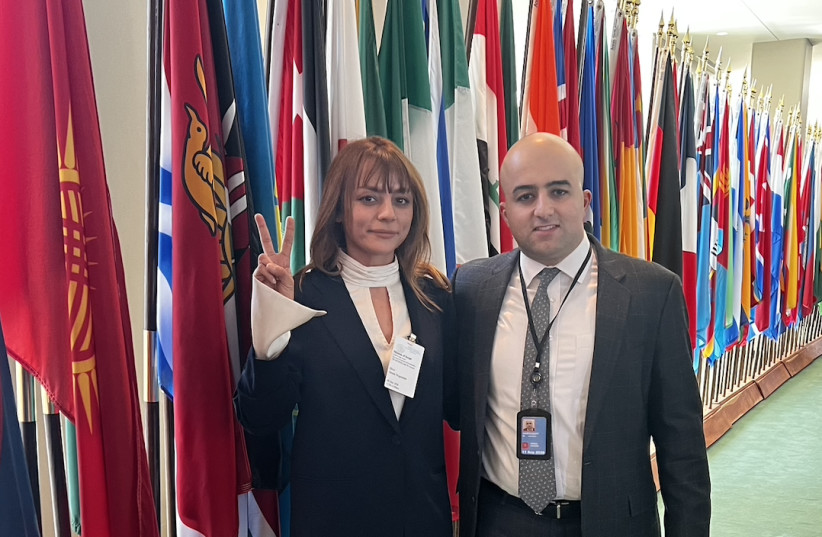
I met Raheleh Amiri at the United Nations during this year’s International Women’s Day. A trained psychologist from Kerman, she spoke before ambassadors and dignitaries with astounding resolve. What struck me most was her gaze. During the 2022-2023 Woman, Life, Freedom uprising in Iran, Amiri was shot in the eye by regime forces, leaving her permanently blind in one eye. Today, she wears that injury not as a mark of victimhood but as an unambiguous badge of defiance.

“You may ask, ‘Why was a bullet fired at my eye?’” she said. “The answer is painful, yet clear. For the crime of seeking freedom. I was a young woman who had taken off her compulsory hijab, walked into the streets with a smile, and carrying a simple dream to live freely.”
On that same day, I reunited with Shiva Amini. Once an elite futsal (indoor soccer) player representing Iran on the global stage, her life was upended by the regime’s dogged persecution. I first interviewed her in 2022, and later for my book.
For years, Amini and her family were harassed by the regime for her “crime” of being photographed playing football with her hair uncovered. For that, she was targeted and forced to flee her homeland, where she has since used her platform to highlight the dangerous politicization of sporting authorities in Iran.
“My whole life I’ve been threatened by the regime with rape, death, lashes, and imprisonment,” she said. “This isn’t just my life. This is the life of millions of Iranians.”
Then there is Gazelle Sharmahd, another lioness I had the privilege of interviewing, and since then, calling a friend. Her father, Jamshid, was kidnapped by regime operatives while on a layover in the United Arab Emirates in 2020. He was taken back to Iran, tortured, placed on death row, and ultimately executed in October 2024.
Throughout his captivity, she petitioned governments, spoke at the UN, and on other international stages in pursuit of his release. And since his demise, she has continued to advocate for the Iranian people and to stress that the people of Iran are not their oppressors.
Reflecting on her father’s unimaginable ordeal, Sharmahd remains optimistic about the power of the Iranian diaspora worldwide. “We can distance ourselves from the traumas that prevented our parents’ generation from sticking together, and that is the strength we have now in the diaspora.”
Not the exception
These women are not isolated exceptions. They are part of a broader movement that the world too often fails to see.
And while the women of Iran – the “lionesses” – have endured appalling hardship, they do not stand alone. Iranian men, too, have suffered deeply under the regime’s brutality and make up the overwhelming majority of those executed. On March 19 alone of this year, the regime hanged three men, Saleh Mohammad, Saeed Davodi, and Mehdi Ghasemi, in the city of Qom on the eve of the Persian New Year.
Among those forced into exile is Sardar Pashaei, a world-class wrestler and former national team coach. He is someone who should have been celebrated purely for his athletic accomplishments. Instead, he was forced to flee his home country after sustained harassment because of his Kurdish identity. His story is a stark reminder that in Iran, even excellence is not a shield against repression when it collides with ethnicity, identity, or dissent.
Together, these stories offer a clearer and more honest picture of Iran; one that is too often obscured.
Inside the country, Iranian people have been cut off from the Internet for approximately 50 days, or 1,200 hours. That means that the only voices from inside the country that are being amplified are those aligned with the regime. Plus, independent journalists face severe restrictions entering the country, exacerbating challenges around documenting the reality of ordinary Iranians.
When glimpses do emerge, they tell a strikingly consistent story of a population deeply disillusioned with its tyrannical rulers, with one poll showing that as many as 92% of the population are dissatisfied with the regime and support a future beyond the Islamic Republic. The reality, one that is too often obscured, is that the Iranian people are not their regime.
To understand Iran solely through the lens of its regime is both incomplete and misleading. It obscures the bravery of women like Raheleh Amiri, the resilience of athletes like Shiva Amini, the unyielding courage of voices like Gazelle Sharmahd, and the perseverance of men like Sardar Pashaei, who continue to endure, resist, and speak out despite extraordinary risk.
They are Iran.■
Jonathan Harounoff, Israel’s international spokesperson at the United Nations, is the award-winning author of Unveiled: Inside Iran’s #WomanLifeFreedom Revolt.