


As Iran’s remaining leadership attempts to stretch out the war, counting on Western fragility, it is becoming clear that the steps being taken by the US, and its president, Donald Trump, are not simply a collection of random, tactical moves but rather are strategic and game-changing.
Trump’s original intention was to seek control of all energy sources belonging to the Islamic Republic of Iran. The latter sold those national assets at relatively low prices to China as a way to circumvent the international sanctions imposed upon it by the West. This has allowed China to gain a significant advantage in industry and trade over the West. For years, this has gone unchallenged, slowly gnawing at the hegemony and universal leadership of the US in the international arena.
Additionally, Tehran established a parallel monetary system within the framework of the BRICS monetary alliance – the initiative set up by several countries to reduce reliance on the US dollar and Western-controlled financial systems. The goal here, again, was to undermine the leadership of the US and strengthen its own currency.
Trump refused to put up with such actions any longer. China topped his agenda, and with that in mind, he decided to launch the war to regain control over energy sources, as well as strategic maritime and other means of passage for their transportation.
Joker in the deck
The first step was the Panama Canal. Americanized.
Next was Venezuela. The American-friendly candidate was supported, while Nicolás Maduro was surgically ousted.
Iran followed, with the Strait of Hormuz being played as the joker in the deck.
At the same time, the Bab el-Mandab maritime passage, separating Yemen and Eritrea in the Horn of Africa, a 32-km. long chokepoint for maritime trade, and the Strait of Malacca, between the Malay Peninsula and the Indonesian island of Sumatra, a 900-km. long route key to maritime shipping, were both secured by the US.
Prior to all this, Trump had already begun claiming ownership over Greenland, which, in the not so distant future, given climate change, is likely to become yet another extremely important maritime passage for transporting oil and other goods. Full of extraordinary natural resources, it was also in danger of falling into the hands of either China, Russia, or both.
Once the prime minister of Spain chose to close a deal with China regarding the Strait of Gibraltar, the US administration did not linger before it closed a deal with Morocco regarding that very same strait.
Not random – strategic
The idea was, and remains, to control every important potential and/or existing maritime passage of oil. The reason is simple: money. Whoever controls the oil controls the global economy. That was and remains the first and most important goal of the US in its quest against the Islamic Republic.
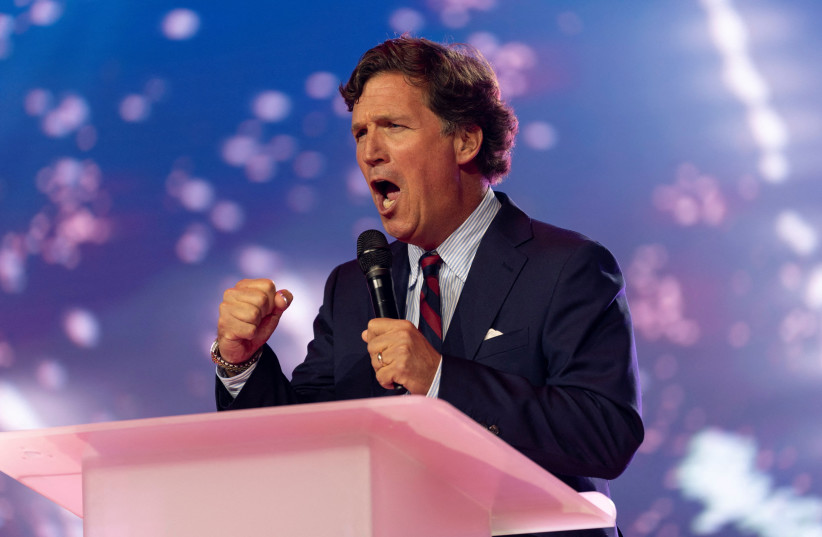
Attempts by the likes of former vice president Kamala Harris and polarizing commentator Tucker Carlson to convince the American public that the US was dragged into the war by Israel are but a cheap endeavor to gain favor in an arena where Israel-bashing is, unfortunately, trendy – in both left- and right-wing political circles.
Indeed, the rush of the Iranian regime and its extremist ideological leadership to nuclear capability added weight to the formerly mentioned economic goal of the war, which was based upon the understanding that once it possesses a nuclear weapon, it will be impossible to approach Iran militarily, similar to the North Korean model, minus the radical Islamic ideology.
Leaving the remnants of this regime with the remnants of the enriched uranium is a recipe for disaster. It is no longer a matter of analysis or interpretation whether the Islamic Republic will still strive to have nuclear weapons and a huge array of ballistic and other missiles with which to bully the world military and economically. The underground cities, with their unbelievable array of weaponry, uncovered in Iran in the recent war, have removed any doubt about that.
The likelihood that Trump and his administration will allow for that to be left untended is extremely low. Think about it for a minute. The very reason that made the US attack Iran in the first place was the oil. Enriched uranium in the hands of Iran creates great danger for the foreseeable future.
Chasms remain
Iran is being led by a depleted and dispersed military leadership of IRGC commanders, each holding on to one of the 31 regions in the massive Iranian terrain, and executing a plan pre-written by a leadership that is no longer with us. The chasms within those IRGC leaders are significant, and much is being done below the surface to deepen those chasms and weaken the remnants of this regime.
This does not minimize the remaining power of this hugely wounded animal with its back against the wall, fighting for its very existence. Many in this leadership still hold onto an apocalyptic Islamic Shi’ite ideology, in which the end of times and the arrival of their mahdi (messiah) is accompanied by approximately 180 signs, which include blood, fire, death, and destruction.
It is, therefore, a complete waste of time and energy, and a total lack of comprehension to believe in the very essence of negotiation with such a group, which sanctifies every means for this bloody but much revered end.
Those with whom a “deal” will be reached will only essentially be a cooperative executor of that which the US is seeking. Nothing less will be accepted. And that shall pave the way and create the circumstances for a regime change brought about by the Iranian people themselves.■
Ruth Wasserman Lande is a former member of Knesset; expert on Middle East and Arab affairs; and senior fellow at the Misgav Institute for Strategic Affairs.