
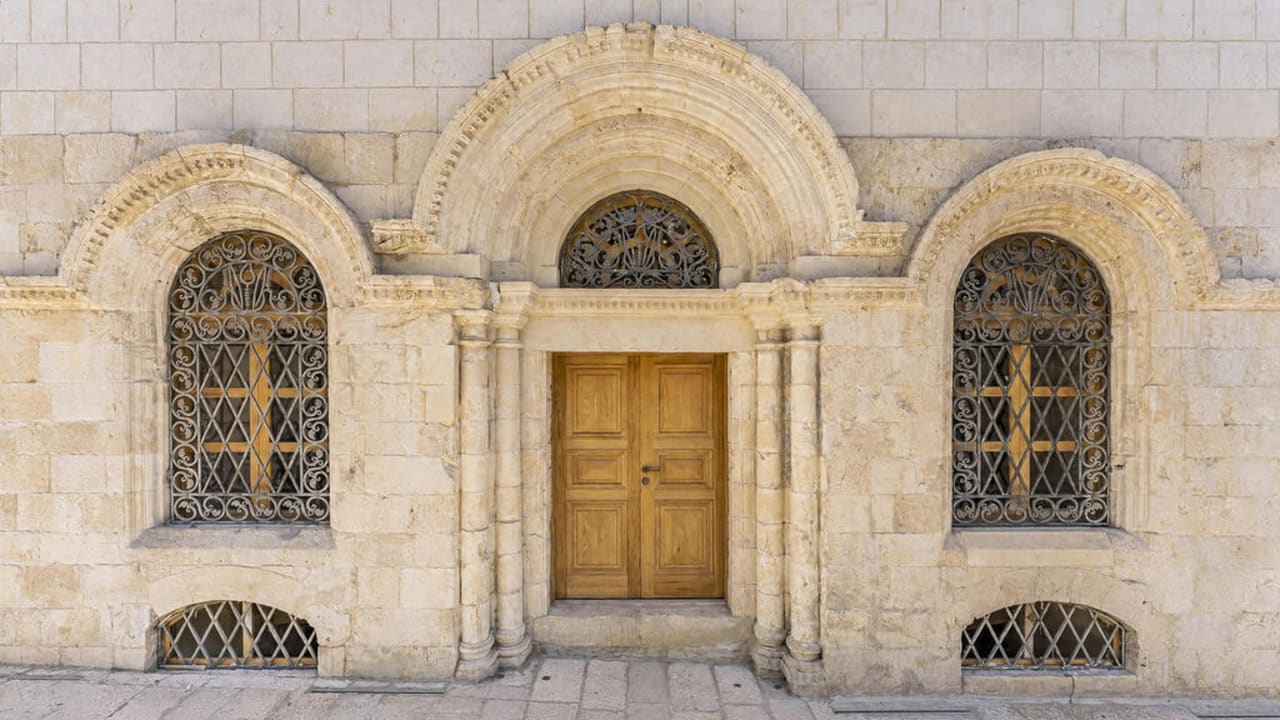

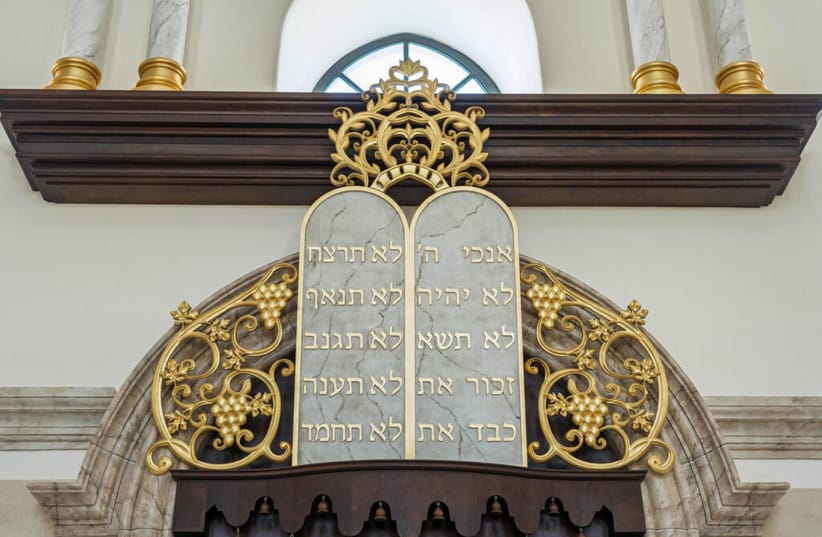
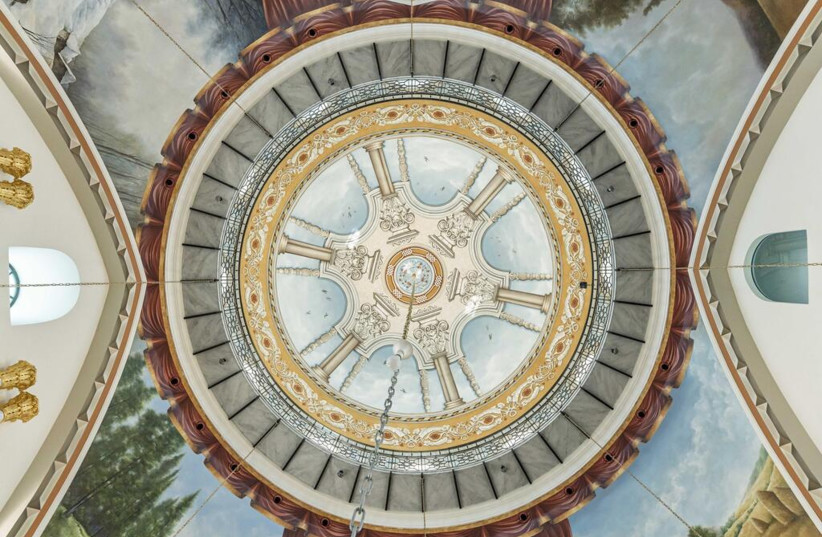
Twelve years after the cornerstone-laying ceremony marking the rebuilding of the Old City of Jerusalem’s Tiferet Yisrael Synagogue – dedicated in 1872 and dynamited by Jordan’s Arab Legion in 1948 – the newly reconstructed, 23-meter-high landmark welcomed 60 visitors during the 20th annual Batim Mibifnim architectural celebration, held recently in October.
Tours led by Carlos Prus, whose firm oversaw the reconstruction, introduced visitors to the archaeological, architectural, and historical issues involved in rebuilding a 150-year-old building. The Argentina-trained architect explained the design reflects the 1872 original rather than the repairs made following the 1927 earthquake.
When the occupancy permit is issued in the indeterminate future, some credit will be due to Brian Sherr, 82, a Fort Lauderdale, Florida real estate attorney. Growing up in New Jersey, Sherr had long dreamed of rebuilding the hassidic synagogue erected by his great-great-great-grandfather, Rabbi Nissan Bak (1815-1889).
Sherr’s ancestor spent a decade fundraising to build Tiferet Yisrael (the Glory of Israel). On August 19, 1872, after six years of intermittent construction, the house of worship finally opened. Both the nearby Hurva Synagogue – the city’s main Ashkenazi house of prayer – and Bak’s hassidic synagogue towered over the Jewish Quarter.
On May 28, 1948, in a pivotal moment in Israel’s War of Independence, the Jewish Quarter’s outgunned Haganah fighters surrendered to Maj. Abdallah Tal of Jordan’s Arab Legion. He ordered the two massive domes to be dynamited in a symbolic act of destruction.
“Nearly eight decades after it was destroyed, the Tiferet Yisrael Synagogue will once again stand out on the skyline of the Old City’s rooftops,” Herzl Ben Ari, CEO of the Jewish Quarter Development Company (JQDC), told The Jerusalem Report; the public company is under the auspices of the construction and housing ministry.
The JQDC received NIS 60 million in 2019 for the reconstruction of Tiferet Yisrael and the upkeep of historical buildings in the Jewish Quarter.
Speaking in 2014, then-Jerusalem mayor Nir Barkat declared: “Today we lay the cornerstone of one of the important symbols of the Jewish community in Jerusalem. The municipality attaches great importance to the preservation and restoration of heritage sites in Jerusalem, and we will continue to maintain the heritage of Israel in this city.”
Citing Lamentations 5:21, housing minister Uri Ariel added, “We have triumphed in the laying of yet another building block in the development of Jerusalem, a symbolic point in the vision that continues to come true before our eyes: ‘Renew our days as of old.’”
The two politicians placed a stone salvaged from the rubble. Construction was expected to take three years.
Four years later, on December 31, 2018, the photo op was repeated, this time with the participation of Jerusalem affairs and heritage minister Zeev Elkin, construction minister Yoav Galant, deputy health minister Yaakov Litzman, and Jerusalem Mayor Moshe Lion.
Following the completion of the Israel Antiquities Authority’s salvage dig, headed by archaeologist Oren Gutfeld, construction began in earnest. But the grand opening was further delayed by a long-standing issue: Who should receive the keys to the rebuilt shrine?
Rebuilding the past
Fundraising to purchase the land for Tiferet Yisrael was initiated in 1839 by Rebbe Israel Friedman of Ruzhyn, Ukraine (1797-1850), and Bak, his disciple. While der Heiliger Ruzhiner (Holy Ruzhyner), as his hassidim called him, purchased the hilltop in 1843, the mystic did not live to see construction begin.
The tzadik’s grandiose plan in Jerusalem reflected his lifestyle in Sadhora, Bukovina, in Galicia’s Carpathian Mountains. There, he lived in a palace, rode in a silver-handled carriage drawn by four white horses and accompanied by an entourage, wore a golden skullcap and clothing with solid-gold buttons, and was attended by servants in livery.
Many of his contemporaries praised this luxury, believing that the Ruzhiner was elevating God’s glory through himself and that the splendor expressed the lofty way of kingship in the worship of God.
In one incident, described in David Assaf’s The Regal Way: The Life and Times of Rabbi Israel of Ruzhin (Stanford University Press, 2002), the Ruzhiner’s hassidim noticed that although their rebbe was wearing golden boots, he was leaving bloody footprints in the snow. Only then did they realize that the gold was merely for show and that his shoes lacked soles. He had been deliberately walking barefoot.
Friedman and Bak foiled Tsar Nicholas I’s ambitions to build a Russian Orthodox monastery on the strategic site overlooking Jerusalem’s Temple Mount. Bak consulted with architect Martin Ivanovich Eppinger.
In a twist of fate, Eppinger went on to plan the Russian Compound, the 680,000 sq.-m fortress-like complex erected by the Imperial Russian Orthodox Palestine Society west of the Jaffa Gate and outside the Old City – after the hassidim outmaneuvered the tsar.
Bak, who both designed the massive synagogue and served as its general contractor, named the three-story building in honor of his deceased master.
The Kaiser’s cap
According to an apocryphal story, the quick-witted Bak completed the ornate synagogue thanks to a donation from Kaiser Franz Joseph of Austria-Hungary, whose enemies called him the “Judenkaiser” for his sympathy toward his Jewish subjects.
On November 10, 1869, while visiting Jerusalem en route to dedicate the Suez Canal four days later, the emperor asked his subjects from the remote Austrian province of Bukovina why their synagogue had no roof. (In 1842, having spent two years in Russian prisons on charges of complicity in the murder of two Jewish informers, Friedman fled to Sadhora and reestablished his resplendent court.)
Seizing the moment, Bak replied, “Your Majesty, the synagogue has doffed its hat in your honor.” The kaiser responded to the royal fundraising pitch: “How much will it cost me to have the synagogue replace its cap?” He then donated 1,000 gold francs to complete Tiferet Yisrael’s dome, which was thereafter known to locals as “Franz Joseph’s cap.”
Tamar Hayardeni, writing in “The Kaiser’s Cap” (Segula, 2018), noted that while the emperor made a donation, the dome was in fact completed with funds provided by Rabbi Israel of Ruzhyn’s son, Rabbi Avraham Ya’acov of Sadhora (1820-1883).
Fall of 1948
In the winter and spring of 1948, the synagogue’s lofty vantage point served as a Haganah military position for the Jewish Quarter’s outgunned defenders. Children, some as young as nine, built defensive positions. The “older” ones – around 12 – carried messages, food, weapons, and ammunition.
Some were killed, including Grazia (Yaffa) Haroush, 16, and Nissim Gini, nine, who was the youngest fallen fighter in the desperate struggle for Israel’s independence, as Britain prepared to surrender its Mandate in May 1948. Like the others who fell in the defense of the Jewish Quarter and were buried there, Gini’s remains were exhumed after 1967 and reinterred in the Mount of Olives cemetery.
Severely damaged by shelling, Tiferet Yisrael was blown up by Jordanian sappers on May 21, 1948. A few days later, following the neighborhood’s surrender on May 25, the nearby Hurva Synagogue – the main sanctuary of Jerusalem’s mitnagdim (anti-hassidic Ashkenazi followers of the Vilna Gaon) – met the same fate.
After the JQDC completed the reconstruction of the Hurva in 2010, Tiferet Yisrael became the last major Old City synagogue destroyed in 1948 to be rebuilt. Both buildings are made of stone, concrete, and steel, facsimiles of their original structures, updated to meet modern building codes and equipped with elevators.
Restoring or erasing?
The reconstruction of these faux-historic synagogues has not been without critics. Writing in the Forward in 2007, as the Hurva was rising, historian Gavriel Rosenfeld, co-author of Beyond Berlin: Twelve German Cities Confront the Nazi Past (University of Michigan Press, 2015), noted the manifold links between architecture, politics, and memory.
“The reconstruction of the Hurva seems to reflect an emotional longing to undo the past. It has long been recognized that efforts to restore ruins reflect a desire to forget the painful memories that they elicit.
“Calls to rebuild the World Trade Center towers as they were before the 9/11 attacks represent a clear (if unrealized) instance of this yearning. And the recently completed reconstruction of Dresden’s famous Frauenkirche – long a heap of rubble after being flattened by Allied bombers in February 1945 – represents a notable example of translating this impulse into reality.
“And yet, the reconstruction project is problematic, for in seeking to undo the verdict of the past, the project will end up denying it. Denial is inherent in the restoration of ruins, as is frequently shown by the arguments used to justify such projects.
“In Dresden, for example, many supporters of the Frauenkirche’s restoration portrayed themselves as the innocent inhabitants of a city that was unjustly bombed in 1945, thereby obscuring the city’s longtime support for the Nazi regime and its war of aggression during the years of the Third Reich.
“Similarly, the physical appearance of the restored Frauenkirche – despite its incorporation of some of the original church’s visibly scorched stones – has effectively eliminated the signs of the war that its ruin once vividly evoked.
“In the case of the Hurva, the situation is somewhat different. If many Germans in Dresden emphasized their status as victims to justify rebuilding their ruined church, the Israeli campaign to reconstruct the Hurva will do precisely the opposite – namely, obscure traces of their victimization.
“As long as the Hurva stood as a hulking ruin, after all, it served as a reminder of Israeli suffering at the hands of the Jordanians. [Mayor Teddy] Kollek said as much in 1991, when he noted: ‘It is difficult to impress upon the world the degree of destruction the Jordanian authorities visited upon synagogues in the Old City… The Hurva remnants are the clearest evidence we have today of that.’
Indeed, as a ruin, the Hurva served the same kind of function as sites such as Masada and Yad Vashem – which, by highlighting the tragedies of the Jewish past, helped to confirm the Israeli state as the chief guarantor of the Jewish people’s future.”
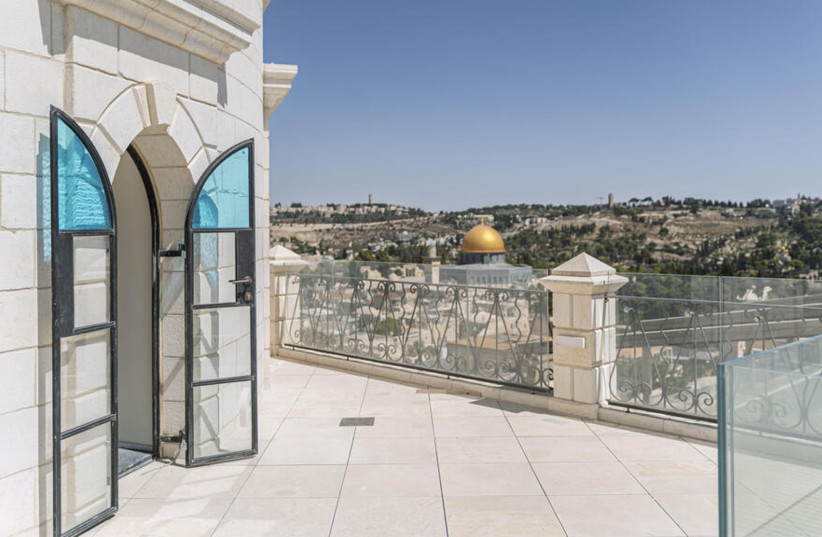
Rosenfeld’s concern about architectural authenticity made little impression on then-JQDC chairman Moti Rinkov. The JQDC, together with the Ben-Zvi Institute, has also published High Upon High, in which 12 historians trace the venerable synagogue’s history.
Rinkov noted at the second cornerstone-laying ceremony: “The renovation and restoration of the Tiferet Yisrael Synagogue in the Jewish Quarter is one of the most important and exciting projects I’ve taken part in.
“Rebuilding the synagogue is, in fact, raising the Israeli flag in the Jewish Quarter. It’s truly a work where they’re restoring the crown to its former glory and restoring glory to the Jewish people.”
The rebuilt Tiferet Yisrael, together with the Hurva, now shapes Jerusalem’s skyline not as an authentic historic landmark but as what Rosenfeld described as a “postmodern simulacrum.”■