Israelis and Arabs can and do work well together - data supports it
92.5% of Jews and 98% of Arabs working in a mixed Jewish-Arab setting viewed relations between the two groups as “good” or “very good.”
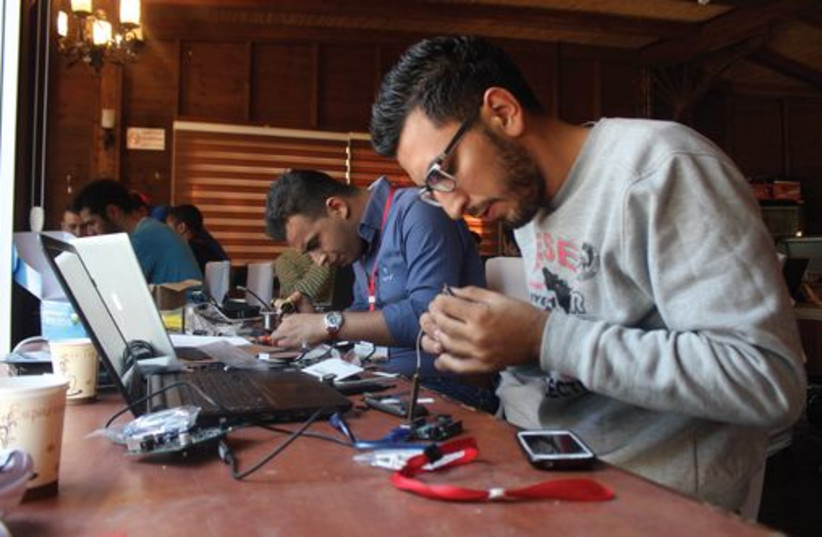
ISRAELI-ARAB and Jewish engineers work together at Moona’s center in the northern Arab town of Majd al-Krum. (photo credit: FADI HASHEM)ByNASREEN HADAD HAJ-YAHYA
The government has now approved a five-year plan for Arab society in Israel, budgeted at around NIS 30 billion – around three times the sum allocated in the previous five-year plan (Government Resolution 922).
That the government has acknowledged the urgency of investing in Israel’s Arab citizens should not be taken for granted. For years, budgets directed to the Arab population were low, did not respond to the population’s real needs, and were allocated without giving the population a voice in the allocation process. Consequently, Arab Israelis were relegated to the margins of society, with discrimination against them being apparent in all areas of life: employment; creation of jobs; the Arab education system; informal education welfare services; infrastructure in Arab localities; transportation; and of course, on issues of planning and housing.
In this context, the Netanyahu government made good progress with its introduction of the previous five-year plan, implemented between 2015 to 2020. That plan was innovative on two levels: the sum of the allocation – about NIS 10 billion – along with the change (even if partial) it brought with it in the budgeting mechanisms of government ministries, and the requirement that their allocations should reflect the relative size of the Arab population in Israel.
At the same time, the plan had many flaws. First, though NIS 10 billion sounds like an unimaginable sum, it is not sufficient to make up for decades of discrimination. Second, the actual budget outlay stands at around NIS 6 billion, meaning that only 60% of the available budgets were utilized. And third, the plan did not relate to several critical areas, such as health, welfare, tourism, and culture.
The new five-year plan represents an unprecedented investment in the Arab population, and it comes at a critical time, with soaring levels of violence and crime in Arab society.
Tsofen encourages the establishment and development of hi-tech centers in major Arab cities and communities. (credit: Courtesy)
Specifically, the investment in employment, estimated at around NIS 1.4 billion, is of critical significance. In recent years, employment rates among Arab men have stagnated, and even dropped slightly. The corona pandemic exacerbated this trend, with the data revealing that Arab men are the population group hit hardest by the labor market crisis.
In 2017, the employment rate for Arab men age 25–64 stood at 77.5%; by 2019, it had declined to 76.1%; and since then (according to data from the second quarter of 2021), it has plummeted to 64.9%.
By comparison, non-haredi Jewish men have barely suffered from the crisis, at least in terms of employment, with a drop of just 1.1 percentage points in their employment rate between 2019 and the second quarter of 2021 (from 86.3% to 85.2%). Among Arab young adults (men and women age 18–24), the situation is even worse: 40% of them are defined as NEET: not in employment, education, or training.
One of the main barriers to budget utilization in the previous five-year plan was the practice of designing programs “over the heads” of the Arab community – without their input and participation, and without a deep understanding of the problems on the ground.
In this sense, the process of developing the new plan has been substantially different, in that representatives of Arab society have had a prominent say in its design. This is a highly unusual situation, possibly unprecedented in Israeli history, in which politicians, civil servants, and representatives of Arab society are all speaking the same language. For the first time, we are seeing the recognition and involvement of at least some of the elected Arab representatives and collaboration with civil society organizations.
For the government to meet the employment targets it has set for Arab society – 46.3% for women and 75.8% for men by 2026 – the ministries and their agencies must continue to collaborate with representatives of Arab society and civil society organizations. Only a joint effort will raise the employment rate and improve employment quality, along with a discourse of equality and transparency that will also help identify barriers on the ground, channel budgets in an efficient manner, and ensure that they are fully utilized.
It should be emphasized that the economic investment is in and of itself a very welcome step, as it will reduce poverty and raise the standard of living in Arab localities, and – in the long term – will also reduce violence and crime.
But the new plan also provides us with an opportunity for generating even greater impact. Growing Arab participation in the workforce, and particularly entry into high-quality employment, will increase the number of “mixed” workplaces in which Jews and Arabs work together. Working alongside one another helps dissipate the stereotypes held by each group, and can have a positive impact on the complex relations between Jews and Arabs, especially in times of crisis.
A survey conducted by the Viterbi Family Center for Public Opinion and Policy Research at the Israel Democracy Institute found that 92.5% of Jews and 98% of Arabs working in a mixed Jewish-Arab setting viewed relations between the two groups as “good” or “very good.” This is an unprecedented finding, which demonstrates that mixed workplaces can play a vital role in fostering relations between Jews and Arab and in Israel, which were dealt a severe blow by the events in May and are in need of recovery and rehabilitation.
Dr. Nasreen Haddad Haj-Yahya is director of the Arab Society Program at the Israel Democracy Institute.