
How did Russia, a land that did not allow Jews to enter its cities until fairly recently in its long history, amass one of the most significant collections of Jewish manuscripts anywhere in the world?
As Prof. Shimon Iakerson explains it, Russia has always been a wealthy kingdom and its rulers had large-scale spiritual aims as well as earthly ones.
“Voltaire’s entire library is in Russia,” he points out, “and the largest collection of Rembrandt paintings is in St. Petersburg. The Codex Sinaiticus, too, used to be in a Russian collection before it was bought by the British Library.” Also known as the Sinai Bible, it is a fourth-century example of a handwritten codex of the scriptures in Greek.
While his theories are no longer seen as valid, it is possible he inspired others, such as Arthur Koestler, to seek alternative Jewish histories. Arthur Koestler argued in his 1976 book The Thirteenth Tribe that European Jews are descendants of Khazars and are, ergo, not really Semitic. His ideas, too, were put aside once modern genetics emerged as a science.
When Russia annexed Jews and the lands they had been living on after the third division of Poland, it kept Jews where they were. Most rabbinical Jews in the west of Russia were meant to reside in the pale of settlement with Crimea, in southern Ukraine, being perhaps the only place in the world where Karaite Jews outnumbered rabbinical ones.
While in Egypt in 1863, Firkovich discovered a Cairo collection of Jewish treasures years before Solomon Schechter made his own contribution in 1896 by studying the Cairo Geniza. To advance his own views, Firkovich was not above “fixing” (some would say, “doctoring”) manuscripts. Iakerson, who is being ironic when he describes Firkovich as “one of my personal ‘heroes,’” presents a detailed record of how the fakes can be correctly understood today using means that were not available when the original collection was sold to the Imperial Library in St. Petersburg (the English-language lectures are online at the Beit Avi Chai website).
IAKERSON (THE surname is a variation of “Ben Yakir”) took the public on a fascinating virtual journey from St. Petersburg to Sarajevo and Washington this Passover as he explained the different forms Jews created to tell the tale of the Exodus from Egypt during the Passover meal.
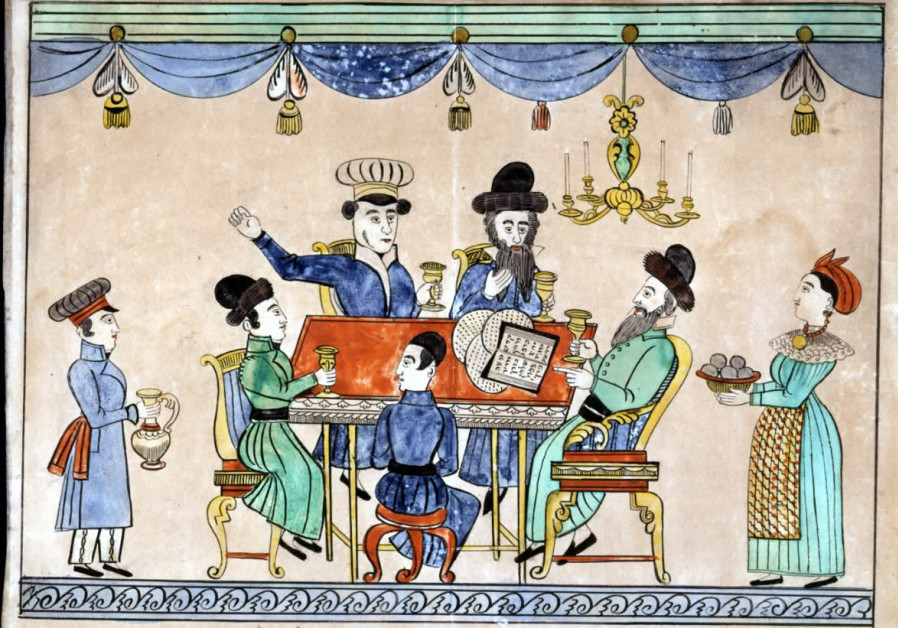
The art depicts the four sons of the Haggadah: the wise son in religious garbs, the evil one clean-shaven with a military hat, and the one who does not know how to pose questions looking at the arrival of a waiter and not paying attention to the dinner table at all.
“I have a very Russian soul,” shares Iakerson, “so this art gave me great joy as it reminded me of the famous poem “Who is Happy in Russia?” by Nikolai Nekrasov, in which he asks when the people will put on their walls not the portrait of some foolish army general but of Gogol or [literary critic] Belinsky. In Russia, children learn this poem in school, and here we have an example of how the average Jewish person going to market to buy his necessities also finds the time to buy something of a spiritual nature, just as the poet hoped.”
Having been raised in the USSR, Iakerson learned of his Jewishness in an unpleasant way as systematic antisemitism limited the numbers of Soviet-Jewish citizens allowed to gain higher education.
“I was actually pretty lazy so I did not mind not going to university,” he jokes, “but I said, if I am a Jew, I might as well know what that means.” He was able to do so thanks to Hebrew education books given to him by Aba Taratuta. An iconic figure from the struggle of Soviet Jewry to exit the USSR, Taratuta authored a study book of his own in the 1980s called Hebrew in Pictures and was deeply involved in spreading samizdat (banned information). He immigrated to Israel in 1988 and resides in Haifa.
“I did not wish to leave Russia to live in Israel myself,” Iakerson explained, “so I knew I had to study on my own and despite not having a unique talent in languages, fell in love with Hebrew. It is only thanks to the generous spirit of many other people who offered me help along the way that I eventually got my education and eventually even an academic career.”
They include Hebrew palaeography expert Prof. Malachi Beit-Arye, Prof. Menahem Ben-Sasson, Judeo-Arabic language expert Prof. Haggai Ben-Shammai and Prof. Joseph Yahalom. All these Israeli scholars arrived to promote their research in Russia as soon as the Iron Curtain collapsed and Iakerson was able to work with them as their assistant as a young man.
“Beit-Arye is my life’s hero,” he explains in earnest, “as he suggested I move from the study of early printed books to the study of manuscripts.” This is not common as most scholars focus on one field or the other, while he is able to do both.
Noting that one of the reasons he enjoys his field so much is that “we study material things – paper, ink and binding.”
He explains that the Passover Haggadah itself was not always in the shape we now recognize.
“Some Jewish prayer books included the Haggadah,” he points out, “and the production of individual books meant to be used on Passover was also acceptable.”
This eventually became the standard for most Jewish families today. Even the format of the Passover meal was formally established by Maimonides in his 1168 work Mishneh Torah. This book too was written and copied by hand, seeing as the printing press would be invented only 300 years later.
FIRKOVICH KEPT a working relationship with another great collector and dreamer, Ephraim Deinard.
Deinard was also a writer and trader who sought to build a Jewish agriculture community in Nevada and was the most prolific Hebrew publisher in New Jersey during his own lifetime. Deinard donated the deeply beautiful Haggadah copy created in 14th-century Germany by Joel ben Simeon to the Library of Congress, which is why it is known today as the Washington Haggadah.
In his lecture, Iakerson reveals more about the Sarajevo Haggadah. Created in the 14th century too, this telling of the Passover story is one of the best-known examples of Jewish-Sephardic art with some claiming its depictions of the creation of the world contain Cabbalistic secrets. Prof. Shalom Sabar, Iakerson notes, is a leading world expert on that volume.
Iakerson is the proud father of Dina Yakerson, a painter who lives in Israel, and Mura Yakerson, a mathematician who lives in Switzerland. He “laments” that despite being the daughters of a famous scholar of Hebrew language, both daughters spell their surname with a Y instead of an I.
While in the US for Passover, the host asked him if he could share a recent discovery with the guests.
“Of course,” said the visiting Jewish-Russian scholar. “I have found that the copies we all use that request people drink four cups of wine are all wrong and that an earlier version requires Jews drink 14 cups of wine. Yet sadly, the “teen” got dropped during the generations of copying the text down.”
The host laughed at the joke and then warned him not to repeat it. “Some people,” he cautioned, “would believe anything you tell them.”