
The great and ambitious project of building a house to host the presence of Hashem (God) was about to begin.
The instructions had already been delivered and carefully studied by Moshe and his team of craftsmen. The materials had been collected and prepared. To launch this construction project, the entire nation was assembled. Our step forward into history began with a moment of shared awareness and national gathering. That experience of gathering – kahal in Hebrew – gives its name to the parasha that records this moment: Parashat Vayakhel.
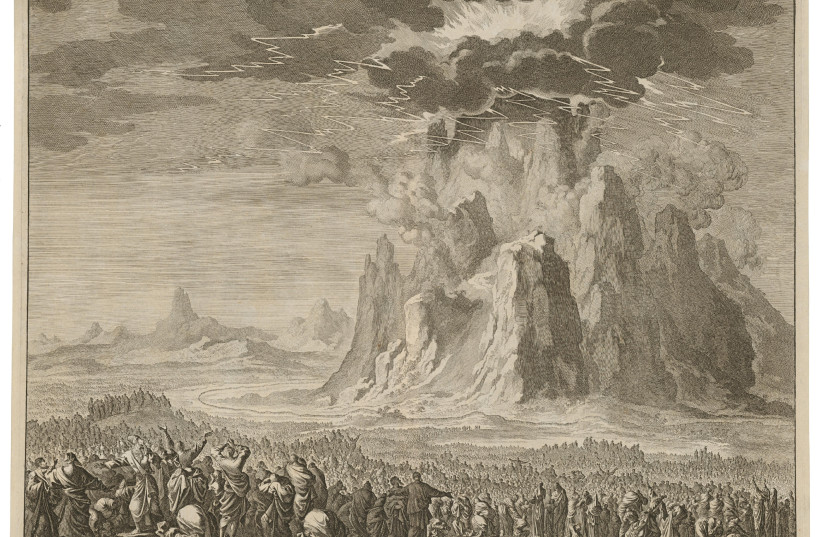
This was not the first moment our entire nation gathered as one. Months earlier, we had stood together beneath a mountain, receiving the direct word of Hashem. Judaism alone makes the bold claim that an entire nation stood shoulder to shoulder and listened to the voice of God. That day became known as the day of assembly – in Hebrew, “Yom HaKahal.”
This seminal gathering at Sinai was later reenacted every seven years in Jerusalem in the ceremony known as Hakhel. On the Sukkot holiday following the shmita cycle, our entire nation stood together in Jerusalem, listening to the Torah read aloud in a manner that echoed the moment at Sinai.
Yet the original pattern of national gathering was first established in the desert. In the desert, twice within a single year, the nation gathered as one – first to receive the Torah and then, months later, to launch the construction of the House of Hashem. The term kahal thus became synonymous with national identity.
But this national experience could not survive exile. When we left Jerusalem 2,000 years ago, we lost this defining feature of kahal. Scattered across the winds of history, we no longer experienced moments of national gathering. The unified voice that had once stood together at Sinai and in Jerusalem was replaced by scattered communities across the world.
Though the national kahal disappeared during galut, a different form of communal gathering emerged that proved essential for preserving Jewish identity throughout our exile. As we journeyed through distant lands, we did not dissolve into the surrounding nations but established semi-autonomous Jewish communities – often referred to as a kahal, especially in Ashkenazi lands.
These communities oversaw religious, legal, social, and economic affairs, ensuring the continuity of Jewish life under foreign rule. The kahal maintained an internal halachic court system so that Torah law and Halacha remained the foundation of Jewish communal life.
Kahals also managed communal taxation and raised funds to support religious institutions and the needy. Finally, they served as the official liaison between the Jewish population and authorities, negotiating communal protections and legal rights.
Through these efforts, the kahal safeguarded cultural distinctiveness, provided stability, and ensured the survival of Jewish life and identity even under the most difficult conditions of exile.
It was an extraordinary cultural and anthropological achievement. The original national identity of kahal was replaced by localized kahal communities that developed self-sufficient systems to preserve the fabric of Jewish life.
The modern 'kahal'
Today, history has begun to shift once again. Having returned to our homeland and built a country for Jews, we have begun to recover the national model of kahal. Israelis are less defined by local communities and synagogues than by a shared national experience.
Many immigrants from Western countries lament the weaker structure of neighborhood communities, but the deeper reality is that Israelis tend to experience their identity more as members of a nation than as members of local congregations.
During wartime, that national identity becomes more pronounced. When we defend our land against those who seek our destruction, we stand together as a single people. In recent days, Israelis have rushed to bomb shelters and remained confined to their homes without school or work.
In these moments, we feel a national experience. Missiles have targeted the entire country. Even when aimed at a specific location, sirens sound across wide regions, since fragments of intercepted missiles can fall far from the original target.
And once again, large numbers of reserve soldiers have been called up to reinforce the defense of our borders. In this war, as in every war we have fought, our belonging to a single people is felt with unusual intensity.
There were numerous personal moments that echoed this broader national experience. On the Shabbat when the war first broke out, we spent much of the late morning and afternoon in shelters. During that stretch, I found myself schmoozing with a group of visitors who had come to the Gush for a reunion of the original class of the hesder yeshiva in Ma’aleh Adumim.
The next day, I sat beside reserve soldiers who had just been called up to help protect the Gush Etzion area. They have been sleeping and eating at our yeshiva since the local army base lacks accommodations for them. In each of these encounters, I was surrounded by strangers, yet for 20 minutes in a shelter, we shared a common fate.
A few days later, the same experience repeated itself. Caught in a siren while in transit, I entered a shelter at an army checkpoint and spent 10 minutes sharing conversation and Tehillim with people who happened to be traveling along the same road when the siren sounded.
I also attended two curtailed weddings – one with fewer than 50 people, held in a backyard. I couldn’t help thinking how similar this wedding must have been to those of previous generations: a small group of relatives and friends gathered in the courtyard beside the synagogue.
Each of these moments highlighted how deeply we can still feel ourselves as a single kahal – one people – in Israel generally, and especially during wartime.
For me, the most poignant moment of collective identity was something I watched on television. Fragments of a missile had struck and damaged a home in Bnei Brak. As I watched local residents and police forces working together to rescue those inside, my mind drifted back to the painful scenes just two weeks earlier when residents of Bnei Brak had violently clashed with police and soldiers.
Without minimizing the severity of that episode, this scene of cooperation served as a reminder that despite our sharp and deeply held differences, we remain one people. We face the same dangers, and we stand together to recover from them.
There is one additional element of the construction of the Mishkan that has surfaced during the initial stages of this war. Women played an outsized role in the building of the Mishkan. They donated the gold and silver taken from their jewelry and were deeply involved in preparing the fabrics and curtains of the desert sanctuary.
Their role was so consequential that the Torah describes them as an army. Their enthusiasm and devotion to this sacred project resembled the dedication of soldiers.
This war, in particular, has highlighted the remarkable role that female soldiers play in defending this country. Many have been fully integrated into the air force. Even more have taken part in the many supporting dimensions of this war, from logistical support for the air force to the thousands involved in gathering and processing intelligence.
Our successes in this war have relied heavily upon the strength of our air force and the depth of our intelligence capabilities. Women are central to both of these pillars of national defense.
Our country has empowered women to play an essential role in defending our people. They deserve great credit for their efforts, and we deserve credit for building a society that enables every part of our population to participate in this heroic moment of Jewish history.
The writer, a YU-ordained rabbi at Yeshivat Har Etzion, holds an MA in English literature. His books include To Be Holy but Human: Reflections Upon My Rebbe, HaRav Yehuda Amital.
www.mtaraginbooks.com