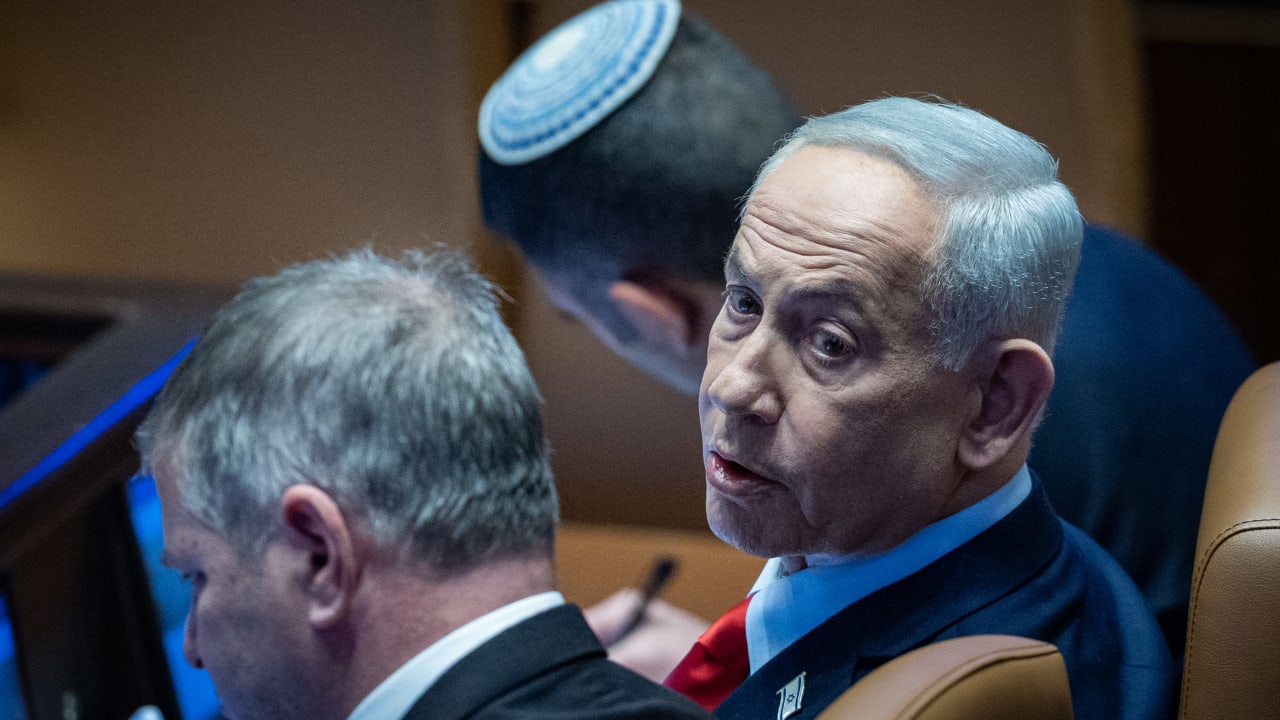
Netanyahu pardon debate exposes deep political and legal tensions in Israel
Al-Ittihad, UAE, February 19
For more stories from The Media Line go to themedialine.org
The prospect of a pardon for Prime Minister Benjamin Netanyahu remains a live and contentious issue within Israel, engaging the Justice Ministry, investigative authorities, advisers to President Isaac Herzog, and a circle of senior legal officials who continue to weigh competing interpretations and possible frameworks for clemency, irrespective of the form it might take or the structure reportedly floated by Washington following Trump’s proposal.
The current US president has been urging movement on the matter, recently reiterating his message to Herzog, who responded that the issue remains under review and that any request from Netanyahu is being examined carefully in light of the specific charges he faces.
Between Washington’s position and Jerusalem’s official reply lie several hard political realities. Most notably, public opinion in Israel – reflected in recent polling – leans toward the view that any decision must be made domestically, free of external pressure.
Even when the pressure comes from the White House, many Israelis regard it as unwelcome interference in internal affairs, underscoring the principle that Israel’s autonomy in decision-making must be preserved. However close and strategically vital US-Israeli cooperation may be, the question of a presidential pardon cannot be reduced to a function of bilateral relations alone.
At the same time, others argue that the debate has long since transcended the purely legal sphere and entered the political arena, raising profound questions about the judiciary’s reaction to a move that would intersect directly with cases in which Netanyahu himself sought to curb judicial authority. His previous efforts to recalibrate the balance of power through legislative initiatives – framed within Israel’s Basic Law and the doctrine of separation of powers – have already polarized the country.

Against this backdrop, the pardon debate is entangled with deep institutional tensions, diverging legal philosophies, and suspicions that the logic of executive clemency could blur into the logic of political intervention in Israel’s democratic processes. The fact that Netanyahu is standing trial while serving as head of government only intensifies the dilemma, particularly given that he formally requested consideration of a pardon only after Trump’s personal intervention.
The timing is especially sensitive as Israel approaches elections at the end of the year, when the mere possibility of clemency could alter the existing balance of partisan power and reshape the political playing field.
On one hand, a pardon could present a genuine strategic quandary for Netanyahu’s rivals, including opposition leader Yair Lapid and figures such as former prime minister Naftali Bennett, potentially reviving Netanyahu’s political momentum and heightening tensions, instability, and even factional divisions ahead of the vote.
On the other hand, failure to reach a definitive resolution could entrench the current stalemate, allowing Netanyahu to retain effective control of the political narrative – particularly if he becomes convinced that clemency will not materialize – while increasing pressure on coalition partners and intervening assertively to steer their leadership as the elections draw near.
Absent a conclusive outcome, an alternative strategy could involve reorganizing party structures and consolidating support through a calibrated plan reminiscent of the internal realignments Netanyahu previously tested within Likud, extending that approach to allied parties while keeping channels for tactical cooperation open.
For its part, the US administration has strategic calculations of its own in maintaining Netanyahu as a predictable interlocutor within an American security umbrella, particularly to ensure alignment on sensitive files such as Iran, Gaza, and the broader regional landscape.
At some juncture, Netanyahu could seek to recalibrate or even disrupt the existing framework – not necessarily over Iran, but perhaps in Gaza or Lebanon – invoking the primacy of Israeli security and asserting that Israel alone determines its defense posture, irrespective of external preferences, including those of the US.
In such a scenario, if divergence were to sharpen, Washington might feel compelled to revise the parameters of engagement and could conceivably extend overt or tacit support to alternative political actors, as Trump signaled when he hosted Lapid at the White House.
Indeed, an American administration could ultimately distance itself from Netanyahu should it conclude that he obstructs its core regional objectives or complicates broader diplomatic arrangements that extend beyond Gaza to encompass the wider Middle East.
This possibility forms part of the strategic calculus for Trump and his advisers, who continue to leave room for maneuver in their dealings with Netanyahu, drawing on experience in shaping political landscapes and constructing an American approach adaptable to unfolding realities.
Meanwhile, certain Israeli strategic visions may evaluate the regional and Arab environment through a narrower lens that diverges in emphasis and context from the perspective adopted by the current US administration – and even from that of Trump himself.
– Tarek Fahmy
Sudan: Necessity of restoring state’s authority
Asharq Al-Awsat, London, February 18
Sudan today confronts one of the most intricate structural crises in its modern history; a crisis in which the ongoing conflict has moved far beyond a conventional political or military rivalry and instead morphed into an existential confrontation between the very idea of the nation-state and its institutions and the competing vision of non-state actors embodied by parallel armed formations.
From the perspective of political sociology, the spiraling violence can only be understood as the predictable outcome of the collapse of the state’s legitimate monopoly over the instruments of force, a collapse that has flung open the gates to a social regression toward primordial ethnic and tribal loyalties and ushered in the ascendancy of warlords.
The recent UN reports documenting the killing of more than 6,000 people in just a few days in the city of Al Fashir by the Rapid Support Forces, along with systematic ethnic targeting of specific tribes, widespread sexual violence, and arbitrary detentions, cannot be dismissed as the incidental byproducts of war.
Rather, they represent the predictable conduct of militias when they supplant the state, transforming violence from a disciplined and legally bounded sovereign instrument into an exterminatory tool for imposing dominance and spreading terror.
Confronted with this unfolding tragedy, and against the backdrop of conspicuous international paralysis at the recent African Union summit, an Arab position is taking shape according to a coherent logic grounded in the imperative of safeguarding the integrity of the state and its institutions.
At the heart of this alignment lies the Saudi strategic vision, which recognizes that its own national security is inextricably linked to restoring the authority and stature of states within its immediate geopolitical neighborhood.
Riyadh’s approach to Sudan stems from a firm conviction that preserving the unity of the national military establishment constitutes the sole bulwark against the country’s descent into a battleground for rival warlords.
This stance stands in marked contrast to certain pragmatic regional policies that display little hesitation in engaging with parallel armed forces, thereby prolonging the conflict and deepening the tragedy of ethnic fragmentation.
For Saudi Arabia, supporting the option of a unified state in Sudan is not a matter of diplomatic preference but a central strategic necessity, since the Red Sea cannot realistically function as a corridor of stability while the opposite shore is consumed by institutional disintegration and ethnic division.
This vision dovetails with Egypt’s recent posture, which has articulated with unusual clarity an Arab strategy aimed at protecting the center of the state. Cairo has drawn explicit red lines, warning of a decisive and resolute response to any encroachment that endangers Sudan’s national security, which Egypt regards as an extension of its own.
A defining feature of Egyptian diplomacy in this context has been its insistence on addressing the root causes of the crisis, specifically the presence of foreign mercenaries and illegitimate militias, while unequivocally rejecting any equivalence between the national army and state institutions on one side and these parallel armed entities on the other. Such a rejection amounts, in essence, to a architecture of these proposals reflects a growing recognition that half measures, which perpetuate the duality of armed authority, merely defer an inevitable reckoning, and that the only durable solution lies in ending the rebellion and restoring the eroded central authority.
The brazen contempt displayed by armed factions toward unarmed civilians, and their attempt to impose a new political reality through the barrel of a gun, is now colliding with a solid wall of Arab resistance to the dismantling of state institutions.
In sum, stability in Sudan and security across its strategically vital regional environment can be secured only by reaffirming the foundational principle that the state alone must hold a monopoly over arms and organized force.
Any political settlement that fails to confront directly and decisively the problem of violent non-state actors would amount, in practice, to legitimizing disorder and postponing an impending collapse whose cost will ultimately be borne by the Sudanese people and the wider region alike.
– Abdullah Faisal Alrabeh
<strong>What Iran needs to know about Donald Trump</strong><em></em>
Nida Al Watan, Lebanon, February 19
What Iran must grasp – though it likely understands much of it already – is that it is not confronting a conventional political dealmaker, but a figure who operates with the patience and calculation of a master carpet weaver, threading strategy carefully and hiding the tightest knots in the finest details.
US President Donald Trump conducts policy through calculated maneuvering: He tests adversaries, escalates pressure, leaves space for tactical retreat, and then strikes when the balance tilts in his favor, aiming to secure advantage at the lowest possible cost.
In politics, there are leaders shaped by the system, skilled at navigating its established rules, and there are those who arrive from beyond its confines and proceed to rewrite those rules altogether. In modern American politics, Trump unmistakably belongs to the latter category. He did not rise through traditional party hierarchies, nor did he build his profile through years in legislative committees or executive offices. He emerged instead from the worlds of high finance and reality television, bringing with him the confidence of a businessman and the instincts of a seasoned media figure.
The evening when former president Barack Obama publicly mocked him before a room of Washington elites was more than a fleeting moment of political theater; it became a defining catalyst for a man who resolved to transform public humiliation into a political mission. Within a remarkably short span, Trump evolved from political outsider to dominant force.
Many questioned his capacity to lead a nation as vast and complex as the US, while others dismissed his rhetoric as a break from the norms of political decorum. Yet events demonstrated his ability to fundamentally reshape the bond between the Republican Party and its grassroots base, consolidating influence to such an extent that internal party challenges became increasingly formidable.
The Trump saga reached a dramatic crescendo after his initial departure from the White House. Criminal indictments, deepening national polarization, and the storming of the US Capitol – events his opponents viewed as the definitive end of his political life – seemed to signal closure.
Instead, the narrative shifted. Trump reentered the political arena and ultimately returned to the presidency for a second term, securing a decisive victory that underscored a profound shift in the American electorate and revealed an enduring crisis of trust between voters and the political establishment.
In foreign affairs, Trump charted a course distinct from that of the Obama administration. After the nuclear agreement with Iran negotiated under Obama, Trump adopted a strategy of maximum pressure, pairing sweeping economic sanctions with unmistakable demonstrations of military resolve.
To his supporters, this represented long-missing firmness in American policy; to his critics, it amounted to a perilous gamble with global consequences. What is beyond dispute is that he altered the negotiating calculus across the Middle East, redefining the parameters of engagement. His approach reflects a doctrine of calibrated pressure rather than reckless impulsivity.
Today, his legacy is frequently weighed alongside that of transformative presidents such as Ronald Reagan and Franklin D. Roosevelt. The comparison is less about temperament or intellectual lineage and more about historical footprint. American political memory tends to enshrine those who leave an indelible mark, whether forged through consensus or carved through confrontation.
Trump has never fit the mold of a conventional president, and he has made little attempt to do so. Yet despite the fierce divisions and controversy surrounding his tenure, he has cemented his status as a central figure at a pivotal juncture in American history.
To some, he remains a populist insurgent challenging entrenched elites; to others, he is a leader who has reasserted and redefined American power. What is undeniable is that the Trump phenomenon has moved beyond the man himself, evolving into a defining feature of an entire political era.
Iran understood this reality when it chose not to respond with direct retaliation after the US strike that killed Qasem Soleimani; the question now is whether it seeks to forestall an even more consequential confrontation today.
– Assaad Bechara
Egypt in Africa
Al-Ahram, Egypt, February 20
With strategic clarity and renewed confidence, Egypt is advancing within its African sphere, drawing on a substantial reservoir of political capital built and consolidated over recent years, in which Africa has risen to the forefront of Egyptian priorities. This trajectory has been shaped by an approach led by President Abdel Fattah al-Sisi, grounded in a clear recognition of the African continent’s centrality to Egypt’s national security and a firm belief in the indispensable role Egypt can play in promoting security and stability across Africa.
Egypt’s notable presence at the African Union meetings in Addis Ababa, the Ethiopian capital, was not symbolic diplomacy but a concrete manifestation of its deliberate and sustained engagement on the continent. The timing was particularly significant, coinciding with Egypt’s presidency of the African Peace and Security Council as well as its leadership of the Steering Committee of Heads of State and Government of the African Union Development Agency (NEPAD).
These positions of influence were visibly reflected in the outcomes of Egypt’s participation at the summit, most prominently in its firm stance against any encroachment on the unity and sovereignty of Sudan and Somalia, and in the African Union’s rejection of unilateral steps to recognize the so-called Somaliland.
Equally important was the adoption of the African Water Vision 2063, which incorporated principles long championed by Egypt, including the imperative of cooperation, respect for international law, and the obligation not to cause harm. Egypt operates from the conviction that the African continent must not remain a theater for disputes, crises, and conflicts, but should instead become a landscape defined by cooperation and economic integration.
It was on this foundation that Egypt articulated its vision during its presidency of the African Union in 2019 – a vision centered on advancing strategic transport corridors and logistics zones, deepening collaboration in energy and cross-border electricity interconnection, strengthening agricultural development and food security, promoting intra-African trade, and expanding partnerships in communications, information technology, and artificial intelligence.
What distinguishes this Egyptian strategy is not merely its scope, but the political will underpinning it – a determined effort to elevate Egypt’s relations with African states to a higher level of engagement and mutual benefit. This commitment was underscored by the appointment of Ambassador Mohamed Abu Bakr as deputy minister of foreign affairs for African affairs, a move that sends an unmistakable signal that the African portfolio occupies a top-tier position in Egypt’s foreign policy agenda.
Cairo’s vision for achieving genuine African integration rests fundamentally on reinforcing collective African action. Having presented what it regards as a distinctive national development experience, Egypt has expressed a clear readiness to contribute to the renaissance that Africa both deserves and possesses the resources to achieve. In this context, Egypt shows no hesitation in asserting a strong and sustained presence within its African environment – a presence that is no longer rhetorical but increasingly tangible on the ground. – Majed Mounir
Translated by Asaf Zilberfarb. All assertions, opinions, facts, and information presented in these articles are the sole responsibility of their respective authors and are not necessarily those of The Media Line, which assumes no responsibility for their content.