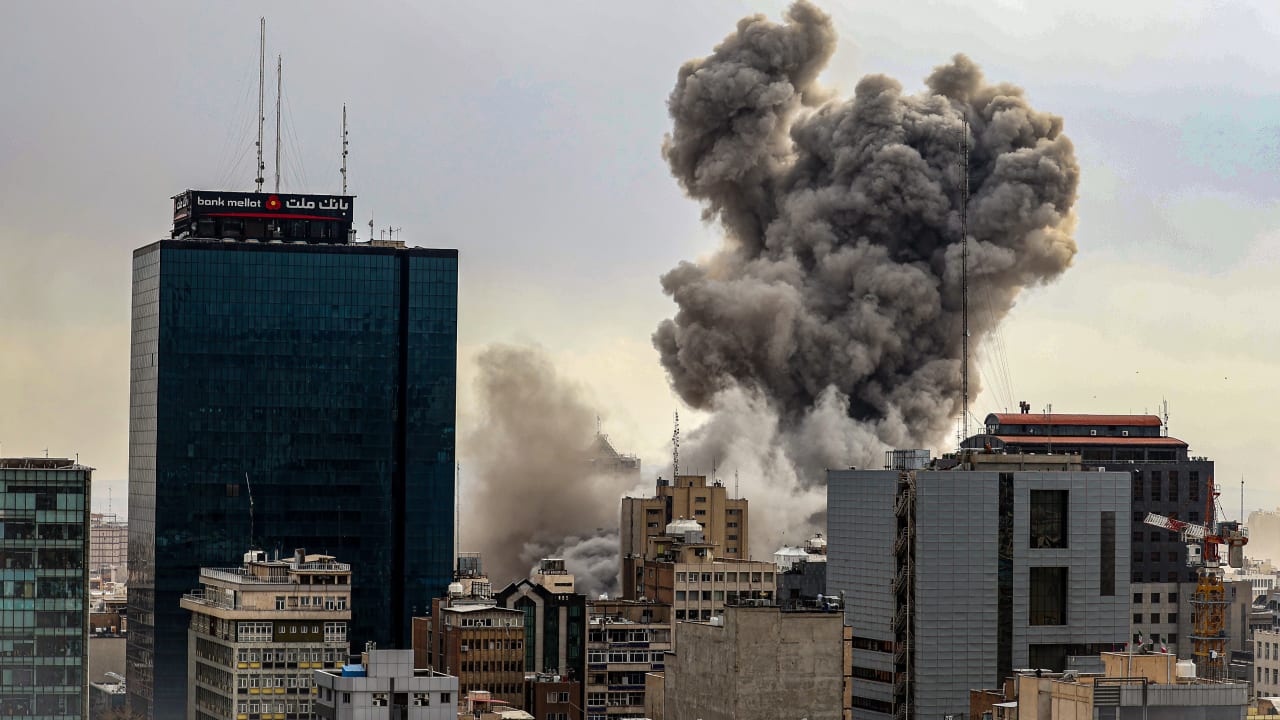
Israel and the US have hit the Islamic regime harder and across a wider swath of territory in recent days than in the opening phase of the 12 Day War in June, experts from the Armed Conflict Location & Event Data Project (ACLED) told The Jerusalem Post this week.
In June, large stretches of southwestern Iran remained largely untouched in the war’s early days. Currently, the combined Israeli and American operations (Roaring Lion and Epic Fury) have reached deep into and around Hormozgan Province, Sistan and Baluchestan Province, and Khuzestan Province, signaling a broader campaign.
The scope of Iranian retaliation has also shifted.
During the June conflict, Tehran concentrated its firepower on Israel. Now, the Islamic regime is expanding its response, targeting neighboring countries and US bases across the region.
“Iran will attempt to impose costs across the region through attacks on tourist areas, expat zones, and US bases,” ACLED CEO Prof. Clionadh Raleigh said.
“Internal chaos is likely in Iran as succession layers are removed and the chain of command fragments,” she said. “It’s hard to define a timeline, but this presents a high risk of rapid escalation rather than gradual deterioration.”
“The US and Israel have said they are pursuing regime change rather than deterrence. In practical terms, the costs of this will be borne by civilians, with a threat to wider regional stability as regional alignment is increasingly fractured. There is clearly potential for wider conflict involving proxy networks,” Raleigh noted.

Right now, the regime is concerned that it lacks the ammunition or launchers, Menahem Merhavy, a fellow at The Harry S. Truman Institute for the Advancement of Peace at The Hebrew University of Jerusalem, told the Post.
He considers Iran’s attacks on its neighbors a “desperate” gamble to see if they will pressure the US to end the attacks.
“I think they’re taking a very big bet, because at some point, their neighbors might turn against them again, just like their people will – if they radiate weakness or people feel that they’re on the brink of collapse,” he said.
“Their neighbors might join in [the attacks against Iran], and it’s a huge risk they’re taking, and they’re taking this risk exactly because of their despair. Really, they’re at a desperate moment now.”
The aims of the war
Regarding the aims of the joint operations, only a change within the Islamic regime is a realistic goal at this point, Merhavy believes, not a new system of governance.
The power structures may change, and Iranian politician Ali Larijani may become president, or an Islamic Revolutionary Guard Corps (IRGC) official may take control, turning the country into a military dictatorship – but the chances of Iran emerging into a liberal democracy are slim, he believes.
In recent weeks, leading up to the death of former supreme leader Ali Khamenei on Sunday, Larijani has been frequently named as a major player on the Iranian political scene.
On Sunday, Larijani announced that a temporary leadership council would be set up to deal with the power vacuum.

Appointed in August as secretary of the Supreme National Security Council (SNSC), Larijani has held senior jobs in a career marked by loyalty to Khamenei and efforts to expand his power.
Larijani ran unsuccessfully for president in 2005 and later sought to contest both the 2021 and 2024 presidential elections, but he was barred by the Guardian Council based on issues such as lifestyle standards and family ties abroad.
The regime “will do its best at the moment, to nominate somebody in place of Khamenei. That’s very important,” Merhavy continued. He foresees, however, that there would be security issues in attempting to follow the constitutional process, since gathering an assembly of senior clerics and officials would be too risky.
Larjani’s temporary leadership council, Merhavy explained, is meant to fill the void and mediate the risk of gathering potential targets under a single roof.
While a temporary council benefits Larjani in the short term, the regime still requires a supreme leader, a role Larjani is unsuited for, in Merhavy’s opinion. He added that the longer the regime continued without a leader, the greater the chance of a civilian uprising.
The regime leadership knows, he said, “that every day and every hour that this extends, it raises the risk of some uprising among the people.” He predicted, “It won’t happen in the next day or two, but maybe a week from now, it’s definitely a possibility. When people start to feel that the system is weak enough to challenge it, they will.”
Raleigh said that a mere 10% of the Iranian population can be considered staunch supporters of the regime, echoing the claims of former US Cyber Command Deputy Commander Lt. Gen. Charles L. Moore Jr., who told the Post on Sunday that 80% of Iranians want to see the regime replaced.
Perhaps the most noticeable differences between the June war and the current operations lie in the events leading up to them. Iranians have braved the regime’s brutality to protest; first against the country’s economic struggles and, later, the brutal and violent repression of their demonstrations.
Merhavy noted that Khamenei’s death was openly celebrated on the streets of Iran, and that currently, due to the war, the Basij and security forces are too busy to attempt to suppress dissent.
The most recent Internet blackout, similar to those imposed in early January, has prevented civilians from sharing online information about strike sites and the status of dissent or civilian damage.
As it currently stands, much of the information available is based on the regime’s own narratives.
The majority of the population of Iran is part of an ”unorganized opposition movement,” Raleigh noted, adding that the coming weeks and months would “see a risk of local power struggles as central control weakens, bringing with it potential for jailbreaks, defections, and localized violence.”
Prince Reza Pahlavi taking power?
Asked specifically about exiled Prince Reza Pahlavi taking power, given his growing presence in Western discussions, Merhavy said he doubted the feasibility of such a plan, despite it aligning with Israel’s interests.
“I still see him as an anecdote, and not more than that,” he admitted. “As much as I wish that he would take over, and, as an Israeli, it’s definitely a better kind of outcome; I think it’s too ideal to believe that he could take over Iran in the foreseeable future.”
The “best you can hope for” in Iran would be someone from within the Islamic regime ”taking the state somewhere less militaristic or less antagonistic… maybe toward the West,” he suggested. “Anything beyond that is a little too naive or too optimistic to hope for.”
Though ACLED highlighted the significant differences in the opening phases of the wars, Merhavy said he believes that the conflict will be of similar duration, suggesting that the regime will “raise a white flag” before risking losing power.
“They will find some kind of compromise,” and will likely commit to giving up their nuclear program and whatever is left of their missiles.
Iran pushing US and Israel to all-out war
The regime was apparently unaware of how far it was pushing the US and Israel to all-out war and threatening its own existence, Merhavy said, but said that now, the point was being “driven home.”
Once it becomes aware of how dire its situation is, either a politician or an IRGC member will seize control and reach an agreement with the US, he predicted.
In light of Iran’s failure to maintain multiple agreements and its denial of access to IAEA monitors multiple times in the past, the Post asked Merhavy how the US and Israel could trust any agreement with the regime. He replied that it was important to be realistic about what could actually be achieved.
“I think look for now the best you can hope for, and I think we need to be realistic about what is achievable here: a trauma to this regime that will make it want to stay away from such a situation for years to come,” he answered, implying that the war would have to be devastating enough to for the regime to refrain from recreating the conditions that led to the conflict.
While Merhavy asserted multiple times that, while he did not believe the US or Israel could overthrow the regime, he did think it would “collapse” eventually.
In the meantime, Larjani could take Iran “on a somewhat less antagonistic and hostile course toward the West,” because otherwise, he warned, “it’s really facing much harder years than the previous ones.”
Reuters contributed to this report.