
AMERICA AND THE TALIBAN – WHAT’S NEXT?
Al-Ahram, Egypt, August 26
For more stories from The Media Line go to themedialine.org
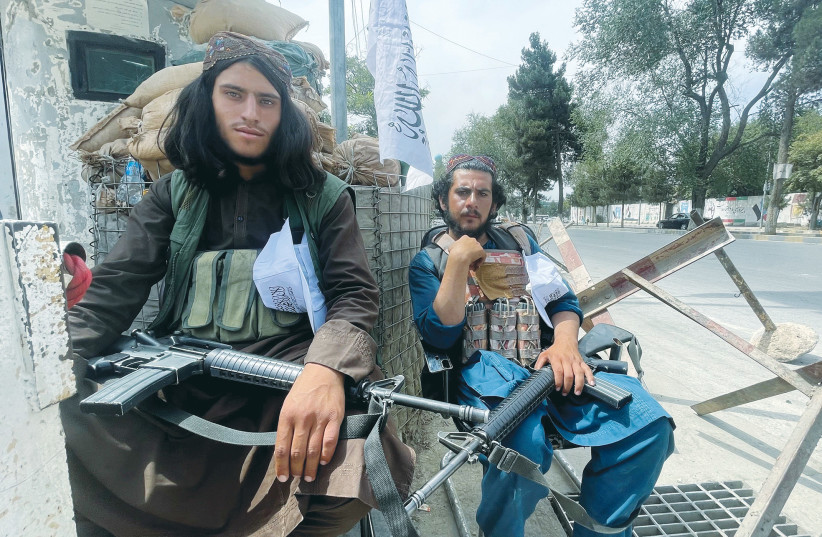
The confusing scenes coming out of Afghanistan in the past few weeks have raised some speculation about secret understandings that may have been reached between the United States and the Taliban. According to some observers, the Taliban agreed to work against two of America’s largest enemies – namely, Iran and China, with whom Afghanistan shares a border.
However, these reports seem to lack credibility. The Taliban has no interest in launching a direct confrontation with a major superpower like China, which extended a helping hand to the movement in the past few years, and can significantly support economic development in Afghanistan. The Taliban desperately needs Beijing’s support to help its recovery efforts following years of war.
Taliban leaders need no intelligence or economic knowledge to realize that they and China have an interest in building a strong relationship.
China is ready to inject investments in Afghanistan, as the opportunity it has long been waiting for to link Afghanistan with Pakistan within the framework of the Belt and Road Initiative is back on the table. Also, other investment projects in Afghanistan already are being discussed in Beijing, which is looking forward to activating agreements it signed with the former Afghan government, but which are yet to be implemented.
Iran, too, doesn’t seem like a military front the Taliban is interested in pursuing. Despite the ideological contradiction between the Taliban and the mullahs, Iran seeks to build on a tacit alliance with the Taliban against the Americans. The Taliban will need, at least for a while, the revenue from duties on goods imported from Iran. There is no reason for it to escalate the situation on its western border.
The decision to allow Afghan Shi’ites to revive the Ashura rituals in Mazar-i-Sharif a few days ago sends a clear pacifying message to Tehran.
All this isn’t lost on the Americans. Even if the United States reached a secret understanding with the Taliban surrounding the withdrawal of US troops from the country, it’s highly unlikely that the Taliban will willingly enter a confrontation with China and Iran, on which it depends for its survival. – Waheed Abdul Majid
RACISM AGAINST JEWS IN THE ARAB WORLD
Al-Qabas, Kuwait, August 26
I wrote a while ago on the subject of racism, and how there are countries that try to limit the phenomenon by imposing severe penalties on those who abuse others on racist grounds.
My article showed that the groups most often targeted with racism in the Arab world aren’t Alawites, Armenians, Assyrians, Bahais, Berbers, Copts, Ismailis, Kurds, Sahrawis, Turkmen, Yazidis or Nubians, but, rather, Shi’ites living in Sunni societies and Sunnis living in Shi’ite societies.
While my article was well received by many, an Iraqi colleague of mine pointed out my failure to address the historically abhorrent treatment of Jews who live in the Muslim and Arab world, particularly in Iraq.
In Iraq, it was customary to take wealthy Jews hostage just so they could be released for exorbitant ransoms. One of those kidnapped, for example, was the son of the chief rabbi of Iraq.
These actions led many wealthy Iraqi Jews to leave their country and move to other states, where they became wealthy businessmen.
With the rise of the Nazi ideology in the 1930s, Jews began facing growing hatred in the Arab world. The decision to revoke the citizenship of Iraqi Jews was one of the ugliest and most prominent manifestations of racism against Jews in Iraq’s history.
My colleague ended his message by pointing out that Jews of other Arab countries have also suffered from racism.
Had it not been for the violence and hatred directed against them, they would have stayed in their homelands, which they loved and to which they were loyal. Instead, the Arab world lost them as active contributors to their societies.
In this regard, let’s not forget the Arabs of Israel, who, despite various types of racism that exists against them, may prefer to stay to live and work in Israel, rather than immigrate to any Arab country. There may be a reason for that. Perhaps, after all, Israel’s “racist hell” is dramatically better than the “paradise” of many of its neighboring countries. – Ahmed Al-Sarraf
DEMONIZING AND VILIFYING SAUDI ARABIA’S TREATMENT OF WOMEN
Al-Riyadh, Saudi Arabia, August 27
Despite the unprecedented empowerment and emancipation experienced by Saudi women, thanks to the incredible reforms led by King Salman bin Abdulaziz, there are still those who wish to demonize Saudi Arabia on the grounds of gender discrimination.
The king’s reforms led to extensive investments in women, their promotion in all fields of life, and their empowerment to enter the workforce. Indeed, in recent years, women’s participation rate in the labor market nearly doubled, growing from 17% to 31% over the course of several months.
The fruits of the reform program, led by His Highness Crown Prince Mohammed bin Salman, the godfather of the kingdom’s Vision 2030, are acutely felt throughout the kingdom. Today, Saudi women hold scientific, educational and governmental positions. They participate in jobs in both the public and private sectors. They’re involved in municipal councils, chambers of commerce, Shura councils and district courts. They even hold leading diplomatic posts, representing Saudi Arabia in international fora and maintaining a remarkable presence in the technology and entrepreneurial worlds.
Unfortunately, there are those in the West who have a vested interest in swaying public opinion against the Kingdom of Saudi Arabia. Many media outlets portray Saudi Arabia as a country of gender persecution and violation of rights, no matter how much we work to pave the way toward gender equality. Those behind these campaigns have a vested interest in embarrassing Riyadh. They include powerful figures associated with the Muslim Brotherhood.
This continuous scheme coincided with the rise to power of the crown prince, who laid out an ambitious vision for Saudi Arabia’s future.
Therefore, it was not surprising that US Sen. Robert Menendez, chairman of the Senate Foreign Relations Committee, recently presented a draft resolution condemning the political detention of women and calling for the immediate release of female political prisoners. The draft resolution targeted 10 countries around the world, including four countries in the Middle East, one of which is Saudi Arabia!
Unfortunately, a loud minority belonging to Saudi society has been helping institutionalize these stereotypes. Despite all of the measures taken by the kingdom to address any shortcomings in women’s rights, the West is looking for any loophole through which it can undermine the kingdom’s progress. This is all part of an organized and concerted campaign to brainwash the minds of Westerners against Saudi Arabia.
This raises the question: How can the kingdom work to combat this smear campaign in order to portray its true image? How can it reach the millions of young people whose views of Saudi Arabia are shaped by the false content they consume on social media platforms and media outlets, many of which are owned or financed by countries and entities hostile to Riyadh? – Baina Al-Mulhim
Translated by Asaf Zilberfarb.