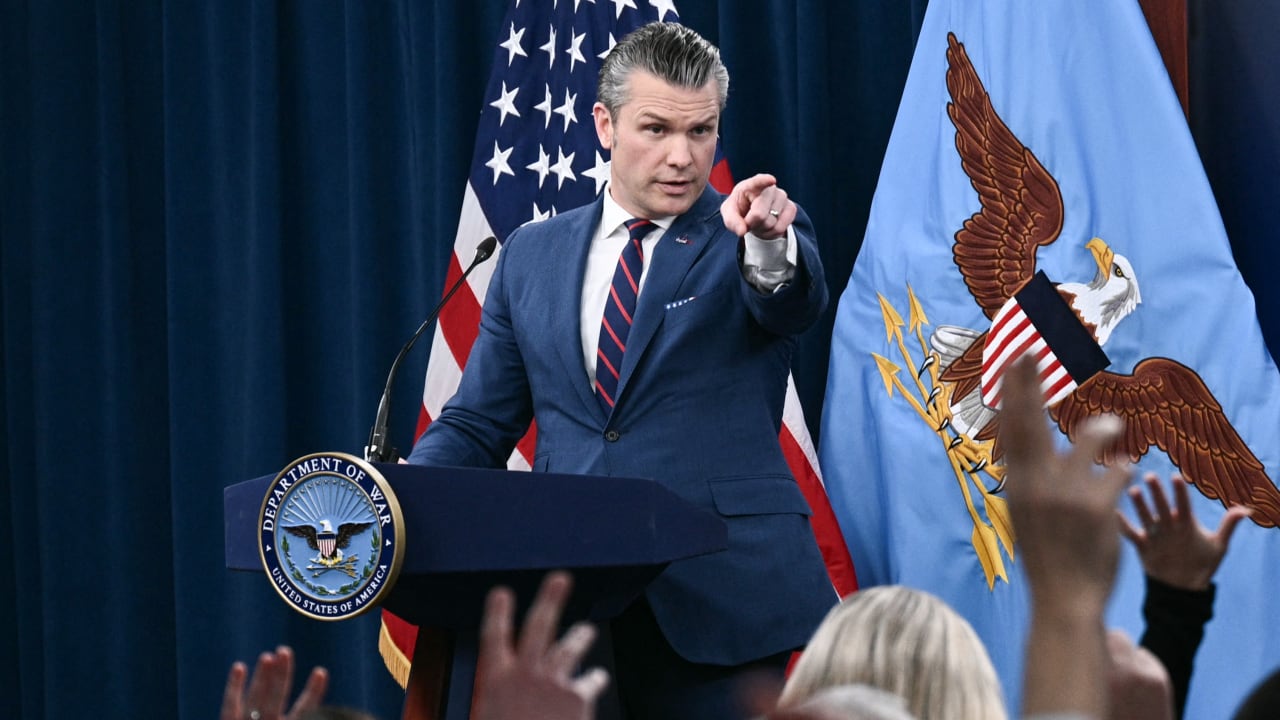
Until this war began on February 28, US Defense Secretary Pete Hegseth was a marginal figure to most Israelis. Then came the Pentagon press conferences. With one briefing after another, the US defense secretary delivered tough talk on Iran, glowing praise for Israel, and a camera-ready performance that Hebrew media immediately seized on. Within days, he had gone from obscure American official to full-blown Israeli fixation, clipped, reposted, thirst-posted, and discussed by men and women alike.
It began with the briefings and with the lines. Hegseth spoke about “historic” results. He praised the Israeli military in warm terms. He said the campaign was producing decisive progress. He insisted it would not become an “endless war.” Then came the reported phone call with Defense Minister Israel Katz, in which Katz’s office said Hegseth urged Israel to keep going “until the end” and added, "We are with you.” For Israeli audiences, that was enough to turn a Pentagon official into a recurring face on the feed.
Shortly after, Mako boldly declared, “Pete Hegseth is the star of the war.” Then it pushed further, with the line, "The women want to be with him; the men want to be him.” Ynet gave its own take, describing him as someone who “adores Israel” and had become the war’s breakout figure. Israel Hayom joined in with its headline, “War star: Trump’s man at the Pentagon.”
Character behind the podium
Ynet described him as “a striking-looking man” who “knows how to look at the camera,” adding that “nothing can damage his arrogant confidence.” Mako ran a second profile under the headline, “The war minister and the scandals: Who are you, Pete Hegseth?” and reminded readers that until a few days earlier, he had been a fairly anonymous figure to most Israelis. In other words, the Hebrew media was already telling two stories at once: the tough-talking war frontman and the messy, complicated character behind the podium.
Hebrew Instagram accounts later turned his face into quote cards and reels. One post framed him as “the TV host who became Trump’s war minister.” Another highlighted his line about Iranian Revolutionary Guard leaders looking up and “seeing only us.” Another blasted out his “historic results” remark in oversized Hebrew text. Another built an entire post around the Katz-Hegseth call and the sense that Trump and Netanyahu were reshaping the Middle East together. By that point, Hegseth had moved from the briefing room to social media feeds.
The tone online shifted from account to account. Some treated him like a serious wartime voice. Others leaned into the full character package. One Israeli post celebrated the partnership between the US and Israel, prominently featuring Hegseth, akin to a movie poster. Another post highlighted Hegseth's praise for Israel as a capable ally, recasting it as an American endorsement that Israelis could proudly display. And then there were the more playful reactions, the ones that made clear that the affair had already spilled into thirst post territory.
'Loves Israel,' and 'handsome'
One of the sharpest came from Mako writer Aspir Eyubov, who summed up the whole phenomenon with the line: “In short: cheater, alcoholic, loves Israel, handsome." This take on the whole ordeal simultaneously captured the tabloid angle, the baggage, the admiration, and the joke. It also succinctly captured the combination of reasons for Hegseth's rapid spread in Israel.
Hegseth is someone who praises Israel without hesitation. He is a Pentagon figure who sounds less like a policy seminar and more like a bar fight. He is an official whose briefings seem built for virality over operational assessment. That makes him unusually legible to Israeli audiences, especially in the middle of a war.
That does not mean every Israeli admires him or agrees with him. It means a striking number of Israelis are watching him, sharing him, and turning him into content. For now, Pete Hegseth is one of the war's most clickable side characters.