
In the autumn of 1978, as the Shah’s regime was collapsing under the weight of mass demonstrations, Michel Foucault traveled to Iran as a special correspondent for Corriere della Sera.
What he encountered there electrified him. He believed he was witnessing something that modern political theory had overlooked: a revolution not driven by class struggle, technocracy, or Western rationalism, but by what he called “political spirituality.”
Foucault was not alone in his fascination. Much of Europe’s New Left, disillusioned with Soviet communism and weary of neoliberalism, watched Iran with a kind of longing. Here, it seemed, was a revolution rising not in the name of bureaucratic socialism, but in defiance of it; not for material abundance, but for meaning.
Foucault described the crowds in near-mystical terms, marveling at their willingness to face death and their refusal to articulate their demands in the familiar grammar of modern politics. He believed he was seeing a rupture in history, a form of revolt that escaped the tired dialectics of Left and Right.
But even as Foucault was being seduced by this vision, Iranian women – feminists, writers, and activists – were already warning that something darker was taking shape. They were not impressed by the rhetoric of transcendence.
Feminists understood the danger first
Long before Ayatollah Khomeini consolidated power, Iranian feminists recognized and warned against the revolution’s core myth: that liberation could be achieved through a return to religious authenticity, and that women’s subordination was a necessary feature of anti-imperial resistance.
When Foucault praised the uprising as a revolt against Western modernity, these women heard something else: the familiar sound of an intellectual romanticizing their erasure in the name of a grand vision.
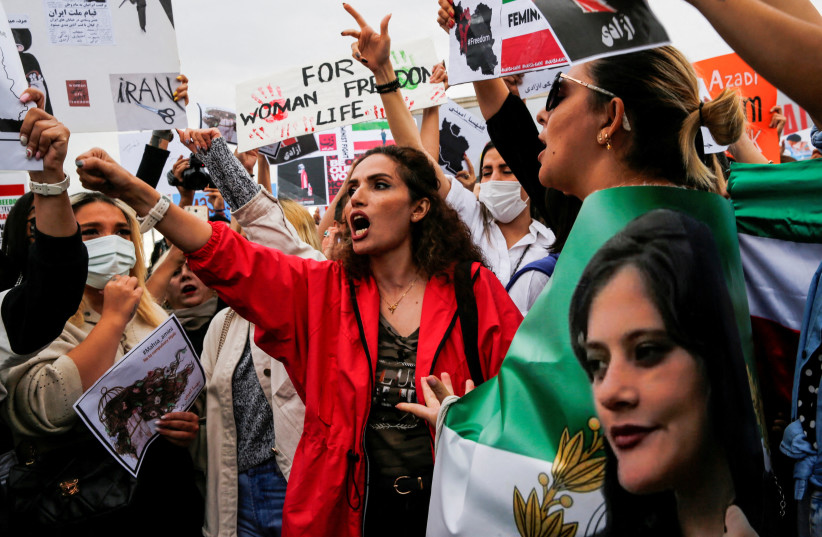
In March 1979, only weeks after the revolution’s victory, thousands of Iranian women poured into the streets of Tehran to protest the imposition of compulsory veiling.
They were met with beatings, threats, and chants of “either a headscarf or a punch to the head.” The revolution’s promise revealed itself with brutal speed. What Foucault had framed as a spiritual uprising had begun to legislate women’s bodies, silence dissent, and fuse theology with state violence.
Foucault’s response was striking – not for its cruelty, but for its absence. Confronted with criticism, including from Iranian women living in exile, he retreated.
Foucault published no sustained reckoning with the regime he had once praised. Instead, he insisted that Western observers should resist judging non-Western revolutions by liberal standards. The implication was clear: to criticize the Islamic Republic’s treatment of women was to impose foreign values, to misunderstand a different civilizational logic.
Writers such as Simin Behbahani, Azar Nafisi, and others, some still in Iran, others already pushed into exile, understood that the language of cultural difference was being weaponized against them by the likes of Foucault and the activist networks of Europe.
They saw how quickly “authenticity” became a euphemism for coercion, and how easily Western intellectuals excused misogyny when it arrived wrapped in anti-imperialist rhetoric.
What angered them most was not that Foucault had been wrong. It was that he had been wrong in a familiar way. They recognized a pattern in which women’s suffering was treated as a secondary contradiction, to be resolved after the revolution – or not at all.
The world had seen this before in Algeria, in Cuba, in China: revolutions that promised universal emancipation while demanding that women wait, endure, or disappear. Foucault’s fascination with death, sacrifice, and transcendence sounded, to them, like philosophy waxing rhapsodically safely from afar.
The Iranian feminists’ critique cut deeper than a political disagreement. It exposed a fault line in post-1968 Western thought itself. Foucault devoted his career to analyzing power, discipline, and the ways bodies are regulated by institutions.
In Iran, he failed to recognize a regime whose central project was precisely that: the regulation of bodies (and minds) through religious law, enforced by the state. He who had warned against the seductive violence of totalizing systems now found himself defending one, so long as it appeared to stand outside the West.
Foucault, like many of his contemporaries, had come to see liberal universalism as a mask for domination. The Iranian feminists understood, from lived experience, what much of Western theory had forgotten: that power does not become benign simply because it rejects liberal language. The boot still presses on the neck, even when it speaks in the name of God.
History has rendered its verdict with grim patience.
The story of Foucault and Iran is not just about one thinker’s failure. Today, as Iranians flood the streets in defiance of a regime that has for decades enforced gender apartheid, the absence of support among Western feminist movements is striking.
There is no sustained appetite for solidarity with Iranian women confronting totalitarian clerics. The conclusion is difficult to avoid. The principles these movements claim to uphold are not universal commitments but conditional postures, activated selectively and suspended when they collide with a preferred political narrative.
What remains is not feminism as a commitment to women’s rights, but feminism as alignment. And it is precisely this substitution of principle for affiliation that the Iranian feminists of the late 1970s warned against.