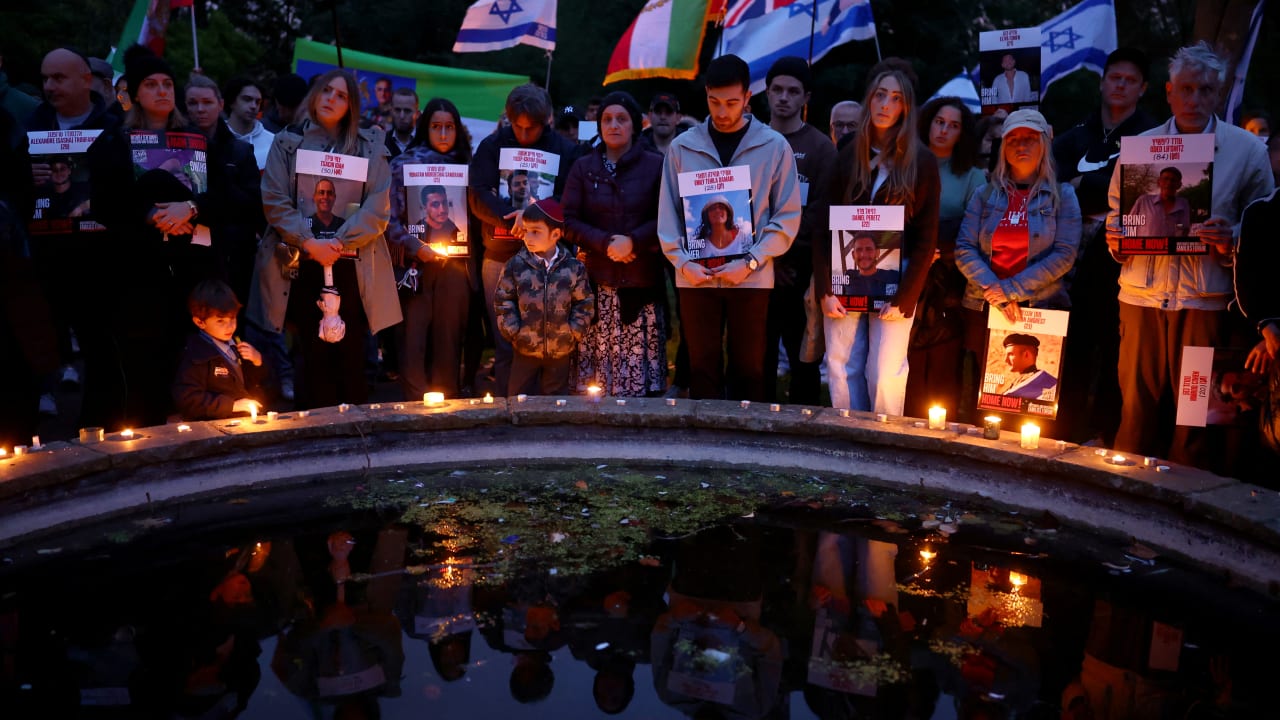
Last Wednesday, January 28, Ran Gvili was laid to rest in his hometown of Meitar, in the southern Negev. His body was recovered by the Israel Defense Forces, bringing to a close the 843-day saga of the Israeli hostages taken to Gaza, alive and dead. For many of us, the story of the hostages unfolded not only as a national trauma but as a moral reckoning.
I was a longtime member of the leadership team of the Hostages and Missing Families Forum in New York, and I believe it is time for us in the religious Jewish community to begin reckoning with the overwhelming silence about Israeli violence against Palestinians – in both Gaza and the West Bank.
I joined the leadership team of the Hostages and Missing Families Forum in New York early in the war. There, I saw how a narrow, focused mission can be incredibly effective. Early on, we made a strategic decision: We would remain nonpartisan. Our chants were simple – “Bring Them Home” and “Seal the Deal.”
We understood that the only realistic path to returning hostages alive ran through negotiation with Hamas. We said nothing publicly about Prime Minister Benjamin Netanyahu, a ceasefire, or the devastation of Gaza. We appealed, deliberately, to both former president Joe Biden and President Donald Trump. We chose the narrowest demand in order to reach the widest audience. The results were real. Of the 251 hostages taken, 168 were returned alive through negotiated deals.
Lessons from the experience
My two years organizing with the Hostages and Missing Families Forum were both meaningful and punishing. Israeli grief was raw and unprocessed. The war in Gaza was devastating. And political polarization in the United States made the expression of basic empathy seem politically radical.

But as the war dragged on, I realized that a broader religious and moral reckoning was necessary in our community. I admired our group’s effectiveness and its lack of ego. But I also felt lonely. I worried that the demand to return the hostages was giving Israel and Hamas an excuse to prolong the war. I vocally called to return the hostages while silently praying for a ceasefire.
I searched for a community unafraid to say that Jewish values demand freedom, equality, and peace for all people. I struggled to find that space within the existing terrain of the religious communal landscape.
At the same time, I could see the growing moral cost of our silence. Violence and vengeance did not remain confined to the battlefield, thousands of miles away. Instead, they seeped into the fabric of everyday American Jewish life.
I saw Facebook posts calling to “flatten Gaza,” and videos of obliterated Palestinian neighborhoods with the caption “this is victory.” I heard the phrase “there are no innocent people in Gaza” repeated casually. And students from schools and youth groups I once trusted sang a song calling for villages to burn. It was language that reminded me of pogroms.
Most disturbing to me was how often this cruelty was framed as authentically Jewish: as mitzvah, or a return to “biblical values.” Racism and dehumanization were becoming a religious virtue.
Creating a new religious and moral home
I am proud of my work with the Hostages and Missing Families Forum. But I also realized that I needed – and believed others needed – a new religious and moral home. One rooted in Torah and human dignity, and unafraid to say that Jewish values demand freedom, equality, and peace for everyone in the land.
That realization led me to help found Smol Emuni US last year. Alongside our Israeli counterparts, we are building a movement, a religious and political affiliation, perhaps even a new denomination, for Jews whose moral and spiritual commitments demand an alternative to the normalization of violence and silence.
In under a year, Smol Emuni US has grown to more than 5,000 members, including a cohort of 30 rabbis, a fellowship for gap-year students in Israel, and chapters around the country. We have hosted dozens of classes and public lectures, joined rallies, and look forward to hosting our second annual conference on March 8.
I am often asked by skeptics of this work whether I have a “solution” to the conflict. But I believe we cannot address this question until we first examine our own wrongdoings. My answer is that we cannot address such questions without first examining our own wrongdoings.
To assume that we can simply return to the pre-October 7 framework of “managing the conflict” seems to me not only a failure of military and diplomatic imagination. It also seems a refusal to interrogate our moral accountability for the violence perpetrated by the Israeli military and settlers against Palestinians.
With the Hostages and Missing Families Forum, I learned that strategic focus matters. But in this moment, moral clarity does, too. Our community’s silence has a growing cost. For too long, too many religious Jews have been asked to choose between loving our people and fulfilling our values. It is time we refuse that choice.
The writer is the founder of Smol Emuni US.