
Indispensability is never declared. It is tested. It arrives when the crisis hits – and everyone in the room turns to the same person. That has been Marco Rubio’s trajectory over the past year. Not louder. Not flashier. Just heavier.
Secretary of State, yes – but also acting national security adviser, crisis manager, alliance stabilizer, and translator between presidential instinct and institutional consequence.
Venezuela fractures. Tehran escalates. Europe recalibrates. Energy markets tighten. China maneuvers. And again and again, Rubio is handed the file. Presidents do naot concentrate that level of responsibility in one person unless they trust both his judgment and his steadiness.
The internet has noticed what Washington already knows. The memes are everywhere: Rubio photoshopped as the new Shah of Iran, the new Venezuelan ruler, the next global strongman, even the halftime performer.
It’s funny precisely because it captures something real. He has become, culturally and operationally, the “Secretary of Everything.” The joke works because the burden is visible. Rubio’s LinkedIn must look like a CVS receipt – unfold it, and it touches the floor. And presidents do not assign that much weight unless they believe someone can carry it.
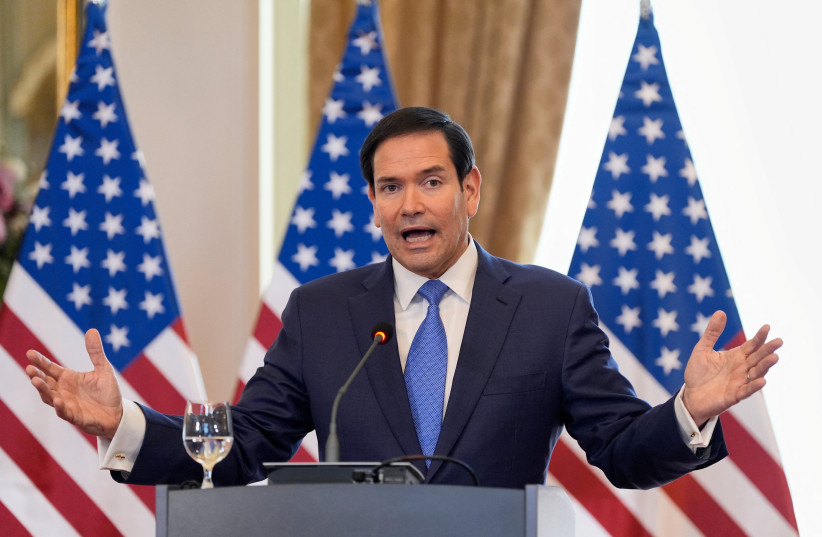
Munich proved he can.
The Munich Security Conference is not a campaign rally.
It is the annual gathering of NATO leaders, defense ministers, intelligence chiefs, and strategic thinkers who shape the Western alliance. When an American Secretary of State speaks there, the audience is not voters. It is history.
Rubio did not deliver technocratic reassurance.
Rubio delivered doctrine. He warned against the “dangerous delusion” that history had ended and that sovereign nations could dissolve into a frictionless global order. He rejected the West’s drift toward “managed decline.” He argued that alliances must be built on strong nation-states, not on dependency or fear. He insisted that what binds the Atlantic alliance is not bureaucracy but inheritance – civilizational confidence and shared responsibility. It was not a rejection of Europe. It was a demand that Europe stand upright.
When he finished, the hall gave him a standing ovation. That matters.
Standing ovation signals recognition
Munich audiences are measured, skeptical, and often wary of American populism. They do not stand on their feet easily. A standing ovation in that room signals recognition – not excitement. It signaled that Rubio was not improvising. He was articulating. And articulation is the first step toward leadership.
In the biblical tradition, Moses delivers revelation. Aaron ensures it is heard. Moses thunders; Aaron translates. One disrupts; the other steadies.
In this administration, Donald Trump often plays the role of a disruptive force – resetting assumptions and forcing debates others avoid. Rubio has increasingly played the Aaron role: not softening the message, but rendering it legible to allies, institutions, and skeptics who might otherwise recoil. That interpretive role is not subordinate. It is indispensable. Munich showed that Rubio can carry the doctrine without losing the room.
But rhetoric without execution is performance.
What makes Munich significant is that it sits atop a year of operational gravity. In Venezuela, Rubio has been central to shaping and managing the aftermath of Nicolás Maduro’s removal and the fragile transition that followed.
Removing a dictator took a weekend. Governing the aftermath takes a season – sometimes a decade. The policy has drawn legal scrutiny, moral debate, and congressional friction. That is what happens when power is used rather than discussed. The question is not whether controversy exists; it is whether order can be imposed without sliding into chaos. That burden has not been theoretical for Rubio. It has been practical.
The consequences have rippled outward. Cutting off Venezuelan oil affects Cuba, regional energy stability, and migration flows that eventually reach American borders. Energy is not abstract; it is leverage. When grids flicker, politics shifts. When politics destabilize, populations move. And when populations move, the geopolitical map redraws itself, whether or not speeches catch up.
This is also where China enters the frame. China’s energy exposure to Venezuela is strategically relevant. More importantly, Beijing’s broader strategy hinges on controlling supply chains, energy routes, and critical minerals.
The next decade will not be defined by missiles alone. It will be defined by supply chains. It will be defined by who controls lithium, cobalt, rare earths, and the chokepoints of global production.
The United States sending troops to Nigeria for training missions is not random. Nigeria sits on major mineral deposits and is in a region where Chinese investment has been deep and sustained. You do not need to declare a coming war over minerals to recognize the strategic positioning underway.
Rubio’s Munich speech directly addressed this worldview. He warned against allowing adversaries to dominate supply routes and economic leverage points. He framed sovereignty not as nostalgia but as a strategic necessity.
That is not reactive diplomacy.
That is long-term thinking.
Tehran fits within this same architecture. Rubio’s approach to Iran has not been read as a reckless escalation. It has been read as disciplined realism: diplomacy first, calibrated force when necessary, reassessment of intelligence, and renewed deterrence.
The volatility in Tehran is real, and Israeli officials read every American move not as commentary but like its the weather.
What distinguishes Rubio’s posture is not aggression; it is control. Power is not a temper tantrum. It is conflict managed without delusion.
Now place that against the progressive contrast.
Representative Alexandria Ocasio-Cortez also appeared in Munich. She is articulate and energetic, and she commands attention within her base. But the progressive coalition in America does not automatically translate into a coherent global worldview. Munich is not a domestic rally. It is a room full of defense ministers and intelligence chiefs.
When pressed on questions of Taiwan, China, and economic realism – including by voices from countries like Argentina that have lived through fiscal collapse – the difference between rhetorical conviction and governing fluency becomes clear. Global leadership requires more than moral posture. It requires structural understanding.
This is not about humiliation.
It is about scale.
Executive readiness is built on classified briefings, sanctions architecture, alliance maintenance, and trade-off management. Rubio has spent years in those rooms. That experience shows. Succession does not begin with slogans.
It begins with a burden.
The post-Trump Republican future will not be decided by who can echo Trump most faithfully. It will be decided by who can manage the world Trump has reshaped, where sanctions, energy leverage, minerals, deterrence, and domestic backlash collide daily. Munich suggested something new: Rubio is not merely executing policy. He is interpreting the era.
Interpretation is how inheritance begins.
Indispensability is not declared. It is accumulated. The world keeps landing on his desk – and he does not flinch. Munich did not crown Marco Rubio. But it made something unmistakably clear. The secretary of everything no longer just carries the message. He is shaping what comes next, and the room is already listening.
The writer is CEO of the Israel Innovation Fund, a contributor to the Jerusalem Post, and founder of Wine on the Vine, Herzl AI, and Project Maccabbe. He is the author of the forthcoming book What Is Zionism?: Why Never Again Is Not Enough.