Five months ago, the “Super-Sparta” address captured the harrowing dissonance of a nation at war. The momentum of the speech was defined by a brutal paradox – a people whose hearts were buried in the darkness of Hamas tunnels, watching the clock run out on their captive loved ones, while their military might was being felt across the Middle East. From the pulverized Houthi headquarters to the smoldering docks of Hodeidah, Israel projected a Spartan resolve.
Amidst these operational triumphs and mounting global condemnation, Prime Minister Benjamin Netanyahu presented a jarring portrait of a democracy pivoting toward absolute self-reliance. He offered the vision of an autarkic (economically independent) fortress as a shield against diplomatic isolation.
Yet, this “Spartan” ideal collides with the harsh realities of the 21st century. In a hyper-connected world, a closed economy is not a strategic sanctuary, but a precarious illusion that ignores the realities of modern statecraft.
But the real message wasn’t about looking inward; it was about looking Eastward. Israeli Eurocentrism has run its course, and the limits of Western dependency have been laid bare post the October 7 massacre in 2023.
Rather than pursuing the hollow phantom of autarky, Israel is pivoting toward a new Asia-centric reality. In this emerging world order, Asia, with India at its helm, is becoming an indispensable pillar of Israel’s national security and its very survival.

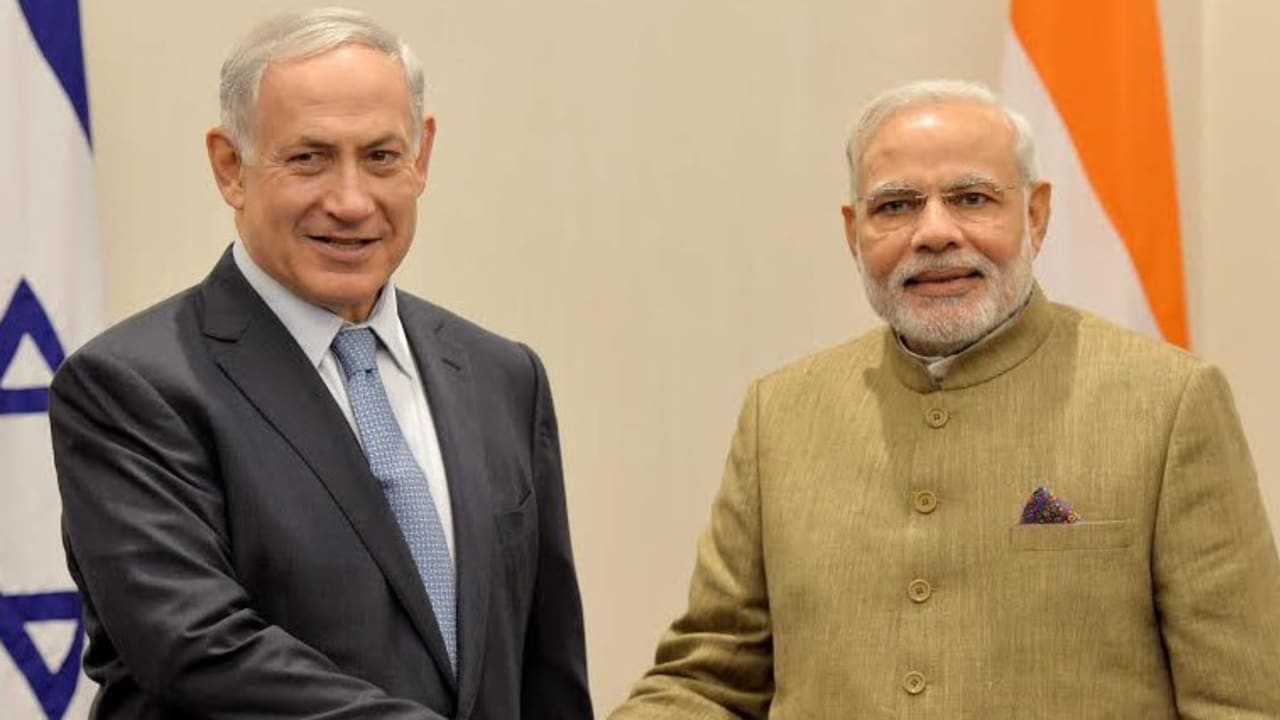
Into this strategic vacuum, Indian Prime Minister Narendra Modi’s arrival this morning serves as a resounding declaration of intent. It illustrates how the world’s largest democracy and the Middle East’s only true democracy envision a shared future, signaling the end of transactional courting and the dawn of an intimate partnership.
India is a primary stakeholder in a shifting world order
In a stark departure from 2017, India no longer arrives as a mere consumer of Israeli innovation, but as a primary stakeholder in a shifting world order. As a rising titan in the global balance of power, India is leading the departure from unipolarity, an old order that has spent the last few years in a protracted state of visitation, mourning the loss of its global hegemony.
Modi’s presence in Jerusalem, occurring as Western capitals waver, signals that the Israeli “Super-Sparta” has secured a strategic anchor that is not hesitant to wield its power. This is the moment when the “Look East” doctrine turns into a solid reality, woven with defense contracts and trade corridors, clarifying that New Delhi is the primary engine of Israel’s strategic depth in a fractured world.
Following the October 7 massacre, Modi was the first to condemn the murderous terror attack. The Indian support did not end with declarations alone; it catalyzed a big and fundamental change in Israel’s national security equation that will never return to the status quo. For the first time, the historical asymmetry that characterized the defense equation has narrowed. New Delhi was provided with vital munitions and advanced military technologies during apocalyptic moments of diplomatic and morale-related nadirs.
This assistance served as the ultimate proof that the “Make in India” initiative is no longer just a vehicle for Indian military modernization against China and Pakistan. Instead, it has evolved into an Israeli existential necessity. In an era where European support is increasingly dictated by political caprice, the ability to maintain joint production lines with a reliable partner has become Israel’s primary insurance policy for strategic continuity.
Netanyahu’s “Super-Sparta” has evolved. An absolute independence is a mirage in a world where economies and security are inextricably linked. Israel’s path to resilience lies in choosing strategic partners who share its scars.
India is that partner.
Having endured the relentless shadow of terror, India is no stranger to the threat of radical Islam, an ideology that seeks to overwhelm its civilizational fabric. The Indo-Israeli alliance represents a profound strategic alignment between two democracies that refuse to yield to the forces of religious fanaticism.
Israel is far from alone in its pivot toward New Delhi.
The global community, as well, recognizes India as the new center of gravity. The historic free trade agreement (FTA) recently signed between India and the EU provides the critical momentum required to breathe life into the IMEC project, placing Israel at the very heart of a new global trade map.
This is a path meant to stream investment, jobs, and large-scale trade into the region, exactly what Israel post-war needs, igniting the regional integration that was brutally hijacked in October.
The gravity of Indian power has transcended politics, capturing the strategic focus of the world’s foremost technology giants. The International AI Summit held last week underscored India’s role as the new frontier for innovation. As the world’s eyes turn toward New Delhi, Israel must act decisively to weave its unique, innovative DNA into this massive ecosystem. Engaging with a market of over a billion people is no longer a choice; it is the 11th commandment in a shifting world.
To achieve this, a regulatory breakthrough is required, primarily the signing of an FTA. Despite Israel’s minute size compared to the Indian giant, it has immense value to contribute, such as Israeli disruptive thinking and “chutzpah”, which remain sought-after commodities for Indian growth. In this win-win equation, where Israeli innovation meets Indian scale, lies the path for Israel to become the “Super-Sparta” that Netanyahu envisions.
The writer is the director of the South and East Asia Center at the Jerusalem Institute for Strategy and Security (JISS).