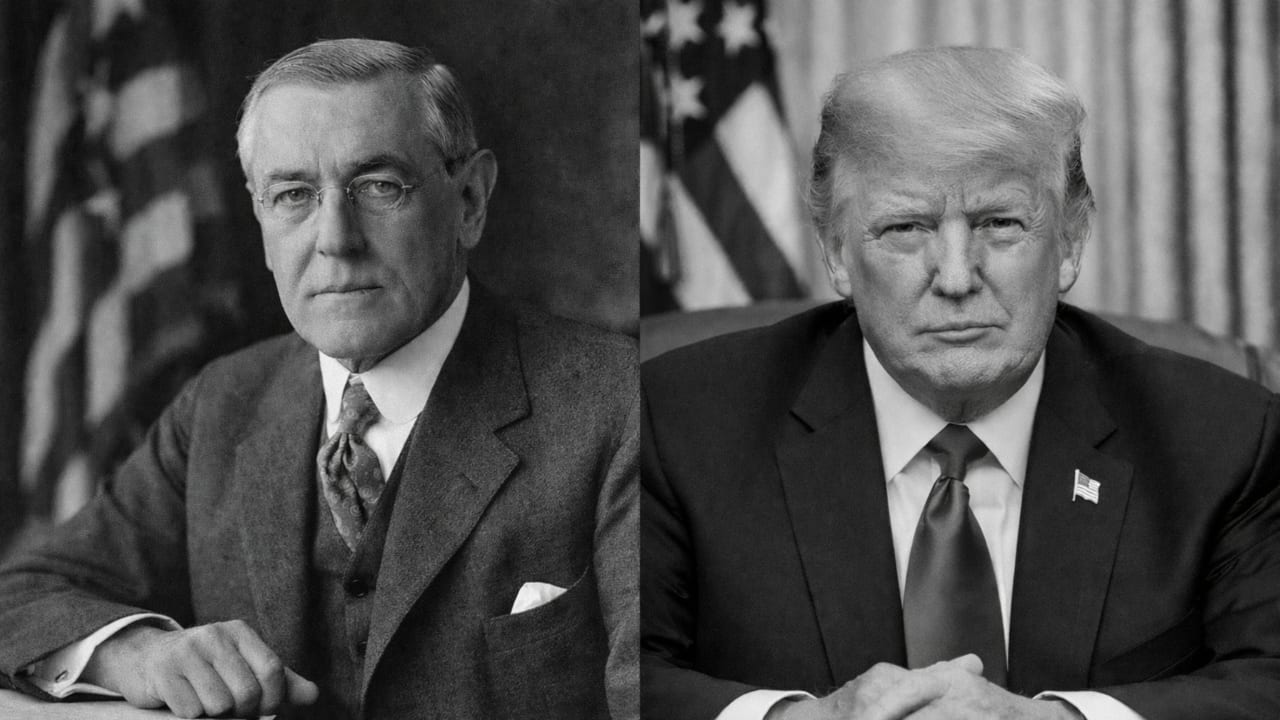
In Washington today, the debate surrounding the war with Iran is no longer confined to military strategy. Increasingly, the argument is about something more fundamental: whether the American people fully understand why the United States is fighting at all.
Congressional disputes over war powers, conflicting explanations from administration officials, and polling that suggests growing public skepticism all point to the same underlying challenge. The Trump administration may have constructed a coherent military strategy for confronting Iran, but it has not yet fully constructed the narrative architecture necessary to sustain long-term public support.
History suggests that this is not a trivial problem.
One of the most instructive historical examples comes from the First World War and the work of George Creel.
When the United States entered World War I in April 1917, the country was deeply divided. American public opinion had long been isolationist. Many citizens believed that Europe’s conflict was not America’s business. The war was widely seen as a distant struggle among imperial powers, and president Woodrow Wilson faced the challenge of mobilizing a nation that was far from convinced.

Wilson’s solution was to appoint Creel to lead the Committee on Public Information. Its task was unprecedented: to explain to the American people why entering the war was necessary and to sustain national mobilization once the decision had been made.
Democratic countries need public support for wars
Creel understood something fundamental about democracies: wars cannot be sustained by military planning alone.
They must also be justified, explained, and believed.
As Creel later wrote in his account How We Advertised America, “What we had to have was no mere surface unity, but a passionate belief in the justice of America’s cause.”
To achieve that goal, Creel constructed what today might be called the first modern national information campaign.
The Committee on Public Information coordinated messaging across newspapers, magazines, pamphlets, films, posters, and advertising agencies. Nearly every major newspaper in the United States received government-approved content explaining the purpose and stakes of the war. Creel described this system as “voluntary cooperation with the press.”
Perhaps the most innovative component of Creel’s campaign was the creation of the “Four-Minute Men.”
These were approximately 75,000 volunteer speakers recruited across the country who delivered short speeches in movie theaters, churches, schools, union halls, and town meetings. The timing was deliberate. Four minutes was the amount of time it took to change film reels in cinemas.
During those brief intervals, speakers explained the war, promoted Liberty Bonds, encouraged enlistment, and framed the conflict as a defense of democracy. Over the course of the war, they delivered more than seven million speeches to audiences numbering in the hundreds of millions of cumulative listeners.
Creel also mobilized artists and filmmakers. Iconic posters such as “I Want YOU for US Army” became enduring symbols of national mobilization. Films like Pershing’s Crusaders and America’s Answer portrayed the war not as a remote geopolitical struggle but as a civilizational defense of democratic values.
Within a year, the results were dramatic. Liberty Bond campaigns were massively oversubscribed. Millions volunteered for military service. Public support for the war surged. Among these results was the fact that my grandfather Arthur Kahn, was motivated to join the war effort so he volunteered and served in the US Army during WWI.
Creel’s methods were controversial and later criticized for encouraging anti-German hysteria and suppressing dissent. Yet his core insight remains relevant: Democratic societies must understand why they fight.
That lesson feels strikingly relevant today.
The Trump administration has often approached the war with Iran in a way that resembles what might be called a “father knows best” approach to leadership. The decision to confront the Islamic Republic has been presented largely as a strategic necessity that the public is expected to accept without extended explanation.
In effect, the message can sometimes sound like a familiar parental response: because I said so.
To be clear, this does not mean the strategy itself lacks coherence. In many ways, President Donald Trump has demonstrated a strategic vision that extends far beyond the narrow question of Iran, and places him as one of America’s great leaders.
The slogan “Make America Great Again” is often dismissed by critics as a political brand printed on a red baseball cap. In reality it reflects something much larger: a worldview about how the United States must defend its position in an increasingly contested global order.
Trump’s strategic outlook recognizes that the international system is shifting. Authoritarian governments in Beijing, Moscow, and Tehran are actively seeking to reshape that order in ways that undermine American power and democratic influence. Iran’s military ambitions, proxy networks, and regional destabilization are part of that broader challenge.
Seen in that light, the confrontation with Iran is not simply a regional crisis: It is one piece of a much larger geopolitical contest.
That contest extends beyond military confrontation. It includes economic warfare, technological competition, and control of critical supply chains. China’s dominance over rare earth minerals – essential materials used in advanced weapons systems, electronics, and military technology – illustrates how strategic competition now reaches deep into the industrial foundations of national power.
These connections form a coherent strategic picture. But they have not been consistently explained to the American public.
Instead, much of the debate in Washington has been framed around narrower and more confusing questions: whether the United States was drawn into Israel’s conflict with Iran, whether the strikes were preemptive, and whether Congress should limit presidential war powers.
This confusion obscures the larger strategic reality.
More recently, Secretary of War Pete Hegseth has attempted to shift the narrative by personalizing the stakes of the conflict.
Drawing on his experience as a combat veteran, Hegseth has emphasized that Iran has effectively been engaged in a shadow war against American troops for decades.
“I’ve walked patrols in Iraq where the biggest threat wasn’t just insurgents,” he noted, “but Iranian-supplied bombs meant to kill Americans.”
That framing reframes the conflict from being a distant geopolitical struggle into something more immediate: the defense of American soldiers and American interests.
It is a powerful argument, but it arrived relatively late in the public conversation.
Had the administration articulated this broader strategic narrative earlier – linking Iran’s actions to the emerging authoritarian alignment involving Russia and China, as well as the economic dimensions of global competition – the American public might today possess a clearer understanding of why the conflict matters.
In authoritarian systems, governments can wage wars without persuasion. Democracies operate differently.
Military success ultimately depends on political legitimacy, and legitimacy requires explanation.
The statesman Edmund Burke famously warned that “the only thing necessary for the triumph of evil is for good men to do nothing.” The lesson is not merely about courage. It is about understanding.
Citizens must know why a struggle matters before they are willing to support it.
President Trump’s leadership style may take some getting used to, particularly for observers accustomed to more traditional forms of political communication. Yet his strategic instincts about the dangers facing the United States – and about the need to confront those dangers – are increasingly proving prescient.
The challenge now is not the absence of strategy: It is the absence of explanation.
More than a century ago, George Creel understood that wars are fought not only on battlefields but also in the minds of citizens.
Winning wars abroad ultimately requires winning the argument at home.
The author is an experienced global strategist for the public and private sectors. globalstrategist2020@gmail.com.