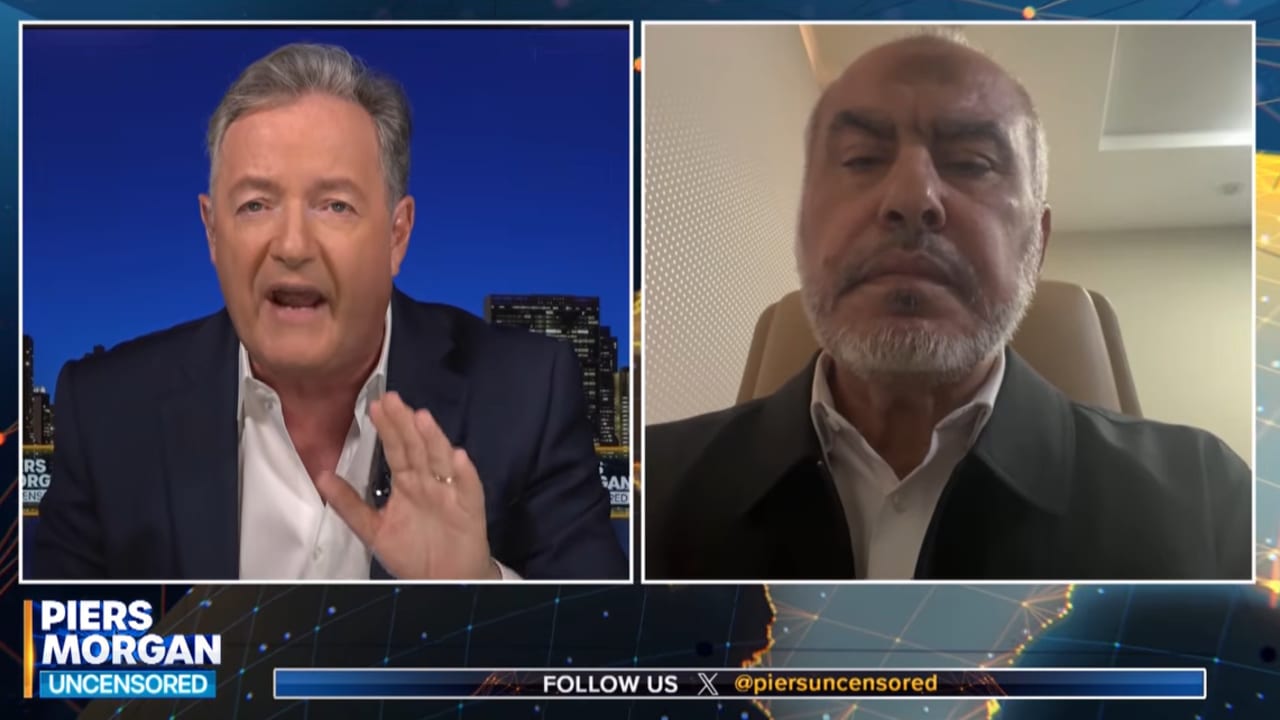
Piers Morgan’s interview with senior Hamas official Ghazi Hamad this week deserves close attention. Hamad insisted Hamas had never intended to kill civilians on October 7. There had been no orders, he said, to kill women or children. If civilians died, those were mistakes.
Morgan accused Hamas of “utter barbarism.” Hamad said: “This is not true. No evidence.”
The demonstrable falsehood is less surprising than the brazen insistence in the face of repeated challenges from the valiant Morgan: Hamas believes that the devastation of Gaza, the length of the war and the collapse of Israel's world standing have created conditions in which the defining event that began the conflict can be relativized and denied.
We should understand that this may very well succeed. If so, it will weaken Israel further.
So it bears repeating: At dawn on October 7, 2023, thousands of Hamas fighters breached Israel's border in multiple waves. They blasted through the security fence with explosives and bulldozers, crossed by motorcycle and pickup truck, landed from paragliders and infiltrated from the sea. They invaded towns, kibbutzim, and civilian communities and carried out a sustained and gleeful massacre of civilians.

At the Nova music festival, Hamas gunmen hunted thousands of young people across fields and roads, murdering hundreds. Elsewhere, terrorists went house to house, shooting families in their homes, turning safe rooms into execution sites, throwing grenades into houses and bomb shelters, burning homes with residents inside, murdering elderly people where they sat, killing parents before their children, sexually assaulting women, mutilating bodies, and abducting children after forcing them to watch family members die.
Wearing body cameras and using mobile phones, they filmed themselves shooting civilians, dragging wounded Israelis into Gaza, forcing elderly women onto golf carts, and abducting 250 people including babies, children, and Holocaust survivors.
Why does Hamas bother to deny their massacre?
Since the attackers happily filmed themselves and their actions, uploading videos in real time, this was one of the most thoroughly documented massacres of modern times – so Hamas’ denials are not exploiting uncertainty but flying in the face of overwhelming evidence. Why, we might ask, would they bother?
Because they believe the world will be receptive to the lies.
The weeks immediately following October 7 were dominated by revulsion at the massacre – but as Israel's military campaign got going, attention shifted. Television screens filled with images of devastated neighborhoods, collapsed apartment blocks, overwhelmed hospitals, displaced families, and immense civilian suffering throughout Gaza. Accusations of genocide emerged with extraordinary speed.
Whatever one's view of Israel's conduct, Hamas understands something fundamental about modern media. Public attention is drawn to the latest images, not the causes. The longer a conflict continues, the more its origins fade into the background.
That is the opportunity Hamad's interview reveals.
Hamas does not need the world to celebrate October 7, as many Palestinians plainly did, but for the massacre to become blurred within a larger narrative of a cycle of endless violence. If enough people conclude that everyone committed atrocities, that history is too complicated to disentangle, that casualty totals matter more than chronology, or that decades of conflict somehow explain what happened, its work is done.
Hamas ensured the casualty count on the Palestine side would be favorable to its cause – that is, far greater – by embedding itself and its weapons completely among the civilian population, refusing to surrender or release the hostages no matter what.
Hamad asked Morgan what he expected of the Palestinians “after 80 years of occupation.” In his narrative, all of Israel, not just the West Bank and Gaza, is occupied – even though Israel’s 2 million Arabs have citizenship and equal rights. Israel’s repeated offers to hand almost all of the West Bank and Gaza to a Palestinian state are meaningless – Hamas views partition as a shameful compromise.
Hamad didn’t even hide it, telling Morgan that the world “should reconsider the existence of Israel,” adding: “Why Israel should exist? Israel is a big burden on the shoulders of the world.”
Truth too complicated for global mainstream media
Let the October 7 revisionism stand, and this will start to seem reasonable. The truth will not necessarily take hold in global public opinion or in the mainstream media – it is simply too complicated. All that matters is that Israel launched a brutal war for years on end – and this is where the Israeli government bears responsibility.
No country could permit an organization capable of carrying out such an attack to remain intact on its border. Destroying Hamas as an effective military force and removing it from power in Gaza were legitimate strategic goals. The question was how those goals should be pursued. Israel always pursued short, effective operations.
Instead, the war increasingly appeared to lose strategic coherence. Israeli soldiers entered, secured, and withdrew from the same areas, only to fight over them again months later.
Just this week, I spoke with a soldier who had served in Khan Younis. His unit entered the city three separate times. They could not understand why territory captured at considerable cost to his comrades’ lives – and those of Gazan civilians – had been relinquished, only for more soldiers to die recapturing it.
Plenty of Israelis suspect that Prime Minister Netanyahu wanted to prolong the war to keep his coalition intact, to let Israelis’ own memories of October 7 recede and be overwhelmed by even bigger narratives of war, and to delay an investigation. I am among them. But whatever the intention, the effect was to move October 7 itself steadily away from the political conversation.
Every additional month of fighting generated more civilian casualties, more destruction and more diplomatic isolation. International coverage naturally concentrated on the newest devastation. Modern journalism is driven by immediacy. Casualty totals become headlines. This does not necessarily reflect bias – it reflects what the audience has patience for. But it creates precisely the environment in which Hamas’ revisionism can succeed.
That is what Hamad's interview foreshadows.
Hamas and the Israeli government both benefit from downplaying October 7
This insane situation also produces one of the strangest political convergences of this war. Hamas benefits when October 7 fades from international consciousness because it carried out the massacre. For entirely different reasons, the Israeli government also has an interest in allowing the massacre to become less central. Indeed, the government is even resisting efforts to call it a massacre, and its spokespersons are pointedly refusing to call it the greatest massacre of Jewish civilians since the Holocaust.
That cannot continue.
If Netanyahu is reelected on October 27, Israel will have even bigger problems – the country will be in existential danger. But if he is replaced, Israel's next government should recognize that preserving the historical record has become a strategic imperative.
It should publicly warn that Hamas is engaged in historical revisionism that makes a mockery of journalists and their audience. It should challenge international media organizations not to allow the destruction of Gaza, however real and however deserving of scrutiny, to erase the massacre that began the war. It should finally establish the long-delayed commission of inquiry, create permanent archives and memorials, support documentaries, museums and educational initiatives, and ensure that every October 7 is marked by the presentation of the evidence rather than by ritual alone.
In real time, wars are fought over territory, security and power. Afterward, they are fought over memory. The battle over what the world remembers about October 7 has only just begun. What is needed, as Netanyahu himself might say, is total victory.