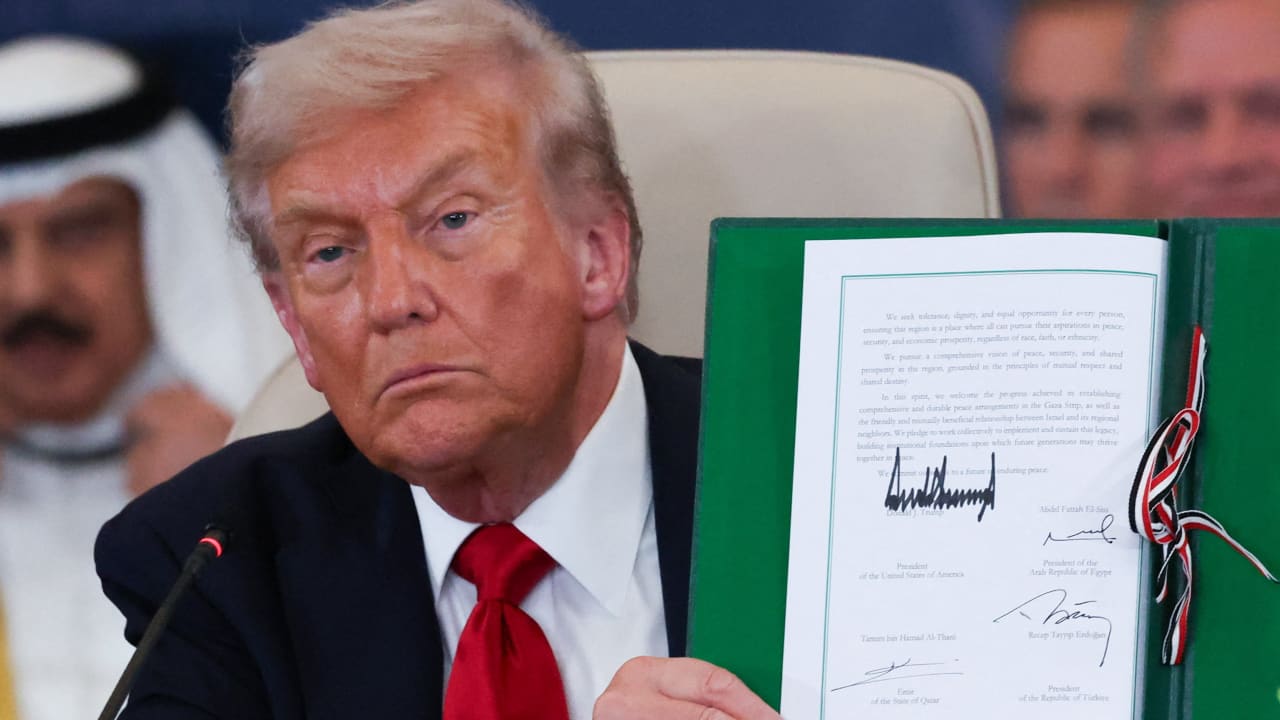
Sunday, November 15, 2026, is a date to circle in your diary. By then – precisely 90 days since a meeting in Jerusalem on August 17 to discuss the Board of Peace’s plan for Gaza – Hamas should be demobilized and the IDF should have begun withdrawing from the Gaza Strip.
That August 17 meeting brought Prime Minister Benjamin Netanyahu together with the three-man team of Jared Kushner, Nickolay Mladenov, and Sir Tony Blair. They had just returned from an unprecedented negotiating session in Egypt with Hamas leader Khalil al-Hayya.
The significance of November 15 lies in what was agreed in Cairo – a handover by Hamas of weaponry and tunnels within 90 days.
As Kushner told Fox News, following the meeting: “For Israel, we think this is a win-win situation, because if Hamas actually gives over the weapons and the tunnels willingly over the next 60 to 90 days, that obviously would be the elimination of a huge security threat for Israel, almost an unthinkable achievement.”

To advance the Board of Peace’s aim of reconstructing Gaza, the August meeting agreed to set up two working groups. One would facilitate the disarmament and demilitarization process, which, according to a statement from Netanyahu’s office, “both Israel and the Board of Peace are determined should be prompt and completed before any reconstruction happens.”
The second would focus on sanitation, clean water, and public health in Gaza.
While Israel has consistently supported the 20-point peace plan produced by US President Donald Trump and endorsed by the Board of Peace, there seemed to be a problem regarding sequencing.
The plan requires both the disarmament of Hamas and the withdrawal of the IDF from Gaza, and for a time both Hamas and Israel were asserting that they would indeed act, provided the other party acted first.
Initially, the Board of Peace planned to connect incremental disarmament with gradual Israeli withdrawals. The August meeting seems to have established a way through the impasse. It now seems there will be no IDF withdrawal until Hamas has disarmed.
The IDF’s withdrawal is linked to agreed standards, milestones, and timeframes as the International Stabilization Force (ISF) establishes control and stability, although an Israeli security perimeter may remain until Gaza is judged secure.
Under the UN-endorsed Trump peace plan, the ISF is envisaged as a temporary multinational security force, operating alongside Israel, Egypt, and a newly trained and vetted Palestinian police force.
Its mandate includes helping to secure borders, supporting Gaza’s demilitarization, dismantling military and terrorist infrastructure, permanently decommissioning non-state armed groups’ weapons, and protecting civilians.
At Israel’s request, the parties agreed that in the initial stage of disarmament Hamas’s weapons would not be turned over to the National Committee for the Administration of Gaza.
Why did Israel make this a condition? Because the National Committee is a wholly Palestinian body – and even though it is specifically apolitical, Israel was taking no chances. Concerned principally with civil administration, it is led by Dr. Ali Shaath, a civil engineer and former deputy minister, and composed of independent Palestinian technocrats and experts.
The future of Gaza
Israel and the US are reported to have agreed that Hamas weapons surrendered during the opening phase would be placed under the control of the ISF for destruction. Maj.-Gen. Jasper Jeffers, the US commander of the ISF, would oversee the process. Precise operational details and sequencing remain for the moment unresolved.
However, the viability of the ISF as a credible military force is far from assured. Five countries have made provisional commitments to provide troops to the ISF: Albania, Indonesia, Kazakhstan, Kosovo, and Morocco. These commitments are at different levels of firmness, and some have subsequently been delayed or narrowed.
Indonesia offered up to 8,000 troops but subsequently put the commitment on indefinite hold. Kazakhstan’s President Kassym-Jomart Tokayev publicly committed the country to fully supporting the ISF.
Subsequent reports, however, indicate that Kazakhstan does not envisage its contribution as a combat contingent, but primarily as a humanitarian component, including medical units and a field hospital.
As for Kosovo and Albania, though they both committed to contributing troops, as yet no figures for their contingents have been released and no troops have been sent.
On August 6, Uganda’s parliament approved the potential deployment of Ugandan forces to Gaza as part of the US-backed ISF, if required. The size, timing, command arrangements, and final operational deployment of any Ugandan contingent have not been publicly settled.
Burundi, too, has been engaged in active preliminary discussions – including a reported pre-deployment site survey – but has not publicly made a final commitment to contribute troops.
Around the time of the August 17 meeting, senior military officers from Uganda and Burundi are reported to have visited the Civil-Military Coordination Center (CMCC) in Kiryat Gat to prepare for the deployment of hundreds of troops in the Gaza Strip as part of the ISF. They met with officers from the IDF and the US Army, who presented the operational plans to them.
In late July, Israel authorized the entry into areas of Gaza outside its control of an initial multinational contingent of approximately 200 personnel, reportedly from Morocco and Uganda. Despite the international commitments, that appears to be the current extent of the ISF – namely 1% of its projected strength of 20,000 troops.
All the same, the Board of Peace says recruitment and deployment efforts are “well advanced.”
Meanwhile, the ISF is functioning primarily as a command, planning, liaison, force-generation, and limited pilot-deployment operation.
The 200 personnel are, among other tasks, reported to be establishing the first ISF headquarters, securing a limited humanitarian zone, and preparing the logistics and command infrastructure for subsequent troop arrivals.
One report says a 150-person Moroccan military outpost is being constructed in Gaza as an initial facility which will eventually be substantially larger.
There is evidence that the ISF infrastructure is beginning to materialize. A US funding notification reported by Reuters on August 19 commits $200 million for ISF equipment, vehicles, and operations, plus about $6 million to adapt US armored vehicles for the force.
Surely the troops themselves will have materialized by November 15.
The writer, a former senior civil servant, is the Middle East correspondent for Eurasia Review. Follow him at: www.a-mid-east-journal.blogspot.com.